Identifying Chronic Fatigue Danger Signals: A Health Decision Guide from a Metaphysical Perspective
把这篇文章落到自己身上验证:先看结构,再进入个人分析,不做泛泛阅读。
Why This Decision Is Particularly Difficult in This Health Scenario
Chronic fatigue and sub-health often manifest as long-term low energy, restless sleep at night, and latent consumption of organs such as the liver, gallbladder, and digestive system. These symptoms usually lack obvious acute manifestations, making them easy to overlook or misjudge, thereby increasing the difficulty of deciding when to escalate to professional medical care. The body's rhythms are closely related to life stress and emotional fluctuations, causing significant symptom variability and blurred boundaries.
From the perspective of modern life pace, work pressure, irregular schedules, and emotional tension often exacerbate chronic fatigue, especially restless sleep that impairs recovery, forming a vicious cycle. Additionally, the hidden burden on liver, gallbladder, and digestive functions often serves as the root of chronic consumption, and the latent nature of symptoms easily delays treatment opportunities.
In BaZi structure, a Day Master (Ri Zhu) that is either overly strong or weak, along with Five Elements imbalances and corresponding organ strengths and weaknesses, affect an individual's adaptability and recovery ability under environmental pressures. The clash and combination relationships between Da Yun (decade luck) and Liu Nian (annual fortune) may trigger or alleviate symptoms, adding complexity to judgment. Combining metaphysics with actual symptoms helps precisely identify potential danger signals.
Therefore, the difficulty in decision-making lies in how to combine real symptoms with the Five Elements imbalances and corresponding organ functions in the BaZi chart to discern when symptoms have exceeded the general sub-health range and must be escalated to professional medical care promptly to avoid more serious health problems caused by delay.
Correspondence Between Metaphysics and Five Elements Organs
The Day Master's Five Elements strength or weakness directly reflects an individual's physical constitution and the carrying capacity of their organs. For example, an overly strong Day Master often indicates energy surplus or increased organ burden, while a weak Day Master suggests insufficient vitality or organ function decline. In chronic fatigue scenarios, the balance among organs such as the spleen and stomach (Earth), liver and gallbladder (Wood), and heart and lungs (Fire) is especially critical.
The choice of Yong Shen (favorable element) reflects the direction for regulating an individual's Five Elements imbalance. For instance, if the Yong Shen is Metal, it indicates the need for Metal to assist in harmonization. Metal corresponds to the lungs and large intestine, representing the respiratory system and detoxification functions. A Ji Shen (unfavorable element) of Earth warns that the spleen and digestive system are vulnerable, and related symptoms such as indigestion, abdominal bloating, and increased fatigue require attention.
The interaction between Da Yun (decade luck) and Liu Nian (annual fortune) reflects the current luck influence on physical health. Auspicious luck often alleviates symptoms and enhances recovery ability; conversely, clashes may induce physical discomfort or aggravate latent consumption. For chronic fatigue patients, understanding the impact of Da Yun and Liu Nian on the Five Elements organs helps scientifically distinguish observation periods from medical intervention timing.
In summary, the correspondence between Five Elements imbalances in BaZi and organ functions provides rhythmical and dynamic references for identifying danger signals in chronic fatigue. Combined with real symptoms, it effectively assists health decision-making.
Three Real BaZi Chart Case Studies
Case 1 (Based on Fact Package 1): This female's Day Master is 丙 (Bing) Fire, which is weak, with a Jie Cai (劫财) pattern. Her Yong Shen is Metal, and Ji Shen is Earth. She is in the 辛卯 (Xin Mao) Da Yun, with a 丙午 (Bing Wu) Liu Nian. Overall, the Da Yun is auspicious, and the Liu Nian is favorable. The weak 丙 (Bing) Fire Day Master indicates insufficient internal fire energy, possibly causing restless sleep and low energy states. Metal as Yong Shen governs the lungs (Metal element), emphasizing the need to strengthen respiratory and detoxification functions. Earth as Ji Shen warns of spleen and stomach damage risk. The Jie Cai pattern suggests significant emotional stress, easily leading to latent liver and gallbladder consumption. In danger signal identification, persistent night sweats, shortness of breath, or digestive abnormalities should be closely monitored. It is recommended to strengthen lung and spleen care regularly; if symptoms worsen, especially with obvious pain or mental abnormalities, immediate medical attention is advised.
Case 2 (Based on Fact Package 2): This male's Day Master is 壬 (Ren) Water, which is weak, with a Shang Guan (伤官) pattern. His Yong Shen is Metal, and Ji Shen are Wood and Fire. He is currently in the 戊戌 (Wu Xu) Da Yun, with a 丙午 (Bing Wu) Liu Nian. The Da Yun is stable. The weak 壬 (Ren) Water Day Master suggests possible latent kidney function consumption. The Shang Guan pattern represents external pressure and significant mental burden, easily causing sleep disorders and fatigue. Metal as Yong Shen regulates the lungs (Metal), indicating respiratory system attention is needed. Ji Shen Wood and Fire warn that excessive liver (Wood) and heart fire may exacerbate anxiety and internal heat symptoms. Danger signals include persistent palpitations, chest tightness, and stubborn insomnia, especially when accompanied by liver area discomfort, which should raise caution. The recommended judgment sequence is to first observe symptom patterns and sleep quality; if chest pain or consciousness disturbances appear, immediate medical care is required.
Case 3 (Based on Fact Package 3): This male's Day Master is 己 (Ji) Earth, which is strong, with a Pian Yin (偏印) pattern. His Yong Shen are Wood and Water, and Ji Shen is Fire. He is in the 庚戌 (Geng Xu) Da Yun, with a 丙午 (Bing Wu) Liu Nian. The luck is stable. The strong 己 (Ji) Earth Day Master indicates relatively strong spleen and stomach function, but the Pian Yin pattern suggests mental stress and overthinking, possibly causing latent liver and gallbladder consumption. Yong Shen Wood and Water correspond to the liver/gallbladder and kidney/lung respectively; Wood assists liver Qi flow, Water nourishes kidneys, while Ji Shen Fire warns of excessive heart fire causing insomnia and anxiety. Clinically, fatigue is present but recovery is slow, with frequent nighttime awakenings. Danger signals such as persistent liver area pain, jaundice, or severe sleep disorders require high alert. The judgment recommendation is to first regulate emotions and routines; if symptoms worsen or are accompanied by obvious liver and kidney abnormalities, prompt medical attention is essential.
Common Misjudgments and Blind Spots in This Scenario
Symptoms of chronic fatigue and sub-health are often latent and fluctuating, easily misjudged by patients and doctors as purely psychological fatigue or life stress, thereby neglecting the risk of underlying organic diseases. While metaphysical assistance provides rhythmical references, it must never replace clinical diagnosis and treatment by medical professionals.
Particular caution is needed to avoid delaying definitive medical examinations and treatments due to metaphysical indications of weakness or Five Elements imbalance. Chronic fatigue may conceal serious endocrine, immune, or metabolic diseases. Any red-flag symptoms such as severe pain, breathing difficulty, or consciousness impairment require immediate medical attention; metaphysical judgment should not interfere with emergency decisions.
Additionally, some patients overly rely on metaphysical adjustments while neglecting scientific lifestyle modifications such as regular routines, balanced diet, and psychological counseling. The greatest value of metaphysical assistance lies in providing reasonable rhythm adjustment suggestions, helping identify deterioration risks, and avoiding blind delays in professional treatment.
Practical Judgment Sequence
First, systematically assess chronic fatigue symptom characteristics, including fatigue severity, sleep quality, liver/gallbladder/digestive discomfort, and mental state. Combine these with the BaZi Day Master’s Five Elements strength or weakness and Yong Shen/Ji Shen to clarify key organ areas potentially affected, such as lung Metal deficiency, liver Wood imbalance, or spleen Earth damage.
Second, integrate current Da Yun (decade luck) and Liu Nian (annual fortune) to observe whether symptoms fluctuate or worsen. If a sustained deterioration trend appears, especially accompanied by pain, breathing difficulty, jaundice, or mental abnormalities—red-flag signals—immediate escalation to professional medical or emergency care is imperative to avoid delay.
Finally, in daily observation, it is recommended to adjust lifestyle rhythm and emotional management according to BaZi Five Elements, such as strengthening lung and spleen care, facilitating liver and gallbladder Qi flow, and calming the mind. If symptoms are stable or mildly fluctuating, appropriate observation combined with professional medical guidance is suitable. Metaphysical assistance serves primarily as a rhythm reference and must not replace medical treatment.
FAQ
Question 1: How to use BaZi metaphysics to judge if emergency medical care is needed during chronic fatigue? Answer: Combine the Day Master’s Five Elements strength or weakness with Yong Shen and Ji Shen, and observe whether red-flag signs of organ dysfunction appear, such as severe pain, breathing difficulty, or consciousness impairment. If so, seek immediate medical care. Metaphysics serves only as a rhythm reference and cannot replace clinical diagnosis.
Question 2: How do Yong Shen and Ji Shen in metaphysics help understand bodily fatigue? Answer: Yong Shen represents the direction to harmonize the Five Elements and improve organ function; Ji Shen indicates the elements prone to damage or excess, corresponding to specific organs. Balancing Yong Shen and Ji Shen helps identify fatigue causes and key areas for nourishment.
Question 3: How should chronic fatigue patients arrange daily life combining metaphysics? Answer: Based on the Five Elements strength or weakness in BaZi and individual organ characteristics, adjust daily routines, emphasize liver and gallbladder Qi flow, spleen and stomach nourishment, and mental calmness. Avoid overexertion and emotional agitation to promote natural physical recovery.
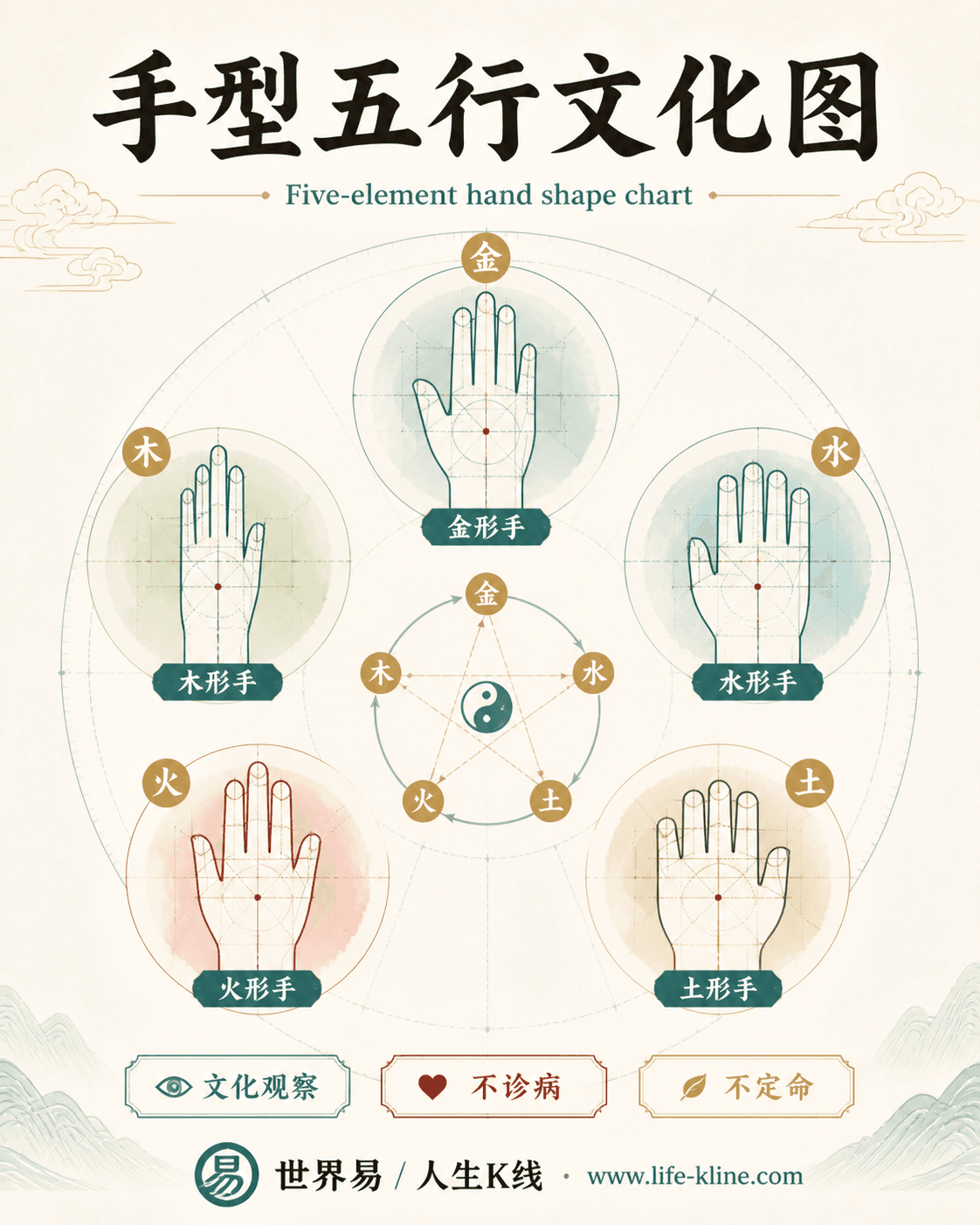
手型五行文化图|北美华人
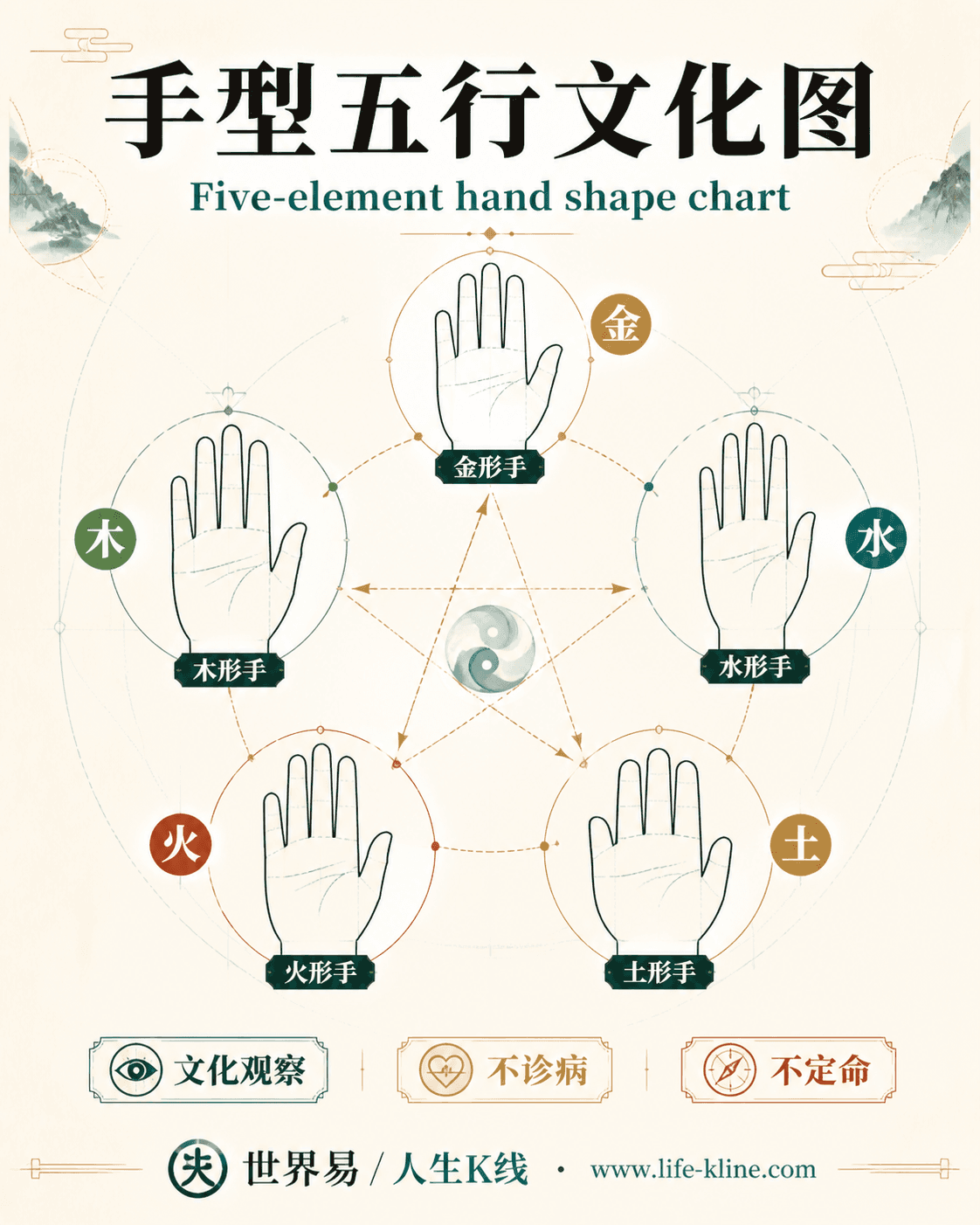
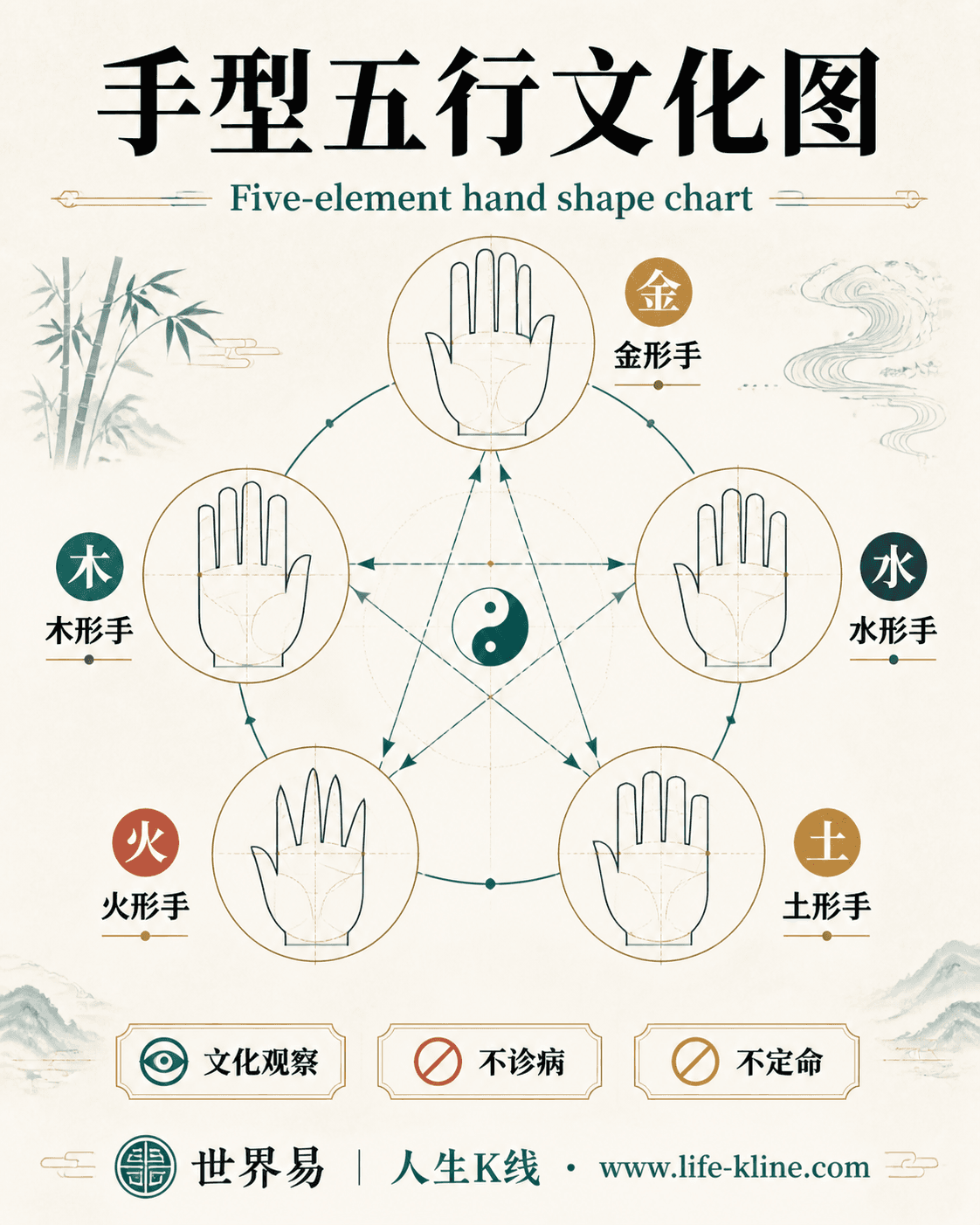
这张图把《Identifying Chronic Fatigue Danger Signals: A Health Decision Guide from a Metaphysical Perspective》里的命理概念转成关系、边界和应用场景,适合先看图建立结构,再回到知识文章正文理解细节。
手型五行文化图用于解释Chinese palmistry hand shape相关的手相文化观察方法,适合北美华人用户理解掌纹术语、上传边界和现实复盘方式。
查看图片解读