Metaphysical Analysis of Actively Ending Friendships and Boundaries in Lending and Cooperation
把这篇文章落到自己身上验证:先看结构,再进入个人分析,不做泛泛阅读。
Why This Decision Is Especially Difficult in This Scenario
Actively ending a friendship often involves complex social dynamics, especially when both parties share the same social circle. The boundaries of lending or cooperation not only affect their relationship but also impact the surrounding interpersonal network. Feelings of guilt and fear of future awkward encounters often make it difficult to decisively set limits. This psychological burden is heavier when emotional investment is deep.
From the perspective of social psychology, the principles of reciprocity and social comparison intensify the difficulty of boundary setting. One party may overly concede out of concern that the other perceives them as untrustworthy or ungenerous; the other may amplify conflicts due to jealousy or dissatisfaction, resulting in blurred boundaries. Such dynamics require precise communication to avoid larger rifts caused by misunderstandings.
The metaphysical structure provides an auxiliary perspective to understand the individual’s energy configuration and emotional tolerance in this scenario. The strength of the Day Master, the prosperity or decline of the wealth stars, and the assistance from Bi Jian/Jie Cai influence the individual’s acceptance and initiative in allocating external resources. The Da Yun (decade luck cycle) and Liu Nian (annual fortune) reflect current environmental pressures and favorable or adverse conditions, further shaping the timing of decisions.
Integrating social dynamics and metaphysical rhythms helps discern when strict limits should be enforced and when higher investment can be borne, avoiding impulsive actions driven by emotions and reducing the risk of fracturing the social circle in the future.
Three Core Dimensions of Metaphysical Judgment
First is the relationship between the Day Master and Bi Jian/Jie Cai. Bi Jian/Jie Cai represent friend stars; the strength of the Day Master determines the individual’s core self and sense of boundaries. A relatively weak Day Master often relies on Bi Jian/Jie Cai support, making boundaries easier to breach and requiring cautious limit-setting; a relatively strong Day Master has stronger self-defense ability and can more clearly define the extent of assistance.
Second is Shi Shen/Shang Guan (expression and emotional release). When Shi Shen/Shang Guan are flourishing, expression is more direct, facilitating clear communication of boundaries, but excessive strength may cause conflicts. When Shi Shen/Shang Guan are weak, expression is insufficient, easily leading to misunderstandings or emotional buildup, requiring other methods to assist communication.
Third is the wealth stars and social debt. Wealth stars represent resource exchanges; when prosperous, social resources are abundant and the capacity to bear burdens is greater. However, under the influence of Ji Shen (unfavorable elements) or when wealth stars are restrained, the risks of lending and cooperation increase. Additionally, Zheng Guan/Qi Sha (official and killing stars) symbolize social pressure and rule constraints; when strong, they encourage adherence to rules, aiding boundary management.
Liu Nian and Da Yun as time rhythms reflect the current social environment’s favorable or adverse trends. During auspicious Da Yun and Liu Nian, boundary adjustments are relatively easier with less impact; during adverse luck or high pressure, greater caution is necessary to avoid conflicts that may break relationships or destabilize the social circle.
Three Real BaZi Chart Case Studies
Case 1: This female’s BaZi chart has a relatively weak Ren (壬, Ren) Water Day Master, belonging to a Zheng Cai (正财) pattern. Her Yong Shen (favorable element) is Earth, and Ji Shen (unfavorable elements) are Wood and Fire. She is currently in the Gui Chou (癸丑, Gui Chou) Da Yun, which is auspicious, with the Liu Nian Bing Wu (丙午, Bing Wu) also favorable. The weak Ren Water Day Master indicates she has weak boundary awareness in friendships. The Zheng Cai pattern shows a strong sense of responsibility in resource exchanges (lending and helping), but the Ji Shen Wood and Fire imply emotional expression may be suppressed or cause internal conflict. The auspicious Da Yun supports her career and wealth, indicating a certain resource base and resilience. Under this structure, when facing pressure from a shared social circle, she tends to overextend lending and assistance due to responsibility and guilt. It is recommended that when actively setting limits, she first assess her own resources and clearly understand the needs of the Yong Shen Earth, avoiding emotional (Ji Shen Fire and Wood) impulsiveness, especially during Liu Nian with strong Fire energy, requiring calmness.
Case 2: This male’s BaZi chart has a relatively strong Gui (癸, Gui) Water Day Master with a Yang Ren (羊刃) pattern. His Yong Shen are Earth and Fire, and Ji Shen is Metal. He is currently in the Ji Chou (己丑, Ji Chou) Da Yun, which is auspicious, with the Liu Nian Bing Wu (丙午, Bing Wu) also favorable. The strong Day Master shows a strong self-boundary, and the Yang Ren pattern brings sharp competitiveness and self-protection will. Yong Shen Earth and Fire mean he is proactive and energetic in lending and cooperation, but Ji Shen Metal weakens his resource management. This configuration implies that when actively ending friendships, he can firmly set boundaries without being emotionally manipulated and can clearly express his stance through communication (Fire). It is advised that when cooperating or helping, he prioritize actual resource capacity, avoid conflicts caused by Yang Ren’s sharpness, maintain rational judgment, and make moderate concessions to preserve harmony in the shared social circle.
Case 3: This male’s BaZi chart has a relatively weak Ren (壬, Ren) Water Day Master, a Zheng Cai pattern, Yong Shen Fire, and Ji Shen Wood. He is currently in the Geng Chen (庚辰, Geng Chen) Da Yun, which is stable, with Liu Nian Bing Wu (丙午, Bing Wu) allowing flexible response. The weak Ren Water Day Master indicates weaker boundary awareness; the Zheng Cai pattern shows he bears considerable responsibility in resource and social exchanges. Yong Shen Fire represents his expressive and active capacity, while Ji Shen Wood may bring internal anxiety or external interference. The stable Da Yun and Fire-strong Liu Nian mean emotional expression is active but may fluctuate. Under this structure, when actively ending friendships, he needs to be cautious of emotional fluctuations causing blurred boundaries and excessive resource outlay. It is recommended to prioritize emotional management, utilize Yong Shen Fire’s expressive advantage to clearly state boundaries for help and lending, while being mindful of Ji Shen Wood’s uncertainties to avoid being swayed by external pressures.
These three cases demonstrate how the strength of the Day Master and specific patterns affect social boundary setting, with Da Yun and Liu Nian allowing dynamic adjustment of investment levels.
Common Misjudgments and Blind Spots in This Scenario
One major misjudgment is mistaking emotional reactions as the sole signal of relationship breakdown. In reality, emotional fluctuations may stem from poor communication or social pressure, especially when Ji Shen elements are overly strong in the metaphysics. Ignoring this often leads to blindly expanding boundaries or severing contact, which exacerbates rifts.
The second blind spot is over-reliance on a single metaphysical dimension for decision-making. For example, focusing only on Day Master strength while neglecting wealth stars or Da Yun and Liu Nian may result in inaccurate assessments of resource tolerance, overlooking the constraints of timing and external environment on interpersonal relationships.
The third is neglecting the interactive influence of the shared social circle. Even if the BaZi chart supports setting limits, ignoring reciprocity rules and others’ reactions within the social circle can still trigger chain reactions, affecting the stability of one’s social resources.
Finally, over-interpretation of metaphysics can lead to neglecting genuine emotional experience and the necessity of professional psychological support. Metaphysics can only assist in grasping rhythm and risk, not replace actual communication and emotional repair.
Practical Judgment Sequence
Step one: Assess the strength of your Day Master and the status of your Yong Shen, clarifying your current energy and resource tolerance. Those with a relatively weak Day Master should prioritize setting limits to avoid overexertion; those with a relatively strong Day Master can bear moderate burdens but should avoid provoking conflicts by being too sharp.
Step two: Combine the wealth stars and Bi Jian/Jie Cai relationships to judge the risks and benefits of lending and cooperation. When wealth stars are prosperous, investment can be increased appropriately, but when Ji Shen is obvious or resources are constrained, strict boundary control is necessary to avoid expanding losses.
Step three: Observe the auspiciousness of the current Da Yun and Liu Nian to judge the social environment’s favorable or adverse conditions. During auspicious luck, proactively communicate to adjust boundaries; during adverse luck or high pressure, choose to wait or reduce investment to avoid escalating conflicts.
Finally, integrate the actual interactions and emotional states within the shared social circle, using steady and clear communication to reduce future awkwardness and misunderstandings. If money or legal disputes are involved, always follow formal professional channels to protect your rights.
FAQ
Question 1: Does a relatively weak Day Master necessarily mean strict boundary setting is required? Answer: Not entirely. A weak Day Master indicates weaker self-defense and susceptibility to others’ influence. It is recommended to prioritize your own resources and emotional state, setting moderate limits to protect yourself. However, adjustments can be made based on Yong Shen and Da Yun conditions.
Question 2: When pressure from a shared social circle is high, how can metaphysics be used to reduce negative impacts? Answer: Focus on the Zheng Guan/Qi Sha combinations and Da Yun/Liu Nian. Strong Zheng Guan/Qi Sha encourage rule adherence, aiding boundary management. Adjust communication style (Shi Shen/Shang Guan) and resource investment (wealth stars), and choose timing wisely to effectively buffer pressure.
Question 3: When wealth stars are strong but Ji Shen is obvious, how should lending and assistance be balanced? Answer: Strong wealth stars bring resource advantages, but Ji Shen represents potential risks and emotional disturbances. Strict boundaries should be set, clearly defining the scope and conditions of assistance to avoid resource loss or interpersonal conflicts caused by emotions or external interference.
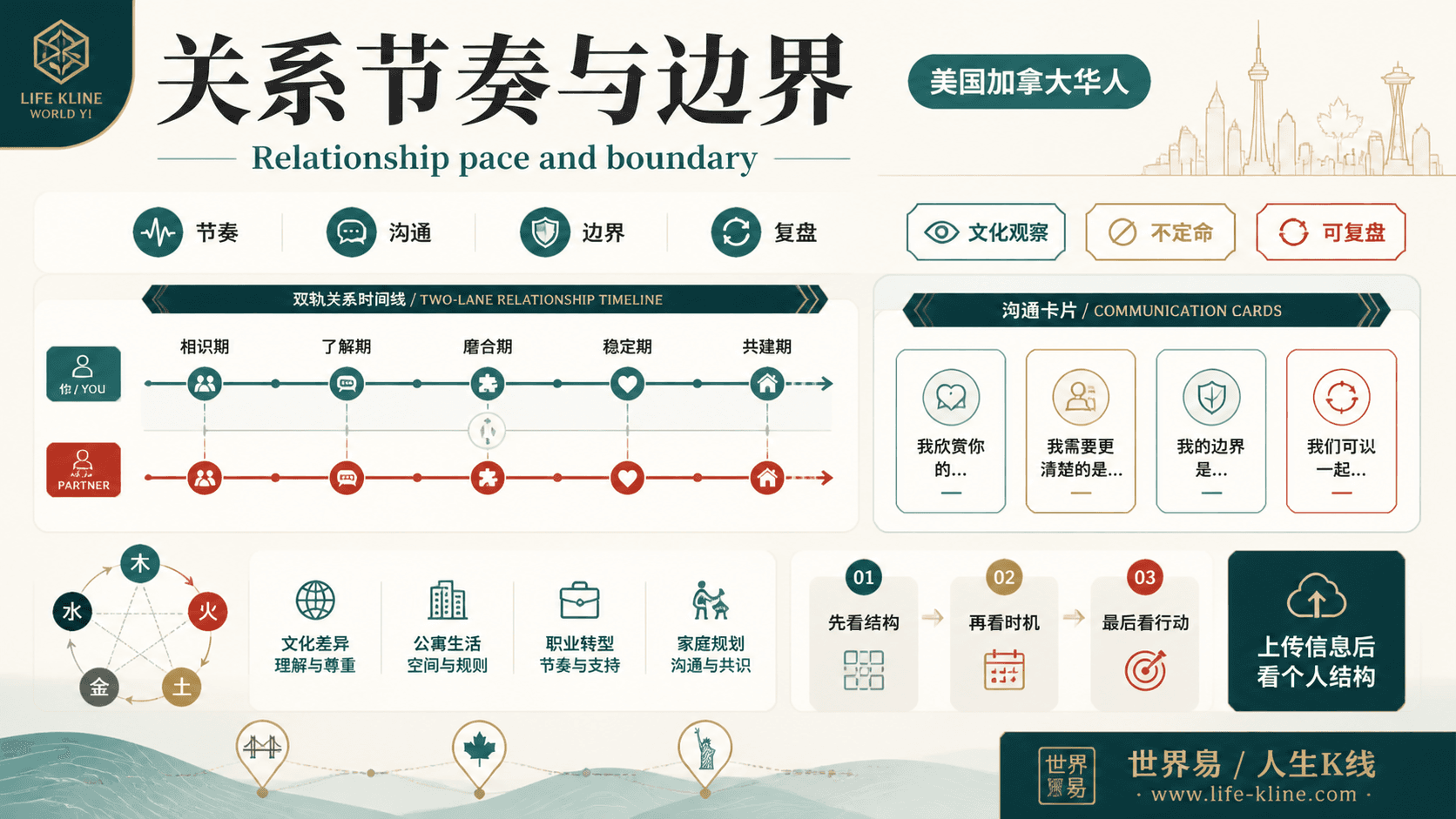
关系节奏与边界|美国加拿大华人
这张图把《Metaphysical Analysis of Actively Ending Friendships and Boundaries in Lending and Cooperation》里的命理概念转成关系、边界和应用场景,适合先看图建立结构,再回到知识文章正文理解细节。
关系节奏与边界不应被写成固定结论。更适合美国加拿大华人的读法,是把传统术语翻译成结构、时机、环境、行动和复盘。
查看图片解读