Metaphysical Analysis of Debt Risk Tolerance: Practical Judgments on Wealth Star, Bi Jian, and Yin Star Structures
把这篇文章落到自己身上验证:先看结构,再进入个人分析,不做泛泛阅读。
Why This Decision Is Particularly Difficult in This Wealth Scenario
The core difficulty in borrowing and debt decisions lies in accurately grasping true risk tolerance. In reality, borrowers often make lending decisions based on subjective judgment or short-term funding needs, overlooking the long-term sustainability of debt burdens. In contemporary China, with soaring housing prices, fluctuating interest rates, and compounded inflation pressures, borrowing risks are further amplified. Especially with the convenience of credit cards and consumer loans, over-indebtedness is easily triggered.
On a psychological level, borrowers often fall into optimism bias, underestimating repayment pressure or being influenced by the emotional burden of borrowing from friends and family. When household savings are insufficient, reliance on external borrowing increases financial vulnerability. The metaphysical structures of Wealth Stars, Bi Jian, and Yin Stars offer a perspective to observe intrinsic risk appetite and financial resilience, helping clarify the gap between apparent willingness and latent capacity.
Moreover, the changes in Liu Nian (annual fortune) and Da Yun (decade luck cycle) have significant impacts on borrowing risk. The auspiciousness or inauspiciousness of Da Yun directly relates to the stability of one’s fortune, while Liu Nian reflects short-term environmental volatility. These metaphysical factors intertwined with real financial conditions make assessing borrowing risk tolerance complex and dynamic.
Therefore, in today’s high-leverage environment, scientifically evaluating borrowing risk tolerance by integrating metaphysical structures is key to helping individuals and families avoid debt traps and achieve stable wealth growth.
Three Core Dimensions of Metaphysical Judgment
The first dimension is the relationship between the Day Master and the Wealth Star. The Day Master represents the individual's core energy and personality, while the Wealth Star corresponds to external resources related to wealth and borrowing. If the Wealth Star is strong but the Day Master is relatively weak, the individual tends to rely heavily on financial resources, resulting in lower risk tolerance and a higher likelihood of psychological stress or financial imbalance due to borrowing pressure. Conversely, a strong Day Master indicates better self-regulation and risk management capabilities.
The second dimension focuses on the presence and strength of Bi Jian (Peer/Rob Wealth). Bi Jian represents competition and similar resources, often indicating borrowing from friends or cooperative relationships. In borrowing scenarios, a strong Bi Jian suggests complex borrowing relationships with a strong tendency to share similar resources, but it may also cause resource contention and conflicts, increasing financial risk. Weak or absent Bi Jian indicates simpler borrowing relationships with clearer risk structures.
The third dimension is the coordination of Yin Stars (Resource Stars). Yin Stars symbolize support and continuity of resources, especially knowledge, protection, and external assistance. When Yin Stars are strong, an individual’s risk tolerance is enhanced due to better protective capacity and resource accumulation, enabling more stable handling of debt pressure. Weak Yin Stars reveal insufficient risk protection, necessitating more cautious borrowing decisions.
By synthesizing the interactions between Liu Nian and Da Yun, especially the dynamic changes of Wealth Stars, Bi Jian, and Yin Stars, one can reflect how the current financial environment influences individual risk tolerance. When Da Yun is auspicious and Liu Nian is favorable, it is suitable to steadily expand borrowing; otherwise, it is advisable to maintain status quo and avoid large debts.
Three Real BaZi Chart Cases
Case 1: This gentleman’s Day Master is Xin Metal (辛, Xin) and relatively weak, belonging to a Bi Jian structure. The Yong Shen (favorable element) is Earth, and the Ji Shen (unfavorable elements) are Water and Wood. He is currently in the Bing Zi (丙子, Bing Zi) Da Yun, with overall stable fortune, and the Liu Nian is Bing Wu (丙午, Bing Wu). His Wealth Star is not prominent, but Bi Jian is strong, indicating a high likelihood of relying on peer resources such as borrowing from friends or family. Earth as the Yong Shen suggests he should enhance risk resistance through stable asset allocation and wealth accumulation. In reality, when facing long-term debts like mortgages or car loans, blind expansion should be avoided; preservation is advisable. Risk tolerance is relatively low and easily affected by external environmental fluctuations. It is recommended to first assess family savings and repayment ability to avoid over-indebtedness from credit cards or consumer loans.
Case 2: This chart’s Day Master is Bing Fire (丙, Bing) and relatively strong, categorized as a Jie Cai (劫财, Rob Wealth) structure. The Yong Shen are Water and Metal, with Wood as Ji Shen. The Da Yun is Geng Xu (庚戌, Geng Xu), an auspicious luck cycle, and the Liu Nian is Bing Wu (丙午, Bing Wu), which aligns well. The Jie Cai structure emphasizes competition and resource sharing, indicating a higher risk appetite in borrowing, possibly inclined to actively use credit cards and consumer loans for expansion. The strong Wealth Stars of Water and Metal show good liquidity and short-term repayment ability, but the Ji Shen Wood warns to guard against adverse external factors. Given the current auspicious luck, it is suitable to seize opportunities but must ensure borrowing scale matches repayment cycles to prevent cash flow strain from impulsive borrowing.
Case 3: This gentleman’s Day Master is Ding Fire (丁, Ding) and relatively weak, with a Pian Yin (偏印, Indirect Resource) structure. The Yong Shen is Water, and Ji Shen are Earth and Metal. He is currently in the Xin You (辛酉, Xin You) Da Yun, which is an inauspicious cycle, and the Liu Nian is Bing Wu (丙午, Bing Wu), requiring caution. The Pian Yin structure symbolizes insufficient resource support, meaning a lack of strong backing when facing debt pressure, resulting in low risk tolerance. The influence of Ji Shen Earth and Metal may cause obstacles in borrowing, such as loan approval difficulties or increased repayment pressure. In practice, large-scale borrowing, especially high-interest consumer loans and credit card debts, should be avoided. Priority should be given to debt restructuring or conservative repayment strategies. It is advised to consult external financial advisors before major financial decisions to reduce risk exposure.
These three cases collectively demonstrate the instructive value of metaphysical structures in risk tolerance. By identifying the strength of the Day Master, the combination of Wealth Stars, Bi Jian, and Yin Stars, as well as the auspiciousness of Da Yun and Liu Nian, one can more accurately assess the reasonable boundaries and potential risks of borrowing behavior, guiding scientific borrowing decisions.
Common Misjudgments and Blind Spots in This Scenario
First, over-reliance on verbal commitments to assess risk appetite while ignoring the inherent differences in risk tolerance indicated by metaphysical structures. Borrowers often appear positive on the surface, but metaphysical analysis reveals limited intrinsic risk resistance, prone to financial crises under debt pressure.
Second, neglecting the dynamic influence of Da Yun and Liu Nian on borrowing risk. Many borrowing decisions only consider current financial status without integrating metaphysical cycle changes, leading to inaccurate risk forecasts and missed opportunities to adjust borrowing strategies.
Third, misjudging the role of Bi Jian. While strong Bi Jian indicates support from peer resources, it may also cause resource contention and emotional disputes. Blindly expanding borrowing scale can increase risk. It is necessary to distinguish the positive and negative impacts of Bi Jian and reasonably adjust borrowing structures.
Fourth, overlooking the critical protective role of Yin Stars. When Yin Stars are weak, actual borrowing risk tolerance is low, making debt restructuring more likely. Without Yin Star support, borrowers should strictly control debt scale and prioritize basic living and repayment capacity.
Practical Judgment Sequence
Step one: Assess the strength of the Day Master and Yong Shen preferences to clarify the individual’s core energy and baseline risk tolerance. Weak Day Masters should borrow cautiously, while strong ones may moderately expand but avoid excessive optimism.
Step two: Analyze the combination of Wealth Stars, Bi Jian, and Yin Stars. A strong Wealth Star calls for attention to wealth liquidity and debt structure; a strong Bi Jian warns of complex borrowing relationships that may cause risk; a strong Yin Star indicates robust resource support to buffer risks.
Step three: Combine the current auspiciousness or inauspiciousness of Da Yun and Liu Nian to judge borrowing timing and environment. When luck is favorable and Liu Nian aligns, moderate borrowing expansion is appropriate; during inauspicious cycles or conflicting Liu Nian, maintain status quo or reduce leverage to avoid negative impacts from environmental fluctuations.
Finally, integrate real financial conditions such as family savings, income stability, interest rates, and inflation trends to comprehensively adjust borrowing amounts and repayment plans. Borrowing decisions should prioritize prudence, avoiding blind following or emotional actions.
FAQ
Question 1: Does a strong Wealth Star in the BaZi chart mean it is safe to borrow freely? Answer: A strong Wealth Star indicates abundant wealth resources, but it must be judged in combination with the Day Master’s strength and Yong Shen situation. A strong Wealth Star with a weak Day Master may have insufficient risk tolerance and requires cautious evaluation of borrowing scale and repayment ability.
Question 2: Does a strong Bi Jian mean borrowing relationships are stable? Answer: Strong Bi Jian means there is considerable peer resource support in borrowing relationships, but it can also cause resource contention and conflicts. Borrowers need to rationally analyze the stability and potential risks of their borrowing network and should not blindly expand borrowing.
Question 3: How to adjust borrowing strategies based on Liu Nian and Da Yun? Answer: Auspicious Da Yun and favorable Liu Nian are suitable for steady borrowing expansion and wealth accumulation. Inauspicious Da Yun or conflicting Liu Nian suggest maintaining current status or reducing debt to avoid increased financial pressure from external fluctuations. Dynamically adjusting strategies according to metaphysical cycles can effectively mitigate debt risks.
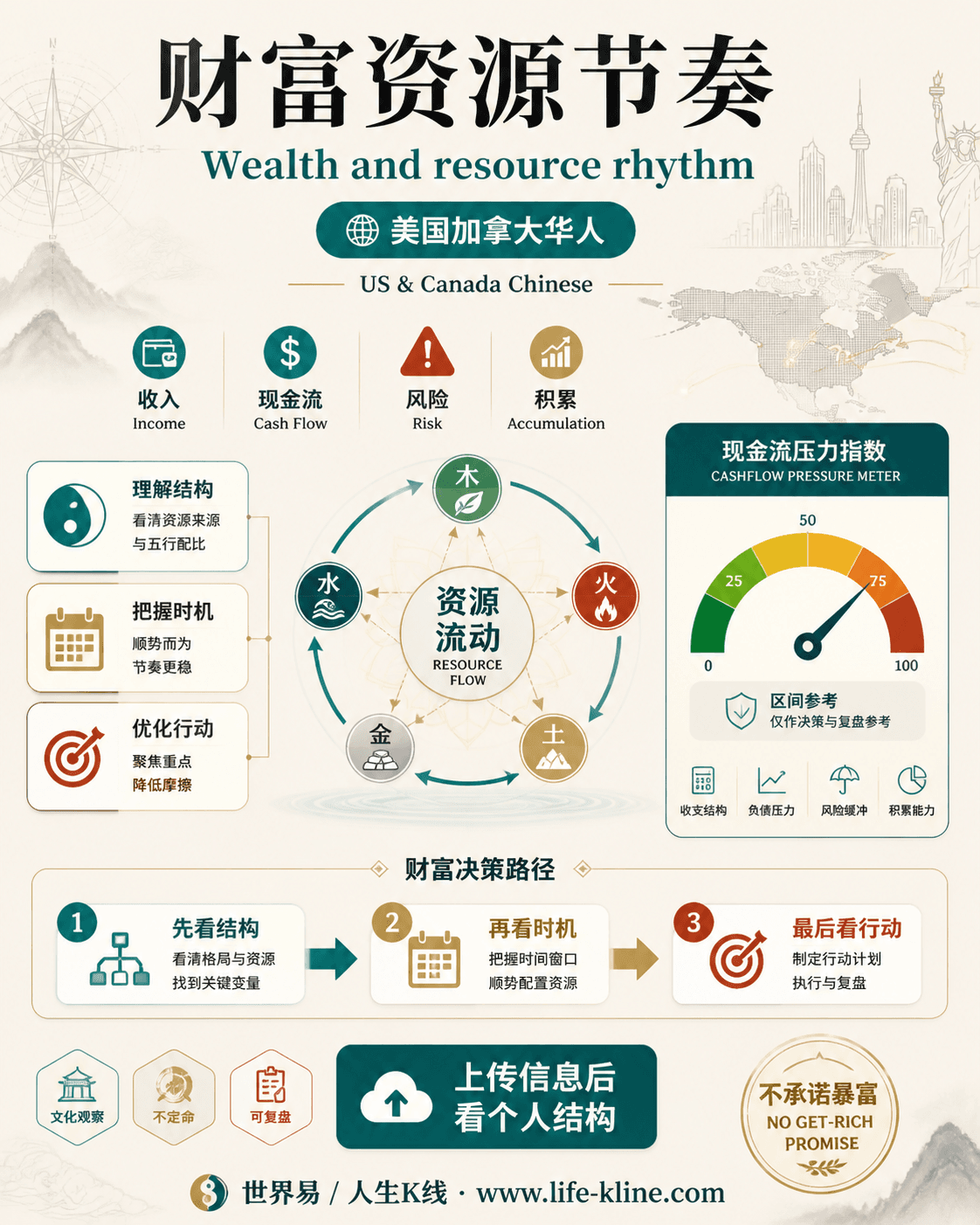
财富资源节奏|美国加拿大华人
这张图把《Metaphysical Analysis of Debt Risk Tolerance: Practical Judgments on Wealth Star, Bi Jian, and Yin Star Structures》里的命理概念转成关系、边界和应用场景,适合先看图建立结构,再回到知识文章正文理解细节。
财富资源节奏不应被写成固定结论。更适合美国加拿大华人的读法,是把传统术语翻译成结构、时机、环境、行动和复盘。
查看图片解读