Review and Restart After Loan and Debt Loss: Risk and Opportunity Assessment from a Metaphysical Perspective
把这篇文章落到自己身上验证:先看结构,再进入个人分析,不做泛泛阅读。
Why This Decision Is Especially Difficult in This Financial Scenario
Decisions to review and restart after loan and debt losses often involve complex real-world constraints and deep psychological conflicts. First, multiple debt channels such as loans from relatives and friends, credit card overdrafts, consumer loans, and mortgage or car loans overlap, creating enormous repayment pressure on individuals. Coupled with the current high housing prices, interest rate fluctuations, and inflation environment in China, adjusting debt structures becomes even more challenging.
Second, the psychological burden and cognitive biases after losses often lead to imbalanced decisions. Many people find it difficult to objectively assess their financial situation after losses, easily falling into wishful thinking and blindly increasing borrowing, or becoming overly pessimistic and hastily accepting losses, which increases subsequent risks.
In this context, the BaZi structure plays a role in amplifying or suppressing risks. Different Day Master strengths, patterns, and Yong Shen/Ji Shen (unfavorable elements) combinations influence an individual's risk tolerance and coping strategies. For example, a relatively strong Day Master combined with favorable Yong Shen often indicates the possibility of steady remediation; whereas when Ji Shen is strong and the Da Yun (decade luck cycle) and Liu Nian (annual fortune) are unfavorable, greater caution is advised to prevent loss expansion.
Therefore, the decision challenge of reviewing and restarting after loan losses is a complex system interwoven with real financial pressure, psychological expectations, and BaZi structure. It requires systematic analysis and reasonable timing of actions.
Three Core Dimensions of Metaphysical Judgment
In metaphysical judgment for reviewing and restarting after loan losses, the first core focus is the relationship between the Day Master and the Wealth Star. A relatively strong or balanced Day Master indicates one’s own resources and carrying capacity; the strength or weakness of the Wealth Star reflects wealth inflow and pressure. If the Wealth Star is overly strong and accompanied by obvious Ji Shen, it often signifies increased risk of excessive debt.
Second, the role of Bi Jian (Peer) and Jie Cai (Rob Wealth) stars should not be overlooked. These represent similar resources and competition, which can share or seize financial sources. In debt restructuring and borrowing from relatives or friends, a strong Bi Jian/Jie Cai often indicates fierce resource competition, increased difficulty in cooperation, and elevated risks.
Third, the interaction between Liu Nian (annual fortune) and Da Yun (decade luck cycle) determines the current auspiciousness or inauspiciousness of the BaZi chart. Favorable luck combined with supportive annual fortune is conducive to steady review and gradual remediation; whereas stable or unfavorable Da Yun with significant annual clashes or penalties suggests the need to maintain the status quo or wait cautiously to avoid greater losses caused by shocks.
In summary, the strength of the Day Master, the relationship between the Wealth Star and Bi Jian/Jie Cai stars, and the interaction of Da Yun and Liu Nian are the three key dimensions for judging whether to continue remediation or accept losses and exit after loan losses.
Three Real BaZi Chart Cases
Case 1: This female’s Day Master is 癸 (Gui) Water, relatively strong; her pattern is Zheng Yin (Proper Seal) pattern; Yong Shen are Earth and Fire; Ji Shen is Metal. Currently, she is in the 乙丑 (Yi Chou) Da Yun, with the Liu Nian being 丙午 (Bing Wu). The Yi Chou Da Yun is auspicious, with progress in career and wealth. In her BaZi structure, the 印星 (Seal star) is strong, protecting the Day Master, and the Yong Shen Earth and Fire help enhance stability. Although Ji Shen Metal exists, the Da Yun and Liu Nian are favorable, so the impact is minor. In real loan and debt scenarios, this structure indicates strong resilience and resource integration ability, suitable for steady remediation through debt restructuring and reasonable planning. The suggested judgment sequence is: first assess whether current debt pressure is within a controllable range; if so, leverage the favorable Da Yun and Liu Nian to gradually reorganize; if the debt far exceeds capacity, then cautiously accept losses to avoid further expansion.
Case 2: This female’s Day Master is 壬 (Ren) Water, balanced; her pattern is Cong Sha (From Killing) pattern; Yong Shen are Earth and Fire; Ji Shen are Metal and Water. She is in 丁巳 (Ding Si) Da Yun (very auspicious) and 丙午 (Bing Wu) Liu Nian. Her BaZi has a strong Sha star, indicating strong initiative and desire for change, but the dual Ji Shen Metal and Water imply emotional volatility and external pressure. Considering the typical young person's loan structure with high risks from credit cards and consumer loans, and unstable financial foundation, this chart suggests caution in reviewing after losses despite favorable Da Yun and Liu Nian. The specific advice is: prioritize reducing high-interest debts to avoid risk amplification caused by Ji Shen recurrence; then use the favorable Da Yun to steadily adjust the financial structure and gradually restore credit and cash flow.
Case 3: This male’s Day Master is 丁 (Ding) Fire, relatively strong; his pattern is Yang Ren (Goat Blade) pattern; Yong Shen is Water; Ji Shen is Wood. He is currently in 丙寅 (Bing Yin) Da Yun, with 丙午 (Bing Wu) Liu Nian. The Da Yun is stable, suggesting maintaining the status quo. The Yang Ren pattern indicates a strong Day Master and vigorous action, but the presence of Ji Shen Wood brings external resistance and internal conflicts. Yong Shen Water serves as a balancing force to moderate the overly strong Day Master. In reality, middle-aged men’s debts mostly involve mortgages and car loans with significant financial pressure. For this chart, due to stable Da Yun not favoring aggressive moves, a steady approach is preferred to avoid larger losses caused by reckless expansion. The suggested judgment sequence is: first evaluate whether the balancing effect of Yong Shen Water is significant; if so, gradually adjust the debt structure; otherwise, prioritize stabilizing the current financial foundation and avoid rash moves.
These three cases, through differences in Day Master strength, patterns, and Yong Shen/Ji Shen, combined with contemporary loan and debt pressures, reveal the risks and opportunities in review and restart decisions, helping readers scientifically judge when to accept losses and exit, and when to proceed with steady remediation.
Common Misjudgments and Blind Spots in This Scenario
One common misjudgment after loan and debt losses is over-reliance on intuition or emotionally driven decisions, ignoring the BaZi structure’s indication of risk tolerance, leading to reckless escalation or hasty exit.
Additionally, some people neglect the influence of Da Yun and Liu Nian on current financial actions, failing to adjust strategies according to favorable or unfavorable timing, resulting in aggressive moves during adverse years that exacerbate losses.
Another blind spot is misunderstanding the Wealth Star; a strong Wealth Star is not always beneficial. If accompanied by strong Ji Shen, it actually intensifies debt pressure. Ignoring this can easily trap one in financial quagmires.
Finally, failure to correctly assess the cooperative and competitive relationships of Bi Jian/Jie Cai stars leads to overlooking hidden risks in borrowing from relatives and friends, causing debt restructuring failures or credit collapse.
Practical Judgment Sequence
Step one: assess the Day Master’s strength and the status of Yong Shen and Ji Shen to clarify your risk tolerance and main contradictions during review. A relatively strong Day Master with effective Yong Shen has stronger resilience and may consider steady remediation; a weak Day Master or strong Ji Shen requires cautious exit to avoid expanding losses.
Step two: combine current Da Yun and Liu Nian to judge the luck cycle’s auspiciousness. When luck is favorable and aligned, gradually adjust debt structure and optimize remediation; when stable or adverse, focus on maintaining status quo and avoid reckless expansion or aggressive actions.
Step three: in specific operations, prioritize reducing high-cost debts (such as high-interest credit cards and consumer loans), reasonably use low-cost funds like loans from relatives and friends, and prevent cash flow disruptions. Also pay attention to the cooperative and competitive relationships of Bi Jian/Jie Cai stars to reasonably diversify risks.
In summary, review and restart should be based on a profound understanding of BaZi structure and financial reality, arranging timing and strategies reasonably, avoiding emotional decisions, and ensuring a healthy and stable financial transition.
FAQ
Question 1: After loan and debt losses, how to judge if one is suitable to continue remediation? Answer: Combine the Day Master’s strength and Yong Shen status; if the Day Master is relatively strong and Yong Shen effective, and the current Da Yun and Liu Nian are favorable, it indicates resilience and suitability for steady remediation; otherwise, caution is needed to avoid expanding losses.
Question 2: Does strong Ji Shen in BaZi necessarily mean one must accept losses and exit? Answer: Strong Ji Shen indicates higher risk, but whether to accept losses depends on the overall BaZi chart including Da Yun, Liu Nian, and Yong Shen adjustments. It should not be judged simplistically but evaluated comprehensively along with real financial conditions.
Question 3: How is borrowing from relatives and friends understood in BaZi? Answer: Borrowing from relatives and friends is often reflected by the Bi Jian/Jie Cai stars’ cooperative and competitive relationships. When Bi Jian/Jie Cai are strong, cooperation is difficult and risks increase. One must handle such borrowing relationships cautiously to avoid credit breakdown due to resource competition.
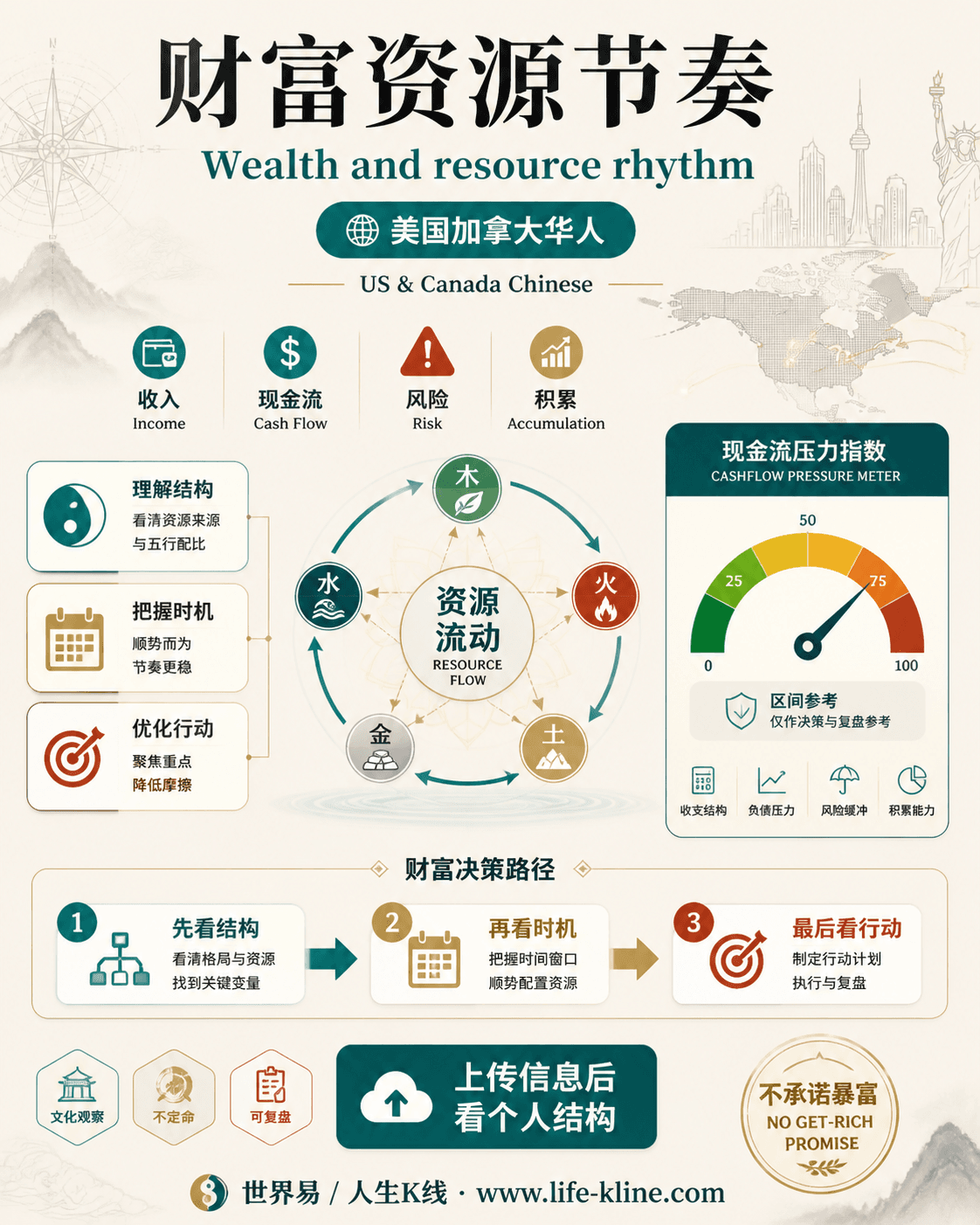
财富资源节奏|美国加拿大华人
这张图把《Review and Restart After Loan and Debt Loss: Risk and Opportunity Assessment from a Metaphysical Perspective》里的命理概念转成关系、边界和应用场景,适合先看图建立结构,再回到知识文章正文理解细节。
财富资源节奏不应被写成固定结论。更适合美国加拿大华人的读法,是把传统术语翻译成结构、时机、环境、行动和复盘。
查看图片解读