Judging Loan Cooperation Partners: Managing Borrowing from Relatives and Debt Risks from a Metaphysical Perspective
把这篇文章落到自己身上验证:先看结构,再进入个人分析,不做泛泛阅读。
Why This Decision Is Especially Difficult in This Wealth Scenario
Under the current Chinese economic environment, borrowing and debt issues are particularly complex, especially involving borrowing from relatives and friends, credit card debts, consumer loans, as well as mortgage and auto loans with diversified liability structures. The decline in household savings ratio and increased inflation pressure make funding needs more urgent, while market interest rate fluctuations and stock market uncertainties also increase borrowing risks. The choice of cooperation partner directly affects fund security and debt repayment ability, thus significantly increasing decision-making difficulty.
On a psychological level, borrowing from relatives and friends often involves emotional factors, leading to biased risk assessments. Excessive trust may conceal financial hidden risks of the partner, while excessive caution may miss reliable funding support. In such cases, using metaphysical judgment to assess the financial potential and risk signals of cooperation partners becomes an important auxiliary decision-making tool.
The metaphysical structure itself contains information such as the strength of the Day Master, wealth star configuration, and interactions among Bi Jian (Peer), Jie Cai (Rob Wealth), and Yin stars (Resource stars). These elements can reflect a person's financial endurance and cooperation attitude in loan partnerships. For example, a strong wealth star but a relatively weak Day Master may indicate the partner has abundant financial resources but insufficient personal capability, requiring attention to fund utilization efficiency; a strong Bi Jian suggests the partner has a strong self-protection awareness, which may affect risk sharing.
Furthermore, the interaction between Da Yun and Liu Nian also indicates the timing and environmental changes for cooperation. A stable Da Yun and a year with favorable wealth stars increase cooperation success rates; whereas when Da Yun is clashing or Ji Shen (unfavorable elements) are excessive, caution is needed to prevent debt risk expansion. Considering real economic pressures, psychological biases, and metaphysical signals, the complexity of borrowing cooperation decisions is significantly heightened.
Three Core Dimensions of Metaphysical Judgment
First, the relationship between the Day Master and wealth stars is central to judging the financial foundation of a cooperation partner. Whether the Day Master is relatively strong or weak determines the partner's stability in fund usage and debt repayment ability. Wealth stars represent financial resources; when wealth stars are strong and the Day Master is moderate, it reflects potential financial strength and management ability; conversely, strong wealth stars with a very weak Day Master may indicate financial dependency and increased cooperation risk.
Second, the presence of Bi Jian (Peer) and Jie Cai (Rob Wealth) stars reflects the partner's interpersonal relationships and willingness to share resources. A strong Bi Jian indicates a strong competitive and self-protection consciousness, often leading to more independent operation and less risk sharing in cooperation; a weak Bi Jian or one restrained by Yin stars (Resource stars) suggests the partner relies more on external support and is more likely to form good cooperative relationships.
Third, the interaction between Liu Nian (annual fortune) and Da Yun (decade luck cycle) reveals the favorability of cooperation timing. Da Yun indicates long-term trends, while Liu Nian reflects the environment and events of the year. When Da Yun is smooth and Liu Nian does not clash, cooperation progresses smoothly with lower debt risk; if Da Yun clashes or Liu Nian shows strong Ji Shen, the cooperation process is prone to fund chain breaks or credit crises, requiring caution.
By integrating these three dimensions, combined with the specific configuration of Yong Shen (favorable elements) and Ji Shen (unfavorable elements), one can carefully assess the financial reliability and potential risks of cooperation partners, providing scientific basis for borrowing cooperation decisions and maximizing avoidance of debt default and capital loss.
Three Real BaZi Chart Cases
Case 1: This female BaZi chart has a Day Master of Xin (辛, Metal), relatively strong, with a pattern of exclusive strength (专旺格). The Yong Shen is Earth, and the Ji Shen is Wood. She is currently in the third year of the Bing Wu (丙午) Da Yun, with the Bing Wu Liu Nian overlapping, resulting in overall stable fortune, suitable for maintaining status quo. The Xin Metal Day Master is relatively strong, born in autumn and winter; Earth as Yong Shen helps stabilize the foundation, and the strong Bing Wu fire generates Earth, forming a positive cycle. In borrowing cooperation, this chart indicates the partner has a stable financial structure and focuses on preservation, with relatively low cooperation risk. However, attention should be paid to the influence of Ji Shen Wood to avoid uncertainties caused by external emerging risks or over-expansion. It is recommended to focus on whether there are recent financial fluctuations or external debt pressures related to Wood, and prioritize cooperation during periods when Da Yun and Liu Nian are stable.
Case 2: This female BaZi chart has a Day Master of Ding (丁, Fire), relatively strong, with a Zheng Yin (正印) pattern. The Yong Shen is Fire, and the Ji Shen is Wood. She is currently in the ninth year of the Wu Wu (戊午) Da Yun, with the Bing Wu (丙午) Liu Nian, overall auspicious fortune with career and financial progress. The Zheng Yin pattern represents strong support and resource backing; the Ding Fire Day Master is vigorous, with clear assistance from Yin stars, reflecting the partner's good financial support and credit background. In borrowing cooperation, such a chart usually indicates strong financial management ability and stable income source, with low cooperation risk. However, the presence of Ji Shen Wood warns to be cautious of risks brought by external competition or industry fluctuations. It is advised to focus on the partner's funding sources and industry stability, and choose timing when Da Yun and Liu Nian are supportive.
Case 3: This male BaZi chart has a Day Master of Yi (乙, Wood), relatively weak, with a Zheng Cai (正财) pattern. The Yong Shen is Water, and the Ji Shen are Fire and Earth. He is currently in the ninth year of the Geng Shen (庚申) Da Yun, with the Bing Wu (丙午) Liu Nian; Da Yun is stable but Liu Nian requires adaptability. The Yi Wood Day Master is weak; the Zheng Cai pattern indicates a clear wealth source but requires Yong Shen Water to nourish it; Ji Shen Fire and Earth may cause financial pressure. The chart shows the partner has a relatively weak financial foundation and is easily affected by environmental changes, posing higher cooperation risks. Especially under the current Bing Wu Liu Nian with strong fire, the Ji Shen Fire and Earth intensify, potentially destabilizing the fund chain. It is recommended to apply stricter financial due diligence and risk assessment, prioritize observing cash flow and debt repayment ability, and delay cooperation until Da Yun and Liu Nian become more favorable.
Common Misjudgments and Blind Spots in This Scenario
A common misjudgment is overly relying on relationships with relatives and friends or initial impressions for loan cooperation, neglecting the balance between wealth stars and the Day Master in metaphysics. For example, a strong wealth star does not necessarily mean the partner has debt repayment ability; if the Day Master is weak and Yong Shen is unbalanced, fund management and risk tolerance are insufficient, easily leading to subsequent debt problems.
Another blind spot is ignoring the amplifying effect of Da Yun and Liu Nian on cooperation risks. Even if the BaZi chart foundation is good, encountering Da Yun clashes or prominent Ji Shen in Liu Nian can suddenly increase cooperation risks and the probability of fund chain breaks. Failure to consider timing factors often results in missing the best cooperation window or overlooking potential risks.
There is also misunderstanding about the combination of Bi Jian (Peer) and Yin stars (Resource stars). Although a strong Bi Jian indicates broad interpersonal relationships, cooperation may involve strong self-protection and competition, making risk sharing difficult; while a strong Yin star indicates dependence on external resources, leading to more stable cooperation but with the risk of resource interruption. Failure to accurately interpret these star characteristics can cause cooperation breakdowns or debt deterioration.
Finally, neglecting the role of Ji Shen (unfavorable elements) is also highly risky. Once Ji Shen becomes excessive, it damages financial security, often causing fund loss and credit damage during cooperation. If metaphysical judgment does not fully consider Ji Shen's impact on the partner, decision quality will be significantly compromised.
Practical Judgment Sequence
First, verify the cooperation partner’s Day Master strength and pattern to clarify their financial foundation and fund operation ability. Those with relatively strong Day Masters and effective Yong Shen have better financial stability and should be prioritized. Next, focus on the combination of wealth stars and Bi Jian/Yin stars to judge the partner’s interpersonal resources and risk-taking willingness. Excessive Bi Jian requires caution for self-interest tendencies in cooperation; strong Yin stars favor long-term stable cooperation.
Second, combine the current Da Yun and Liu Nian situation to evaluate whether the timing is suitable for cooperation. A stable Da Yun and non-clashing Liu Nian indicate a favorable cooperation environment with lower risks; otherwise, caution or adjustment of cooperation strategies is advised to avoid falling into debt difficulties at unfavorable times.
Finally, based on metaphysical indications, conduct due diligence on actual financial status, focusing on cash flow, debt structure, and credit records. Metaphysics is only an auxiliary tool; final decisions should be based on comprehensive information and risk assessment. It is recommended to actively promote cooperation when metaphysics shows favorable signs, and to wait or adjust cooperation plans when Ji Shen is prominent or fortune is poor.
FAQ
Question 1: How to understand the practical impact of Yong Shen and Ji Shen in loan cooperation? Answer: Yong Shen represents favorable elements in the BaZi chart that enhance the partner’s fund stability and risk resistance, while Ji Shen are unfavorable elements that may cause fund flow issues or credit risks. Cooperation should prioritize partners with strong Yong Shen and minimal Ji Shen to reduce debt default probability.
Question 2: How do Da Yun and Liu Nian affect loan cooperation decisions? Answer: Da Yun reflects long-term trends, and Liu Nian reflects the current year’s environment. When Da Yun is smooth and Liu Nian is auspicious, cooperation success rate and fund security are higher. When Da Yun clashes or Liu Nian shows prominent Ji Shen, it is advisable to delay cooperation or strengthen risk control to prevent financial crises.
Question 3: Can metaphysical judgment replace financial due diligence? Answer: Metaphysical judgment is an auxiliary tool providing reference on the partner’s financial potential and risk characteristics, but cannot replace detailed financial due diligence. Combining metaphysics with real data enables scientific and prudent borrowing cooperation decisions.
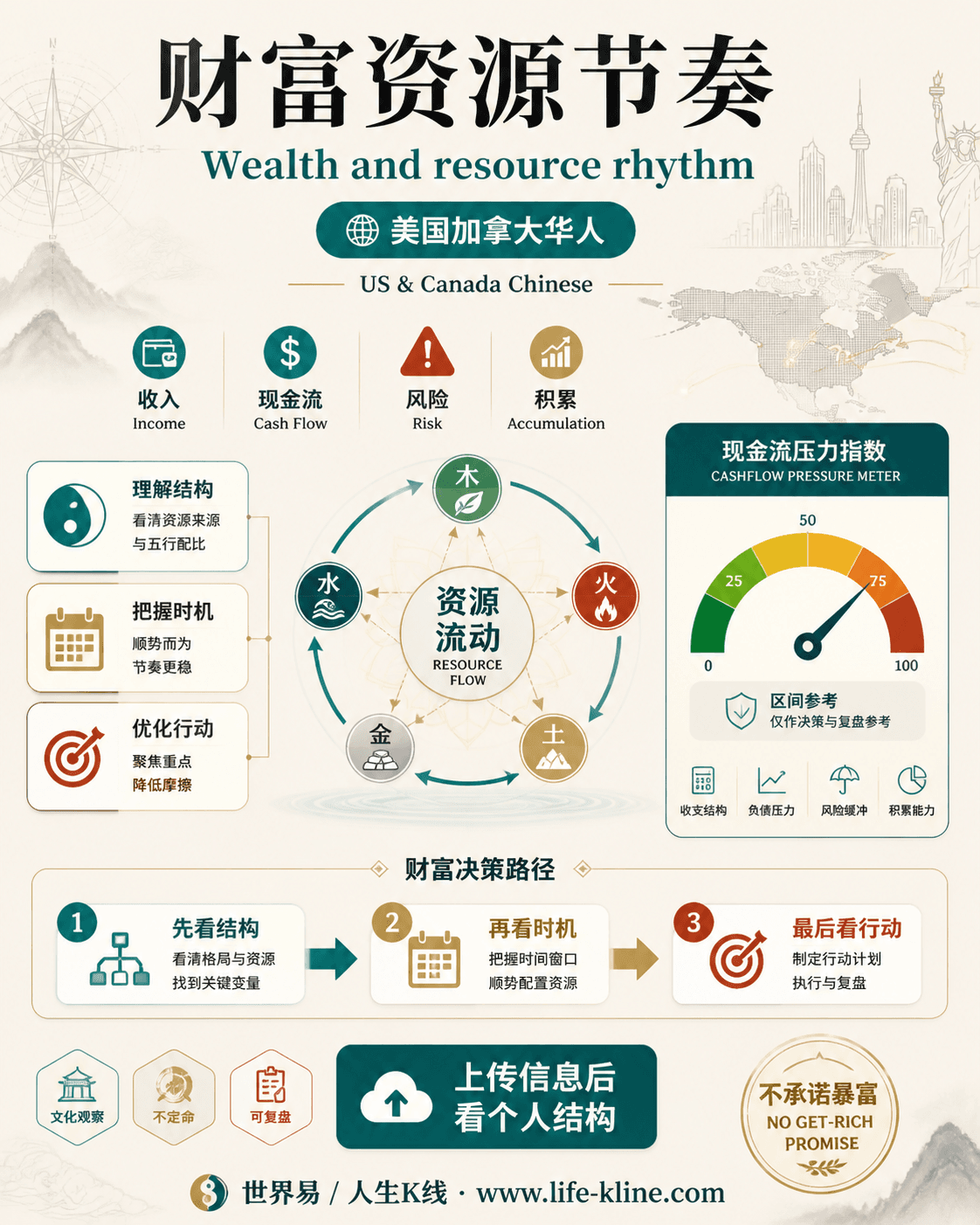
财富资源节奏|美国加拿大华人
这张图把《Judging Loan Cooperation Partners: Managing Borrowing from Relatives and Debt Risks from a Metaphysical Perspective》里的命理概念转成关系、边界和应用场景,适合先看图建立结构,再回到知识文章正文理解细节。
财富资源节奏不应被写成固定结论。更适合美国加拿大华人的读法,是把传统术语翻译成结构、时机、环境、行动和复盘。
查看图片解读