Analysis of the Optimal Time Window for Loans and Debts: The Metaphysical Connection between Da Yun, Liu Nian, and Financial Decisions
把这篇文章落到自己身上验证:先看结构,再进入个人分析,不做泛泛阅读。
你现在搜索的,
其实是一个要落到自己身上的判断。
当前页面主要回答「Loans and Debts」这类搜索问题;真正有价值的下一步是把这套结构带进自己的报告、工具与案例验证。
Why This Decision Is Particularly Difficult in This Financial Scenario
In modern society, loan and debt management involves diversified channels, including borrowing from friends and family, credit card overdrafts, consumer loans, as well as car and mortgage loans. In reality, high housing prices, inflation pressures, and interest rate fluctuations significantly increase the risks and uncertainties of borrowing, while loans from friends and family involve complex interpersonal relationships, further increasing decision-making difficulty.
Psychologically, borrowers are often driven by short-term cash needs, neglecting long-term repayment capacity and changes in the market environment. This is especially true during periods of rising interest rates or economic volatility, when blind borrowing behaviors are more likely. At such times, scientifically judging the optimal time window for borrowing becomes key to reducing risks and improving financial stability.
From a metaphysical perspective, the strength of the Day Master, the configuration of the wealth stars in the pattern, the combination of Yong Shen (favorable elements) and Ji Shen (unfavorable elements), as well as the clash and harmony relationships between Da Yun (decade luck cycles) and Liu Nian (annual fortune), all amplify or suppress the probability of success in borrowing decisions. Especially under the current economic environment, the energy changes indicated by the BaZi structure correlate highly with real capital flows, serving as an important reference for rational decision-making.
Therefore, the optimal time window for loans and debts is not only a superposition of economic indicators but also the result of the interaction between metaphysical structures and the real environment. Proper use of metaphysical judgment can help borrowers identify risk signals, enabling more scientific timing of borrowing and reducing debt pressure.
Three Core Dimensions of Metaphysical Judgment
The first dimension is the relationship between the Day Master and the wealth stars. Loan decisions essentially involve the inflow and outflow of funds; wealth stars represent wealth and income, and the strength of the Day Master determines an individual’s control over wealth. A relatively strong Day Master combined with powerful wealth stars tends to have a higher loan success rate and more controllable risks; otherwise, caution is required.
The second dimension is the Bi Jian (Peer) and Jie Cai (Rob Wealth) stars representing cooperative relationships. Bi Jian and Jie Cai signify competition and resource sharing, which in borrowing reflect support from friends and family or partners. When Bi Jian is strong, the borrowing network is relatively stable, but excessive strength may cause resource dispersion or internal consumption, so judgment should consider the regulation by Yong Shen.
The third dimension is the interaction between Da Yun and Liu Nian. Da Yun represents the overall trend of life stages, while Liu Nian reflects the specific environment of the year. The best borrowing timing is during a favorable Da Yun and a Liu Nian that follows the trend, especially when the Liu Nian forms Sheng Fu (nurturing) or He Hua (harmonizing transformation) with the Yong Shen. At such times, loan success rates significantly increase and risks are relatively low.
Integrating these three dimensions, rational loan decisions should not only focus on the current economic situation but also consider the dynamic changes in BaZi, avoiding impulsive actions when Ji Shen is strong or Da Yun is clashing, ensuring smooth capital flow and controllable risks.
Three Real BaZi Case Studies
Case 1: This female’s Day Master is 戊 (Wu, Earth), relatively strong, with a Shi Shen (Eating God) pattern. Her Yong Shen are Wood and Water, and Ji Shen is Fire. She is currently in the 乙丑 (Yi Chou) Da Yun (age 49-58), year 5 of the cycle, which is a favorable Da Yun with progress in career and wealth. The Liu Nian is 丙午 (Bing Wu), which follows the trend. Her Day Master is relatively strong, and the Yong Shen Wood and Water receive nurturing support, benefiting the flow of loan funds. In the Yi Chou Da Yun, Earth is strong and generates Metal, benefiting the wealth star. Although the Liu Nian Bing Wu contains Fire, the overall Da Yun and Liu Nian interaction is smooth, making the loan timing relatively favorable. It is recommended to act during a favorable Da Yun and Liu Nian that nurture the Yong Shen, with clear loan purposes and fund usage, while avoiding excessive Fire in the Liu Nian that might increase risks.
Case 2: This female’s Day Master is 己 (Ji, Earth), relatively strong, with a Zheng Yin (Proper Seal) pattern. Her Yong Shen are Wood and Water, and Ji Shen is Fire. She is currently in the 壬寅 (Ren Yin) Da Yun (age 52-61), year 4, which is a very auspicious Da Yun with smooth affairs. The Liu Nian is also 丙午 (Bing Wu), following the trend. The Ji Earth Day Master is relatively strong; the Zheng Yin pattern indicates good resource support. In the Ren Yin Da Yun, Ren Water generates Wood, and Yin Wood strengthens the Yong Shen, facilitating loan fund mobilization and repayment ability. Although the Liu Nian Bing Wu contains Fire as Ji Shen, the strong nurturing from Da Yun keeps overall loan risks controllable. This chart is suitable for mid-Da Yun use of Liu Nian’s favorable window to carry out debt restructuring or large loans, provided impulsive consumption is avoided and fund turnover remains stable.
Case 3: This female’s Day Master is 甲 (Jia, Wood), relatively weak, with a Jie Cai (Rob Wealth) pattern. Her Yong Shen is Water, and Ji Shen are Fire and Earth. She is currently in the 庚子 (Geng Zi) Da Yun (age 50-59), year 6, a stable Da Yun suitable for maintaining status quo. The Liu Nian is 丙午 (Bing Wu), requiring adaptability. The Jia Wood Day Master is relatively weak; the Jie Cai pattern indicates strong peer and cooperative borrowing relationships, but the weak Day Master limits fund control. The Geng Zi Da Yun is stable but lacks strong nurturing, and the Liu Nian Bing Wu’s strong Fire as Ji Shen increases risks. Loan decisions at this time should be cautious, avoiding large-scale debt expansion, adopting a conservative strategy focused on repaying existing debts, and waiting for more favorable Da Yun or Liu Nian to actively expand.
All three cases demonstrate that the optimal time window for loans and debts must combine the strength of the Day Master, pattern Yong Shen, and Da Yun–Liu Nian interaction to scientifically judge current capital flow and risk tolerance, avoiding blind following or impulsive borrowing.
Common Misjudgments and Blind Spots in This Scenario
A common misjudgment in loan decisions is relying solely on economic data or market trends while ignoring the impact of individual BaZi structure on risk tolerance. For example, blindly expanding borrowing during low interest rate periods without considering a weak Day Master or strong Ji Shen in the chart can easily lead to cash flow disruptions.
Another blind spot is treating Da Yun as an absolute indicator of good or bad fortune, ignoring real-time interactions between Liu Nian and monthly Earthly Branches. Even if Da Yun is favorable, if Liu Nian has clashes or overly strong Ji Shen, loan risks can sharply increase. Conversely, if Da Yun is stable but Liu Nian nurtures the Yong Shen, breakthroughs may still occur.
Additionally, borrowing from friends and family involves complex emotional factors. In BaZi, a strong Bi Jian star facilitates cooperation but excessive strength may cause resource dispersion and internal conflicts. Without adjustment by Yong Shen, borrowing disputes and fund losses are prone to occur.
Finally, ignoring the matching of loan purposes and repayment plans is a pitfall. Although BaZi structure can indicate timing, unreasonable fund usage and disorderly debt management exacerbate risks. Metaphysics should only serve as an auxiliary tool; decisions must still integrate financial planning.
Practical Judgment Sequence
Step one: Analyze the individual BaZi chart’s Day Master strength and pattern Yong Shen; confirm whether the current Da Yun is auspicious, especially focusing on the vigor of wealth stars and nurturing Yong Shen. If the Day Master is relatively strong and Yong Shen is effective, loan risks are lower and timely action can be considered; otherwise, caution is advised, prioritizing waiting for structural improvement.
Step two: Analyze the interaction between Liu Nian and Da Yun, judging whether Liu Nian nurtures or clashes with Ji Shen. When Liu Nian harmonizes or nurtures the Yong Shen, it is a good opportunity for borrowing; if Ji Shen is strong or clashes with Da Yun in Liu Nian, it is recommended to postpone major loan decisions to avoid risk exposure.
Step three: Combine with actual financial status and borrowing needs to evaluate the rationality of fund usage and repayment ability. BaZi timing indications are only references; practical operations should ensure liquidity and robust risk control mechanisms, avoiding blind expansion or overdue pressure.
By following these steps rhythmically, borrowers can time loans in accordance with BaZi energy changes and real financial principles, maximizing loan success rates and capital safety.
FAQ
Question 1: Why are Yong Shen and Ji Shen so important in loan decision-making in metaphysics? Answer: Yong Shen represents the nurturing energy needed by the person; when Yong Shen is strong during borrowing, capital flows smoothly and repayment ability is stronger. Ji Shen may bring obstacles and risks; when Ji Shen is strong, borrowing is more likely to encounter difficulties and pressure. Therefore, judging the strength and interaction of both is essential when timing loans.
Question 2: How to combine Da Yun and Liu Nian to judge the optimal time window for borrowing? Answer: Da Yun represents long-term trends, while Liu Nian reflects the environment of the specific year. The best borrowing time usually occurs when Da Yun is auspicious and Liu Nian nurtures the Yong Shen, ensuring smooth capital flow and lower risk. If Liu Nian clashes with Ji Shen, caution or waiting for a better time is advised.
Question 3: How to reduce risks in borrowing from friends and family through metaphysics? Answer: Borrowing from friends and family is reflected by Bi Jian and Jie Cai stars in BaZi. Moderate Bi Jian supports cooperation and assistance, but excessive Bi Jian may cause resource dispersion and disputes. Before borrowing, assess the strength of Bi Jian, adjust with Yong Shen, choose timing supported by Da Yun and Liu Nian, and maintain reasonable planning and communication to reduce risks.
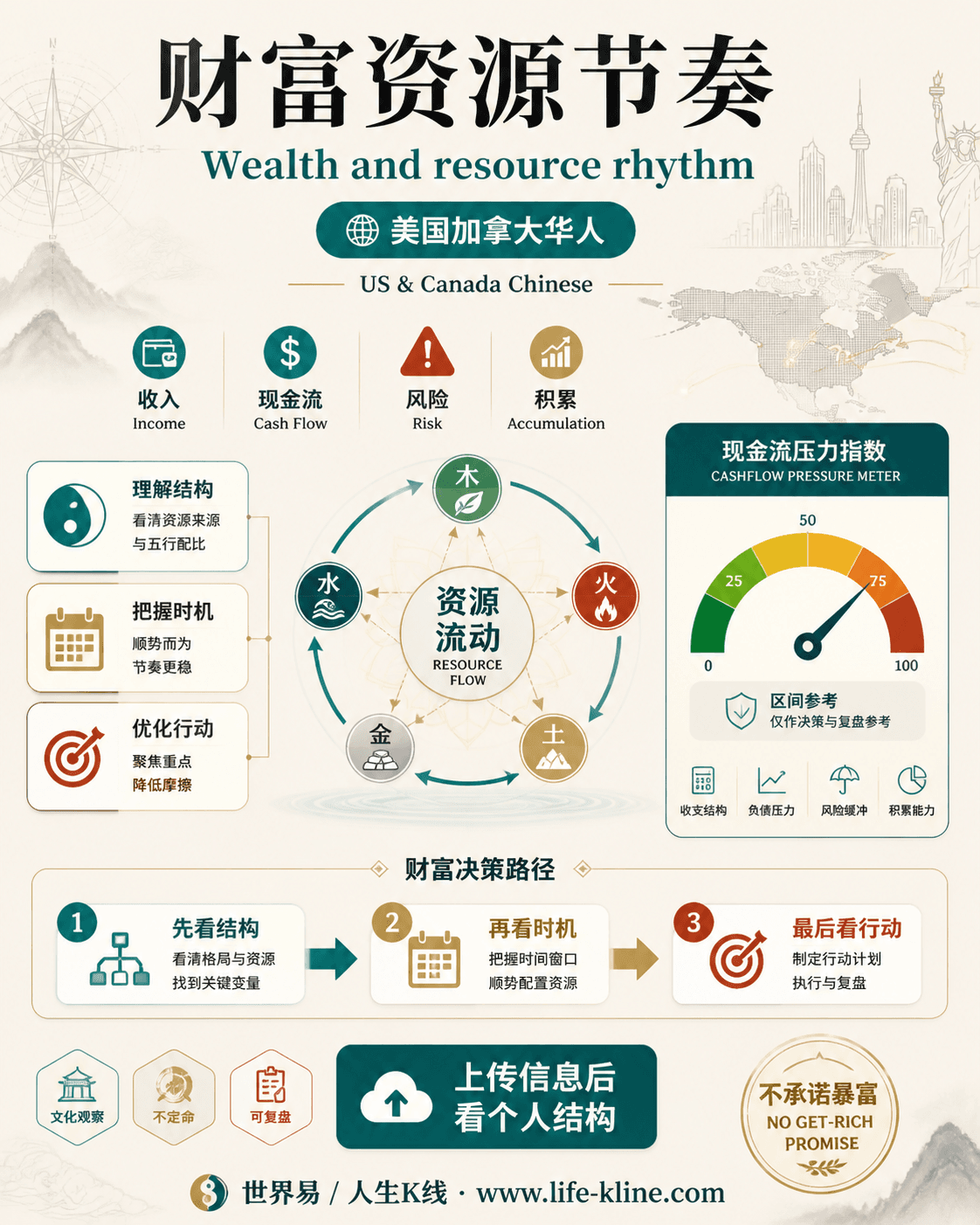
财富资源节奏|美国加拿大华人
这张图把《Analysis of the Optimal Time Window for Loans and Debts: The Metaphysical Connection between Da Yun, Liu Nian, and Financial Decisions》里的命理概念转成关系、边界和应用场景,适合先看图建立结构,再回到知识文章正文理解细节。
财富资源节奏不应被写成固定结论。更适合美国加拿大华人的读法,是把传统术语翻译成结构、时机、环境、行动和复盘。
查看图片解读