Metaphysical Assessment and Social Decision-Making Boundaries for Lending Money to Friends
把这篇文章落到自己身上验证:先看结构,再进入个人分析,不做泛泛阅读。
Why This Decision Is Especially Difficult in This Scenario
When friends borrow money, it involves a complex binding of money and friendship, with mutual expectations of reciprocity but hidden uncertainties about repayment and the cost of refusal. Emotional debts between people are often harder to settle than monetary debts, and family opinions and social pressures often exacerbate the psychological burden of decision-making.
In social dynamics, jealousy and trust intertwine. On one hand, borrowing money may be misinterpreted as a display of power or dependence, triggering social comparisons and internal anxiety; on the other hand, the expectation of reciprocity in friendship makes refusing help a test of the relationship, potentially leading to tension.
In BaZi structure, Bi Jian (Peer) represents the friend star, Shi Shen (Eating God) governs expression and release, Cai (Wealth) stars correspond to social debts and wealth flow, while Guan Sha (Officer and Seven Killings) imply external pressure and responsibility. In lending decisions, the combination of these Ten Gods amplifies or suppresses the dual risks of money and emotion, influencing rational judgment and boundary setting.
Moreover, changes in Da Yun (decade luck) and Liu Nian (annual fortune) dynamically affect the chart’s state, influencing an individual’s tolerance and coping strategies for social risks. This makes lending decisions not only emotional issues but also complex processes of rhythm control and risk management.
Three Core Dimensions of Metaphysical Assessment
The relationship between the Day Master and Bi Jian (Peer) is a core dimension in the scenario of friends borrowing money. Bi Jian symbolizes the sharing and competition of friendship resources, while the strength of the Day Master determines an individual’s psychological capacity and initiative. A relatively weak Day Master tends to feel more pressure, whereas a strong Day Master may take on more responsibility proactively.
Shi Shen (Eating God) represents expression and emotional release, also indicating verbal communication and emotional appeals during borrowing requests. Those with Shi Shen patterns usually have strong expressive desires, making their borrowing requests clear but easily driven by emotions, requiring attention to balance rationality and feelings.
Cai (Wealth) stars relate to social debts and cash flow, directly symbolizing lending money. Individuals with Zheng Cai (Direct Wealth) patterns emphasize clear accounts and defined responsibilities when lending. Guan Sha (Officer and Seven Killings) represent external pressures, possibly from family or social environments, affecting risk perception and pressure management in lending decisions.
Additionally, Da Yun and Liu Nian influence the current fortune rhythm. Stable Da Yun encourages maintaining status quo, while flexible Liu Nian require adaptive adjustments in assistance levels. The clash and combination relationships between Yong Shen (favorable elements) and Ji Shen (unfavorable elements) also highlight key risk points in emotional and financial entanglements.
Three Real BaZi Chart Cases
Case 1: Female, age 25-30, Day Master Jia Wood (甲 Jia) relatively weak, Zheng Cai pattern, Yong Shen Earth, Ji Shen Fire, currently in the 9th year of Xin Chou (辛丑 Xin Chou) Da Yun, Bing Wu (丙午 Bing Wu) Liu Nian. The Jia Wood Day Master is relatively weak; the Zheng Cai pattern emphasizes financial responsibility and reasonable social debts. Earth as Yong Shen supports stabilizing the financial foundation. The current Da Yun is stable, but the Liu Nian requires flexible adaptation. Lending should be strictly limited to avoid emotional fluctuations and pressure accumulation caused by the Ji Shen Fire. In lending decisions, it is recommended to first assess the borrower’s willingness and ability to repay, clearly define lending boundaries, and avoid blurred responsibilities due to emotional involvement. Judgment sequence: first confirm the borrower’s repayment plan and own tolerance, then combine Da Yun and Liu Nian to judge timing, reducing involvement or setting clear conditions if necessary.
Case 2: Male, age 55-60, Day Master Bing Fire (丙 Bing) relatively strong, Shi Shen pattern, Yong Shen Water and Metal, Ji Shen Wood, currently in the 4th year of Jia Shen (甲申 Jia Shen) Da Yun, Bing Wu (丙午 Bing Wu) Liu Nian. The Bing Fire Day Master is relatively strong; the Shi Shen pattern is good at expression and communication, but the Ji Shen Wood may bring external interference. Yong Shen Water and Metal help regulate emotions and resource flow. This chart shows strong initiative and expressive ability in lending to friends and can bear a higher level of assistance, but must be cautious of external pressures and family opinions. Decision-making should emphasize reasonable communication and boundary setting to avoid family conflicts caused by over-involvement. Judgment sequence: first assess own resources and family attitudes, combine Liu Nian’s flexible rhythm, provide appropriate help, and clarify boundaries when necessary.
Case 3: Male, age 50-55, Day Master Ding Fire (丁 Ding) balanced, Bi Jian pattern, Yong Shen Earth, Ji Shen Water, currently in the 9th year of Ren Yin (壬寅 Ren Yin) Da Yun, Bing Wu (丙午 Bing Wu) Liu Nian. The Ding Fire Day Master is balanced, representing stable self-energy; the Bi Jian pattern indicates both support and competition among friends. Yong Shen Earth helps stabilize, while Ji Shen Water may bring emotional fluctuations. This chart is suitable for maintaining a moderate attitude in lending decisions, able to help moderately while setting reasonable boundaries to avoid negative emotions eroding friendship. Decision-making should focus on the borrower’s integrity and own emotional changes, avoiding overreactions caused by emotional fluctuations. Judgment sequence: first confirm the true needs and repayment willingness of the borrowing friend, combine Da Yun and Liu Nian to assess risks, and adjust assistance level timely.
Common Misjudgments and Blind Spots in This Scenario
Many people easily fall into emotional blackmail when friends borrow money, neglecting the balance between financial risk and psychological consumption. Especially with relatively weak Day Masters or obvious Ji Shen in the chart, it is easier to lose rationality under emotional burdens, leading to excessive lending or inner torment after refusal.
Another blind spot is ignoring the rhythm influence of Da Yun and Liu Nian. Being blindly aggressive during stable Da Yun or blindly conservative during flexible Liu Nian may miss reasonable judgment timing and increase social risks.
Some overly rely on expressive ability (strong Shi Shen) but neglect financial responsibility, resulting in overly emotional borrowing requests that easily cause misunderstandings and trust crises. Conversely, charts with strong Bi Jian or Jie Cai (Peer and Rob Wealth) without boundary awareness may lead to excessive resource sharing and damage friendships.
Lastly, family opinions and social comparisons are often underestimated. Especially when Guan Sha combinations are obvious, external pressure may become a significant variable in decision-making. Ignoring this can bring additional psychological and relational costs.
Practical Judgment Sequence
Step one: Verify the authenticity of the borrowing request and the borrower’s willingness to repay. Combine the chart’s Cai (Wealth) stars and Bi Jian/Jie Cai strength to assess the borrower’s credit risk and own resource capacity. For relatively weak Day Masters or obvious Ji Shen, priority should be given to confirming the repayment plan to avoid blind investment.
Step two: Combine Da Yun and Liu Nian to judge the current fortune rhythm. Stable Da Yun is suitable for maintaining status quo and avoiding large loans; flexible Liu Nian require adaptive adjustment of assistance level, timely refusal or setting limits to prevent risk expansion.
Step three: Pay attention to emotional and psychological consumption, especially for charts with strong Shi Shen or obvious Guan Sha, and beware of irrational decisions driven by emotions. If necessary, set clear lending agreements to maintain the health and stability of both parties’ relationship.
In summary, lending decisions require integrating metaphysical rhythms with real social dynamics, setting rational limits to avoid long-term burdens caused by friendship debts. When involving money and legal issues, always seek professional channels to protect rights.
FAQ
Question 1: How do Yong Shen and Ji Shen in the chart affect lending decisions? Answer: Yong Shen represents the chart’s regulating power, which can alleviate pressure and risks, helping stabilize lending relationships; Ji Shen are factors that may cause conflicts and emotional fluctuations. When lending, one should be cautious of emotional entanglements or repayment risks triggered by Ji Shen.
Question 2: Why is the strength of the Day Master important for lending decisions with friends? Answer: The Day Master’s strength reflects an individual’s psychological capacity and initiative. Those with a weak Day Master tend to feel more pressure and burden when lending, requiring more cautious limits; those with a strong Day Master may take on more risks but should avoid over-investment leading to resource depletion.
Question 3: What role do Da Yun and Liu Nian play in social decision-making? Answer: Da Yun and Liu Nian reflect the current fortune rhythm and balance state of the chart owner. Stable Da Yun favors maintaining status quo and reducing risks; flexible Liu Nian indicate the need to adjust strategies adaptively to respond to sudden changes. Combining fortune analysis when lending can improve the timeliness and scientific nature of decisions.
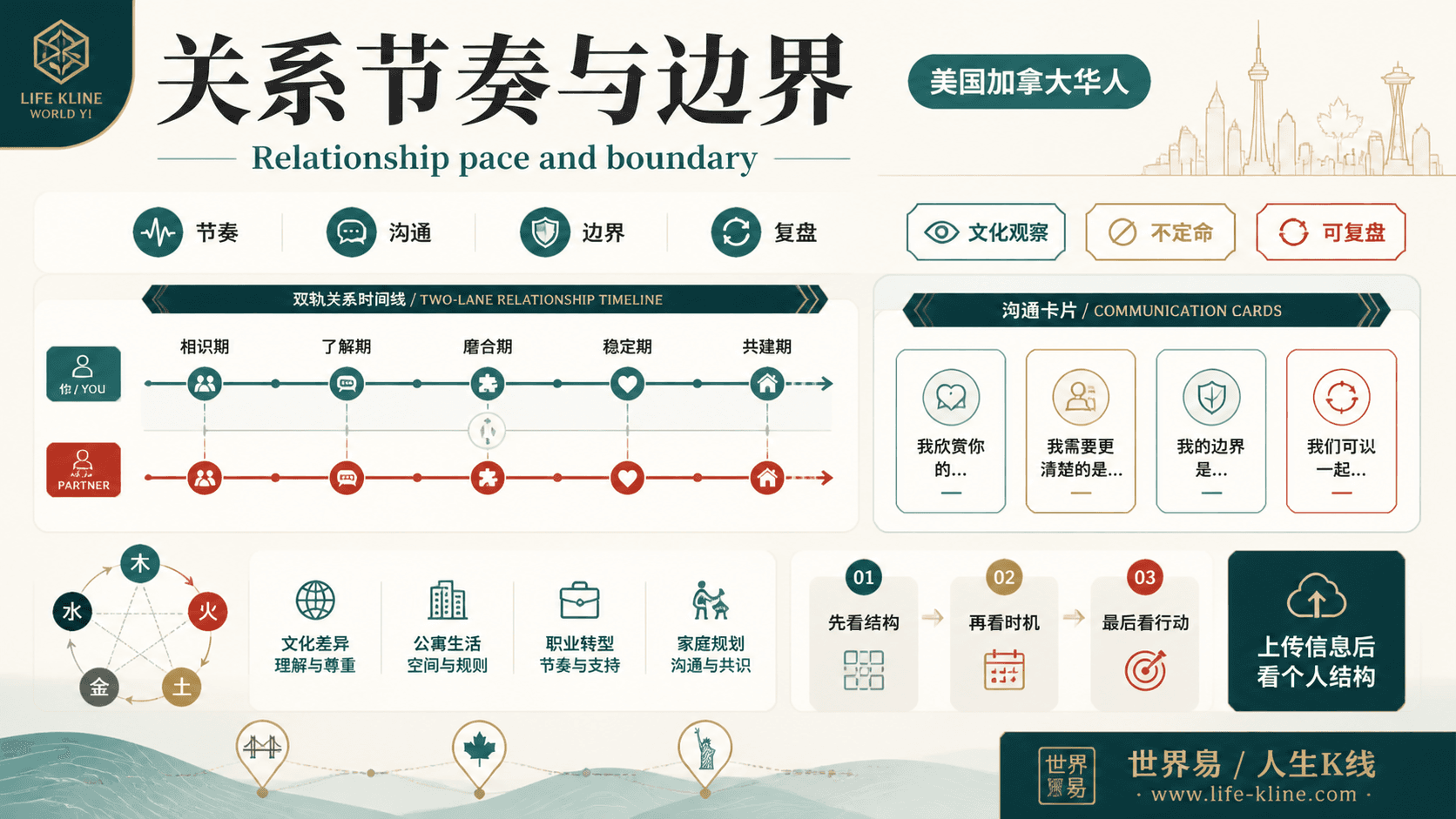
关系节奏与边界|美国加拿大华人
这张图把《Metaphysical Assessment and Social Decision-Making Boundaries for Lending Money to Friends》里的命理概念转成关系、边界和应用场景,适合先看图建立结构,再回到知识文章正文理解细节。
关系节奏与边界不应被写成固定结论。更适合美国加拿大华人的读法,是把传统术语翻译成结构、时机、环境、行动和复盘。
查看图片解读