Friends Borrowing Money and Social Obligations: A Metaphysical Guide to Investing in or Gradually Withdrawing from Relationships
把这篇文章落到自己身上验证:先看结构,再进入个人分析,不做泛泛阅读。
你现在搜索的,
其实是一个要落到自己身上的判断。
当前页面主要回答「Friendship」这类搜索问题;真正有价值的下一步是把这套结构带进自己的报告、工具与案例验证。
Why This Decision Is Especially Difficult in This Scenario
The scenario of friends borrowing money and social obligations essentially involves a complex intertwining of money and emotions. Lending money often brings repayment uncertainties, creating trust risks and psychological burdens. Refusing to lend may trigger tensions in social relationships and even affect the stability of the friend circle. Family members' opinions also intervene, increasing the tug-of-war between emotions and rationality, making the decision exceptionally complex.
From a social dynamics perspective, the binding of money and friendship amplifies interpersonal expectations of reciprocity and social comparison psychology. Lending and borrowing behaviors easily provoke jealousy and feelings of imbalance, especially when repayment schedules are unclear, leading to significant emotional exhaustion. At this time, the trust foundation and emotional investment in the friendship become key variables influencing the direction of subsequent interactions.
In BaZi structures, Bi Jian stars represent support and competition among friends and peers; Shi Shen stars reflect expression and emotional release; Cai Xing (Wealth Stars) relate to social obligations and material exchanges. The strength and combinations of these Ten Gods in different charts determine an individual's psychological endurance and coping strategies when facing friends borrowing money. For example, those with strong Bi Jian tend to proactively maintain relationships, but if Cai Xing is overly strong, they may bear heavier social debts.
The regulating effects of Da Yun (decade luck cycles) and Liu Nian (annual fortune) on chart energies cannot be ignored; they determine the stability and volatility of the current environment. In stable Da Yun periods, the cost of maintaining friendships is easier to bear, while Liu Nian clashes and combinations signal potential relationship fluctuations. In summary, decisions to invest in or withdraw from friendships involving borrowed money require a comprehensive consideration of social psychology and metaphysical rhythms to carefully weigh risks and benefits.
Three Core Dimensions in Metaphysical Judgment
First, the Day Master and Bi Jian stars. The Day Master represents the self; if it is relatively weak or strong, it affects the ability to withstand external pressures. Bi Jian stars symbolize support and competition among peers and friends; when strong, they facilitate mutual assistance of social resources but may also bring competition and emotional friction. In the context of friends borrowing money, those with strong Bi Jian are more likely to lend proactively but need to beware of being emotionally manipulated or overly depended upon by friends.
Second, Shi Shen stars and expression/communication. Shi Shen stars connect to emotional release and modes of expression; when flourishing, one is better able to resolve conflicts through communication and adjust the tension between money and friendship. If Shi Shen is weak or restrained, it may cause emotional buildup and misunderstandings, increasing the risk of relationship distancing. In borrowing scenarios, the strength of Shi Shen helps the lender express boundaries and aids the borrower in releasing emotional knots.
Third, Cai Xing stars and the burden of social obligations. Cai Xing represents wealth and material exchanges; if overly strong, it can create heavy social debts, intensifying repayment pressure and psychological burden. The controlling influence of Ji Shen (unfavorable elements) on Cai Xing also affects the controllability and risk exposure of social debts. Zheng Guan and Qi Sha stars often relate to external pressures and regulatory constraints, jointly influencing the social environment and family opinions involved in lending decisions.
Additionally, the interaction of Da Yun and Liu Nian imparts temporal rhythms to the chart; stable Da Yun favors preservation and relationship maintenance, while Liu Nian clashes and combinations warn of potential changes and conflicts. Combining these three dimensions with temporal analysis provides a more comprehensive understanding of metaphysical signals regarding investing in or gradually withdrawing from friendships when money is borrowed.
Three Real BaZi Chart Cases
Case 1: This male chart has a relatively weak Day Master Jia (甲, Wood), with a Pian Cai (偏财, Indirect Wealth) pattern; the Yong Shen (favorable element) is Water, and the Ji Shen (unfavorable elements) are Fire and Earth. He is currently in the Jia Yin (甲寅) Da Yun, with the Liu Nian being Bing Wu (丙午). The Bi Jian stars are not strong and the Day Master is weak, indicating limited capacity to bear pressure when friends borrow money. The Pian Cai pattern suggests many social debts related to finances. The stable Da Yun is favorable for maintaining status quo, but the Liu Nian Bing Wu, with strong Fire as Ji Shen, may bring emotional fluctuations and repayment pressure. In social interactions, there is a tendency to find it difficult to refuse increasing investment after lending, causing emotional burden. It is recommended to first verify friends’ sincerity in repayment and family support attitudes; cautiously increase investment only when reliability is confirmed, otherwise gradually withdraw to avoid unnecessary consumption.
Case 2: This female chart has a relatively strong Day Master Wu (戊, Earth) with a Yang Ren (羊刃) pattern; the Yong Shen are Wood and Water, and the Ji Shen is Fire. She is currently in the Gui Hai (癸亥) Da Yun, with the Liu Nian being Bing Wu (丙午). The Yang Ren pattern and strong Day Master give her strong self-protection and coping abilities. Bi Jian stars (Jia Yin in the year pillar) indicate strong mutual assistance and competitive dynamics among friends. The Yong Shen Wood and Water help regulate emotions and communication, and the Da Yun is auspicious, allowing her to act in harmony with the environment. When facing borrowing requests, she can rationally evaluate the value of investing in maintaining relationships and has strong ability to express refusal. It is advised that within reasonable social debt limits, she may moderately increase investment but remain vigilant against potential emotional conflicts brought by the Ji Shen Fire, and withdraw gradually when necessary to protect her own interests.
Case 3: This female chart has a balanced Jia (甲, Wood) Day Master, a Pian Cai pattern, Yong Shen Fire, and Ji Shen Metal. She is currently in the Jia Wu (甲午) Da Yun, with the Liu Nian being Bing Wu (丙午). The Bi Jian stars are relatively strong and the Day Master stable, showing she has strong support and competitive vitality among friends. The Pian Cai pattern means she bears considerable responsibility in social debts, but the Yong Shen Fire helps emotional expression and release, facilitating communication to resolve conflicts arising from borrowing. Both Da Yun and Liu Nian are stable, favorable for maintaining status quo. In social interactions, she has a strong sense of boundaries and adjustment ability, suitable for flexibly adjusting investment based on actual repayment and friends’ attitudes. It is recommended to first assess financial risks and friends’ credibility, and if necessary, gradually withdraw through clear communication to avoid dual emotional and economic exhaustion.
Common Misjudgments and Blind Spots in This Scenario
Firstly, a common misjudgment is to completely bind friendship and money, ignoring differences in psychological endurance between parties. In BaZi, strong Bi Jian stars do not imply unconditional support; rather, competitive relationships may intensify friction, and blindly increasing investment can increase burdens. Neglecting the expressive power of Shi Shen stars may lead to emotional suppression and increase the risk of relationship deterioration.
Secondly, mistakenly assuming that strong Cai Xing stars necessarily mean bearing more social debts, overlooking the balancing effects of Yong Shen and Ji Shen on Cai Xing. Lack of understanding of Da Yun and Liu Nian rhythms can lead to impulsive decisions at inopportune times, causing friendship breakdown or financial loss.
Also, overreliance on metaphysical rhythms while neglecting real-world factors such as family opinions and legal risks. Friends borrowing money involves multiple interests and significant psychological consumption; BaZi serves only as auxiliary reference and cannot replace professional psychological counseling and legal channels, especially in repayment disputes.
Finally, ignoring personal boundaries and the importance of communication. BaZi structures only indicate potential risks; actual decisions must consider emotional states and social environments to avoid emotional-driven misjudgments.
Practical Judgment Sequence
Step one: Assess the strength of Bi Jian stars and the Day Master’s endurance to judge your support and tolerance capacity in friendships. Those with strong Bi Jian and strong Day Master are suitable for proactive maintenance and have abundant interpersonal resources; those with weak Bi Jian or Day Master should cautiously increase investment to avoid emotional manipulation.
Step two: Focus on the condition of Shi Shen stars to evaluate communication smoothness. Those with flourishing Shi Shen can effectively define social debts and emotional boundaries, suitable for adjusting investments through communication; those with restrained Shi Shen should avoid emotional buildup and seek third-party support if necessary.
Step three: Combine the strength of Cai Xing and the relationship between Yong Shen and Ji Shen to determine financial risk and social debt burden. When Cai Xing is strong, Yong Shen supportive, and Da Yun and Liu Nian stable, moderate investment is possible; otherwise, prioritize risk control and gradually withdraw to avoid excessive consumption.
In practice, it is recommended to first clarify repayment plans and friends’ sincerity, integrate family opinions to make rational judgments, and clearly refuse when necessary to avoid relationship deterioration. BaZi serves as a supplementary rhythm reference, not an absolute prediction; when money and legal disputes are involved, always follow formal procedures.
FAQ
Question 1: Does having strong Bi Jian stars mean you must help friends by lending money? Answer: Strong Bi Jian stars represent friend support and competition, indicating abundant interpersonal resources but not unconditional help. Decisions should consider the strength of the Day Master and the burden of Cai Xing, making rational judgments to avoid emotional manipulation and excessive consumption.
Question 2: Does weak Shi Shen affect communication during borrowing? Answer: Yes. Shi Shen stars relate to expression and emotional release; when weak or restrained, emotional suppression and misunderstandings are likely, causing poor communication during borrowing and increasing the risk of relationship breakdown. It is recommended to improve communication skills or seek third-party assistance.
Question 3: How to use Da Yun and Liu Nian to judge relationship trends after lending money? Answer: Da Yun and Liu Nian reflect metaphysical rhythms; stable Da Yun favors preservation and maintenance, while Liu Nian clashes and combinations warn of potential risks and changes. Observing these temporal changes in the specific chart helps judge whether to increase investment or gradually withdraw.
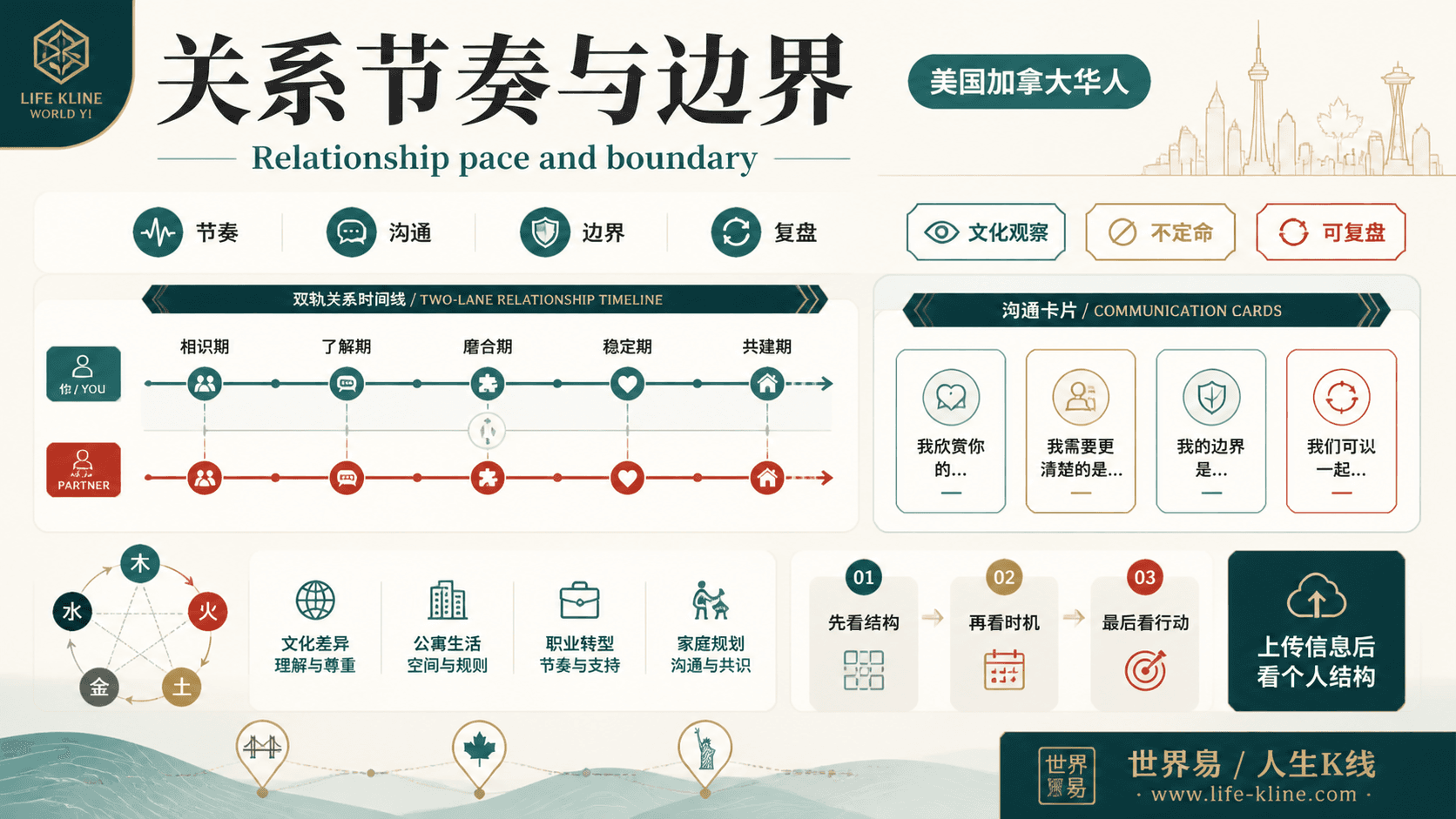
关系节奏与边界|美国加拿大华人
这张图把《Friends Borrowing Money and Social Obligations: A Metaphysical Guide to Investing in or Gradually Withdrawing from Relationships》里的命理概念转成关系、边界和应用场景,适合先看图建立结构,再回到知识文章正文理解细节。
关系节奏与边界不应被写成固定结论。更适合美国加拿大华人的读法,是把传统术语翻译成结构、时机、环境、行动和复盘。
查看图片解读