Analysis of Optimal Rhythm and Cycle Decisions for Bonds and Interest Rate Products
把这篇文章落到自己身上验证:先看结构,再进入个人分析,不做泛泛阅读。
Why This Decision Is Especially Difficult in This Category
The difficulty in investment decisions for bonds and interest rate products lies in precisely grasping changes in interest rate cycles and credit risk. Although categories such as government bonds, corporate bonds, and convertible bonds generally have relatively good liquidity, they are heavily influenced by macroeconomic conditions, monetary policies, and credit environments, making duration management particularly critical. Fluctuations in interest rate cycles directly affect bond prices, requiring investors to adjust positions across different cycles to both avoid the risk of rising interest rates and not miss earning opportunities.
Fee structures and tax factors within market frameworks further complicate decision-making. Bond trading fees are relatively low, but frequent position adjustments incur significant tax costs. Additionally, regulatory policy changes may impact credit risk assessments for corporate bonds, increasing uncertainty in asset allocation. Investors often chase short-term volatility while neglecting cyclical patterns, leading to frequent operations and unstable returns.
From a metaphysical perspective, the rhythm and cycles of bond investment can be assisted by analyzing combinations of Cai Xing (Wealth Stars), Bi Jian (Peer Stars), and Yin Xing (Resource Stars) within Da Yun and Liu Nian. Cai Xing represents wealth flow, Yin Xing reflects resources and support, and Bi Jian relates to competition and risk sharing. Properly integrating metaphysical rhythms with market cycles helps rationally assess entry and exit timing, avoiding blind following or excessive conservatism.
In summary, optimal rhythm and cycle decisions for bonds and interest rate products require multidimensional consideration of market liquidity, credit risk, interest rate trends, and personal metaphysical rhythms to improve success rates and effectively control risks.
Three Core Dimensions of Metaphysical Judgment
First is the relationship between the Day Master and Cai Xing (Wealth Star). Bond investment essentially involves steady wealth accumulation; the strength of the Day Master determines the investor’s control over capital, while Cai Xing represents wealth inflow and opportunities. In the bond market, when Cai Xing is strong and well-supported, it indicates a favorable environment for wealth accumulation, suitable for increasing positions; otherwise, caution is advised.
Second is the relationship between Bi Jian (Peer Stars) and shared risk. Bi Jian, as stars of the same category, embody support and competition, influencing the investor’s ability to handle market fluctuations. When Bi Jian is strong, investors tend to be in sync with the market, effectively sharing risks through cooperation or diversification to reduce single credit risk; when weak, investors may be isolated and need to strengthen risk management.
Lastly, the interaction of Da Yun (decade luck cycles) and Liu Nian (annual fortunes) involves clash and combination dynamics. Da Yun represents medium- to long-term trends, while Liu Nian corresponds to the current year’s market environment. A stable Da Yun with a strong Yong Shen indicates a relatively favorable cycle for stable holdings; if Liu Nian shows clashes, it signals the need for flexibility and timely position adjustments. The rhythm of clash and combination serves as an auxiliary signal for bond investment entry and exit, indicating risks or opportunities.
These three dimensions complement each other and, combined with actual changes in market interest rate cycles and credit risk, provide comprehensive assistance to investors in grasping the optimal rhythm and cycle for bond investments.
Three Real Birth Chart Cases
Case 1: This female’s BaZi chart has a Day Master of Gui Water (癸, Gui), balanced, with a Qi Sha (Seven Killings) pattern. The Yong Shen is Metal, and the Ji Shen (unfavorable element) is Earth. She is currently in the 3rd year of the Bing Zi (丙子, Bing Zi) Da Yun—a stable cycle suitable for preservation—with the Liu Nian of Bing Wu (丙午). The Gui Water Day Master represents gentle capital flow; Metal as Yong Shen supports capital consolidation and transformation; Earth as Ji Shen should be avoided to prevent excessive burden. In bond investment, the stable nature of the Bing Zi Da Yun aligns with a market environment of relatively low interest rates and controllable credit risk, suitable for steady holdings of government bonds and high-grade corporate bonds, avoiding chasing high-risk products. The Bing Wu Liu Nian brings signals for adaptive flexibility, advising attention to short-term interest rate or credit environment fluctuations. It is recommended that this investor maintain positions during the Da Yun’s dominant steady cycle and moderately adjust duration and credit quality during Liu Nian fluctuations to control risk. Market-wise, focus on mid- to short-duration bonds during interest rate downtrends and avoid credit deterioration risks caused by excessive Earth (Ji Shen).
Case 2: This female’s BaZi chart has a Day Master of Bing Fire (丙, Bing), relatively weak, with a Bi Jian (Peer Star) pattern. The Yong Shen is Wood, and the Ji Shen are Earth and Metal. She is currently in the 4th year of the Gui Si (癸巳, Gui Si) Da Yun—a stable cycle suitable for preservation—with the Liu Nian of Bing Wu (丙午). The relatively weak Bing Fire Day Master reflects limited capital vitality; the Bi Jian pattern indicates a tendency towards peer competition and cooperation; Wood as Yong Shen represents growth and support; Earth and Metal as Ji Shen indicate adverse credit risk and capital transformation factors. In the bond market, the stable nature of the Gui Si Da Yun combined with the Bing Wu Liu Nian suggests the investor should remain cautious and avoid high leverage and high credit risk products. Limited capital vitality implies delayed responses to interest rate cycle changes. It is advised to focus on high-grade bonds and convertible bonds, leveraging Wood’s growth characteristics to identify potential targets while avoiding risks brought by Ji Shen. Operationally, emphasize buying windows at the early stages of interest rate declines and avoid increasing positions during Liu Nian periods of rising rates.
Case 3: This male’s BaZi chart has a Day Master of Jia Wood (甲, Jia), balanced, with a Jie Cai (Rob Wealth) pattern. The Yong Shen is Water, and the Ji Shen is Metal. He is currently in the 7th year of the Geng Xu (庚戌, Geng Xu) Da Yun—a relatively weak cycle requiring cautious action—with the Liu Nian of Bing Wu (丙午). The Jia Wood Day Master symbolizes growth and expansion; the Jie Cai pattern shows strong abilities in competition and risk sharing in the market; Water as Yong Shen supports capital flow; Metal as Ji Shen represents capital pressure and potential risks. The relatively weak Geng Xu Da Yun indicates an overall low fortune, demanding cautious operations. Within the bond market environment, the investor should focus on interest rate rise risks and credit deterioration, avoiding blind position increases. The Bing Wu Liu Nian offers signals for adaptive flexibility, urging close attention to market risks. It is recommended that this investor focus on short-duration bonds and high-grade credit bonds, reasonably allocate liquidity, and promptly adjust positions to respond to interest rate cycle fluctuations, avoiding exposure to interest rate risks from long-duration bonds.
These three cases demonstrate how different Day Masters and patterns, combined with varying Yong Shen and Ji Shen, influence the rhythm and cycle of bond investments. The stability of Da Yun determines medium- to long-term holding strategies, while Liu Nian signals short-term risks or opportunities. Investors should flexibly adjust according to market interest rate and credit cycles.
Common Misjudgments and Blind Spots in This Category
One common misjudgment in bond and interest rate product investments is ignoring the phase characteristics of interest rate cycles, blindly chasing highs or panic selling. Interest rate cycles have intrinsic rhythms; metaphysical Da Yun and Liu Nian can assist in grasping this rhythm, but relying solely on metaphysical signals while neglecting macroeconomic and policy environments can easily lead to misjudgments.
Secondly, investors often underestimate the cumulative effect of credit risk, especially during economic downturns when default risks for some corporate bonds increase, affecting overall portfolio performance. The Ji Shen in metaphysics represents risks that must be combined with actual market credit ratings and capital structures to form effective judgments.
Moreover, overreliance on the power of Bi Jian stars, blindly pursuing scale expansion, neglects the importance of risk diversification. Bond investment emphasizes steadiness; appropriate risk sharing and allocation adjustments are more critical than merely increasing investment size.
Finally, ignoring fee and tax costs leads to frequent position adjustments that erode returns. Metaphysics provides rhythm references and should be combined with actual market operation rhythms to avoid additional burdens caused by frequent trading.
Practical Judgment Sequence
First, confirm the nature of the current Da Yun and the state of the Yong Shen. A stable Da Yun with a strong Yong Shen indicates the investor is in a relatively favorable medium- to long-term cycle, suitable for maintaining or moderately increasing bond positions, especially products with high credit ratings and moderate durations. If the Da Yun is weak or Ji Shen is strong, risk awareness should be heightened, durations shortened, and liquidity reserves increased.
Second, combine Liu Nian with the current year’s macroeconomic environment to judge whether short-term fluctuations in interest rates or credit risk signals appear. The clash and combination relationships in Liu Nian reflect adaptability; when Liu Nian involves clashes, flexible adjustment strategies are recommended, such as timely position reduction or switching, to avoid losses from sudden market changes.
Finally, adjust risk tolerance based on the strength of the Day Master and Bi Jian stars. When Bi Jian is strong, investors can appropriately use peer capital to diversify credit risk and actively seize market opportunities; when weak, caution is advised to avoid excessive exposure to credit and interest rate risks. Overall operations should integrate market data with metaphysical rhythms to ensure rhythm and cycle alignment, enhancing investment success rates.
Always remember, investment involves risks; metaphysics serves only as a rhythm-assisting reference and cannot replace professional financial advice.
FAQ
Question 1: How to determine if the Da Yun and Liu Nian are suitable for increasing bond positions? Answer: Focus on whether the Da Yun is stable and the Yong Shen is strong, indicating a favorable medium- to long-term market environment with lower risks for increasing positions. If Liu Nian shows clashes, exercise caution, monitor short-term market fluctuations, and adjust positions timely.
Question 2: How does Ji Shen in metaphysics correspond to market risks? Answer: Ji Shen typically represents unfavorable factors such as credit risk and capital pressure. In bond investment, when Ji Shen is strong, pay close attention to credit rating downgrades and rising interest rate risks, moderately reduce positions, control durations, and enhance portfolio risk resilience.
Question 3: What impact does the strength of Bi Jian stars have on bond investment decisions? Answer: Strong Bi Jian stars symbolize peer capital support and risk sharing, helping to diversify credit risk and improve market responsiveness; weak Bi Jian indicates insufficient risk-bearing capacity, advising investors to be more cautious and avoid over-concentration in high-risk bonds.
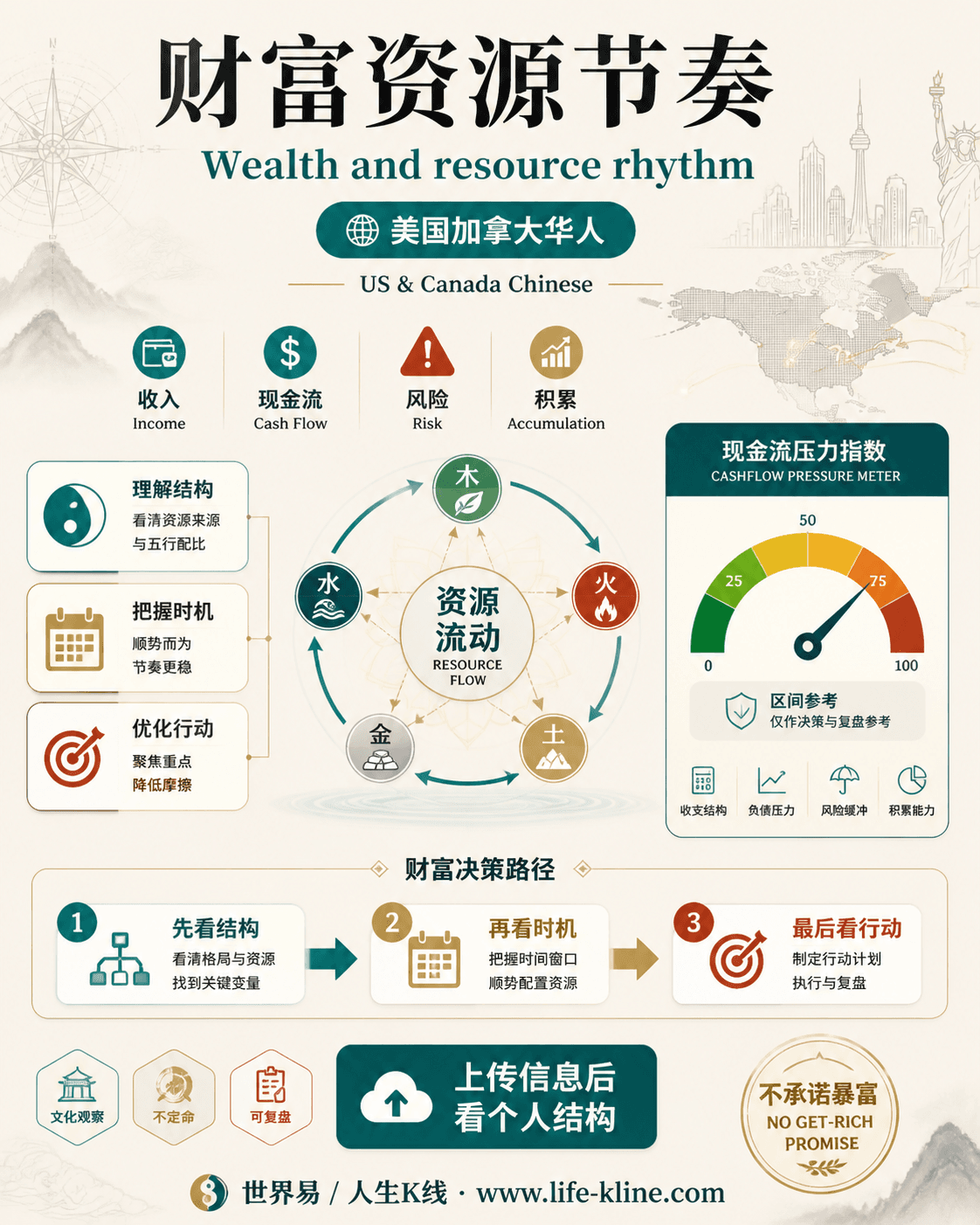
财富资源节奏|美国加拿大华人
这张图把《Analysis of Optimal Rhythm and Cycle Decisions for Bonds and Interest Rate Products》里的命理概念转成关系、边界和应用场景,适合先看图建立结构,再回到知识文章正文理解细节。
财富资源节奏不应被写成固定结论。更适合美国加拿大华人的读法,是把传统术语翻译成结构、时机、环境、行动和复盘。
查看图片解读