Should Overseas Chinese in Australia and New Zealand Return Home or Stay: Decision Analysis Based on Migration Palace and Da Yun
把这篇文章落到自己身上验证:先看结构,再进入个人分析,不做泛泛阅读。
你现在搜索的,
其实是一个要落到自己身上的判断。
当前页面主要回答「Overseas Chinese」这类搜索问题;真正有价值的下一步是把这套结构带进自己的报告、工具与案例验证。
Why This Scenario Is Especially Difficult for Overseas Chinese
When overseas Chinese in Australia and New Zealand face the question of whether to return to their home country or continue staying locally, they are usually constrained by multiple practical factors. First, career development opportunities and stability often present a dilemma: familiarity with the local market and career space contrasts sharply with the rapidly developing domestic economic environment. Second, emotional pressure from family distance and the cost of cross-border living, combined with differences in identity and tax policies, further complicate the decision-making process.
Cultural differences and lifestyle adaptations also make the choice between returning home or staying more than just an economic consideration. Overseas Chinese often seek a balance between two cultures, and the Migration Palace in BaZi reflects the Day Master's adaptability and change trends in different environments, which is particularly important in overseas decision-making.
The metaphysical structure itself, such as the strength or weakness of the Day Master, the Yong Shen (favorable element), and the influence of Da Yun and Liu Nian (annual fortune) on migration, is often magnified or suppressed in overseas environments. For example, whether the Yong Shen is supported in the local environment directly affects the Day Master's career development and family relationships, thereby influencing the decision to return or stay.
Therefore, when weighing whether to return home or remain overseas, Australian and New Zealand Chinese must consider not only practical economic and identity issues but also combine the Migration Palace and Da Yun metaphysical characteristics to scientifically judge the best timing for action suited to their current BaZi chart status.
Three Core Dimensions of Metaphysical Judgment
First is the Day Master and the chart structure. The Day Master represents the intrinsic energy strength of the individual, relating to adaptability and internal motivation. Structures such as Qi Sha (Seven Killings) pattern, Shang Guan (Hurting Officer) pattern, Shi Shen (Eating God) pattern, etc., reflect how the individual handles external environments and latent resources. When making migration decisions, Australian and New Zealand Chinese need to assess their own stress resistance and flexibility based on the Day Master's strength.
Second are the Yong Shen (favorable element) and Ji Shen (unfavorable element). Yong Shen harmonizes the chart and brings smoothness, while Ji Shen represents obstacles. The degree of support the Migration Palace provides to the Yong Shen in the BaZi chart directly influences the Day Master's life and career status in a foreign place, determining whether migration or staying is suitable.
Lastly, Da Yun (decade luck cycle) and Liu Nian (annual fortune) are crucial. Da Yun reveals the energy changes over ten-year periods, while Liu Nian reflects the environmental adaptability of the current year. The current Da Yun phase for many Australian and New Zealand Chinese is often stable, suitable for maintaining the status quo, but Liu Nian such as the Bing Wu (丙午) year brings change factors, requiring combined judgment with the Migration Palace on whether it is appropriate to act.
The palace environment is also key, especially the interaction between the Migration Palace, Career Palace, and Family Palace. If the Migration Palace is supported by the Yong Shen and the Da Yun and Liu Nian are favorable, it is suitable to act; otherwise, waiting is advised. Additionally, real factors such as identity, taxation, and cross-border capital flow for Australian and New Zealand Chinese interact with metaphysics, creating unique decision-making scenarios.
Three Real BaZi Chart Cases
Case 1: This female's Day Master is Ding Fire (丁火) and relatively weak, belonging to the Qi Sha (Seven Killings) pattern. Her Yong Shen is Wood, and Ji Shen are Earth and Metal. She is currently in the Wu Yin (戊寅) Da Yun (ages 44-53), which is a stable period suitable for maintaining status quo. The Liu Nian is Bing Wu (丙午), bringing opportunities for adaptability. In the reality of Australian and New Zealand Chinese, she faces a tug-of-war between career stability and family responsibilities. Since Ding Fire is weak and requires Wood to generate and assist, if the Migration Palace contains sufficient Wood elements, migration could bring career breakthroughs. However, if the Ji Shen Earth and Metal are intensified in the migration environment, it would hinder development. Considering the stable Da Yun, it is recommended to observe Liu Nian changes first, seeking migration timing cautiously and avoiding rash decisions.
Case 2: This female's Day Master is Yi Wood (乙木) and relatively weak, with a Shang Guan (Hurting Officer) pattern. Her Yong Shen is Water, and Ji Shen are Fire and Earth. She is in the Xin Si (辛巳) Da Yun (ages 44-53), also a stable period. The Liu Nian is Bing Wu (丙午), bringing variability. In reality, Yi Wood's weakness and the presence of Yong Shen Water in the Migration Palace can enhance her adaptability and resource flow, benefiting cross-border capital and identity conversion. However, if Ji Shen Fire and Earth are intensified in the new environment, family stability and career development could be obstructed. Given the stable Da Yun, it is advised to act prudently within the opportunity window brought by Liu Nian, prioritizing assessment of Yong Shen support in the Migration Palace.
Case 3: This male's Day Master is Geng Metal (庚金) and relatively weak, with a Shi Shen (Eating God) pattern. His Yong Shen is Earth, and Ji Shen are Water and Wood. He is currently in the Bing Xu (丙戌) Da Yun (ages 34-43), a stable period, with Liu Nian Bing Wu (丙午) bringing change. In this chart, Earth as Yong Shen, if strengthened in the Migration Palace, can stabilize career and identity and improve adaptability to cross-border taxation and exchange rate fluctuations. However, if Ji Shen Water and Wood are active in the migration environment, adverse effects may arise. In reality, this male is in a career growth phase with increasing family responsibilities. Migration decisions should combine Da Yun and Liu Nian, choosing periods when the Yong Shen is strong for action.
Common Misconceptions Among Overseas Chinese in This Scenario
Many Australian and New Zealand Chinese overly rely on short-term economic environment changes when deciding whether to return or stay, neglecting the influence of Da Yun and Liu Nian on migration timing. Ignoring the match between Yong Shen and Ji Shen leads to deterioration in career or family relationships after migration.
Some Day Masters simply interpret the Migration Palace as a geographic relocation without integrating the support of Da Yun, Liu Nian, and Yong Shen, resulting in blind actions. Consequently, due to environmental incompatibility or identity policy restrictions, life pressure and tax burdens increase.
Additionally, neglecting the intersection of family and identity is a common error. The Migration Palace often interacts with the Family Palace and Career Palace in BaZi. Failure to comprehensively evaluate these palace relationships easily results in one-sided decisions, causing difficulties in balancing career and family.
Practical Judgment Sequence
Step one: Prioritize clarifying the status of Yong Shen and Ji Shen in the current Migration Palace, judging whether the environment favors the Yong Shen and weakens the Ji Shen, ensuring the migration environment supports the Day Master's career and family development.
Step two: Combine the current Da Yun and Liu Nian to analyze whether it is a stable period for maintaining or a suitable window for action. Stable Da Yun suggests maintaining status quo, while Liu Nian changes may permit action but require comprehensive evaluation of their impact on the BaZi chart.
Step three: Consider practical factors such as identity, taxation, and family distance to judge whether migration causes cross-border capital or cultural adaptation obstacles, avoiding conflicts between metaphysics and reality that lead to decision errors. Based on the above, formulate a dynamic adjustment plan to act timely or wait for the best opportunity.
FAQ
Question 1: What role does the Migration Palace play in the decision to return home or stay? Answer: The Migration Palace reflects the Day Master's adaptability and change trends in foreign environments, helping to judge whether migration will be smooth and beneficial for career and family development.
Question 2: How do Da Yun and Liu Nian affect the migration decisions of Australian and New Zealand Chinese? Answer: Da Yun represents long-term trends, while Liu Nian reflects yearly changes. Together they determine the auspiciousness of migration timing. Stable Da Yun favors maintaining status quo, while Liu Nian changes provide actual windows for action.
Question 3: How to combine real cross-border factors with metaphysics for rational decisions? Answer: It is necessary to evaluate the impact of identity, taxation, exchange rates, and family distance on the Day Master's Yong Shen, ensuring the real environment supports the favorable elements in the BaZi chart to avoid migration failure due to practical obstacles.
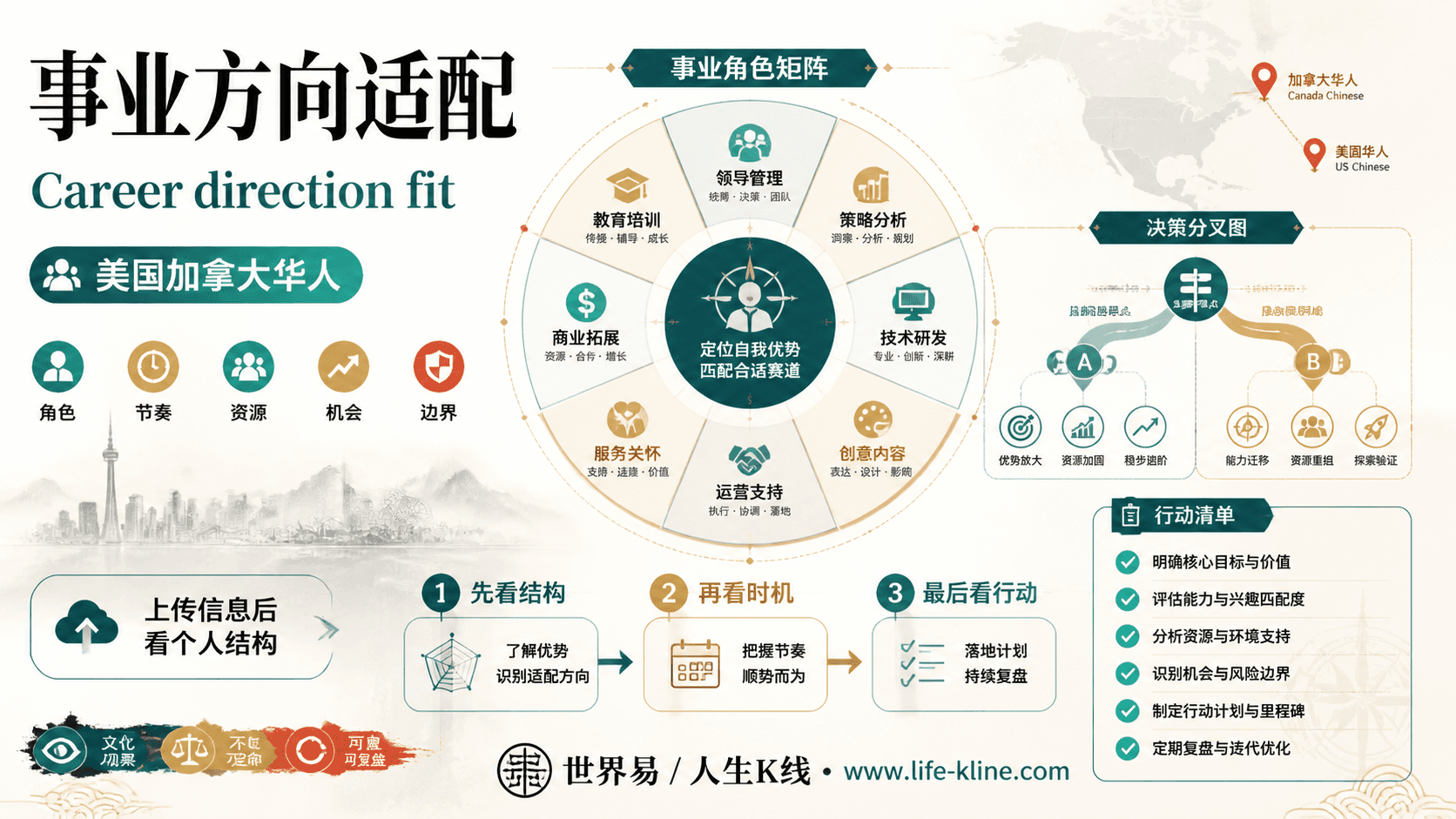
事业方向适配|美国加拿大华人
这张图把《Should Overseas Chinese in Australia and New Zealand Return Home or Stay: Decision Analysis Based on Migration Palace and Da Yun》里的命理概念转成关系、边界和应用场景,适合先看图建立结构,再回到知识文章正文理解细节。
事业方向适配不应被写成固定结论。更适合美国加拿大华人的读法,是把传统术语翻译成结构、时机、环境、行动和复盘。
查看图片解读