BaZi Analysis and Decision Guidance for Environmental Matching in Migration of Chinese in Australia and New Zealand
把这篇文章落到自己身上验证:先看结构,再进入个人分析,不做泛泛阅读。
Why This Scenario Is Especially Difficult for Overseas Chinese
Australia and New Zealand, as typical immigrant countries, present Chinese migrants with complex socio-economic structures and cultural environment differences. Migration involves not only identity changes, tax planning, cross-border capital flows, and managing family distances but also adapting to new languages, lifestyles, and social resources. These practical constraints make environmental matching a crucial and detailed decision for Chinese migrants.
Moreover, economic fluctuations, exchange rate changes, and frequent policy adjustments in Australia and New Zealand directly impact career opportunities and wealth accumulation for overseas Chinese. Different geographical environments and social atmospheres have obvious effects on the expression of individual BaZi patterns. A BaZi chart that is suitable in China may not perform advantageously in Australia or New Zealand; it might even be suppressed by environmental factors, increasing obstacles in life and career.
Cultural differences further complicate this challenge. Traditional Chinese metaphysics emphasizes the balance of the Five Elements and harmonizing the Yong Shen (favorable elements). However, natural climate, social customs, and interpersonal relationship patterns in Australia and New Zealand can either amplify or restrict the influence of the Yong Shen. BaZi judgments must integrate the real environment to maximize the advantages of the BaZi after migration.
Finally, factors such as family distance and cross-border tax arrangements often make migration decisions more complex. Even if a BaZi chart maintains strong career momentum, neglecting family reunion and financial stability can severely reduce the effectiveness of migration. A comprehensive consideration of BaZi and practical multidimensional factors is the core challenge in environmental matching for Chinese migrants in Australia and New Zealand.
Three Core Dimensions of BaZi Judgment
First, the Day Master and pattern form the foundation of BaZi analysis. The Day Master represents the individual's intrinsic energy, with its strength or weakness determining the overall energy level of the chart. Patterns such as Yang Ren (Yang Blade) or Shang Guan (Hurting Officer) reflect personality traits and potential conflicts or breakthroughs. In environmental matching for migration, it is essential to evaluate how the Day Master adapts and whether its energy is strengthened or weakened in the new environment.
Second, the matching of Yong Shen (favorable elements) and Ji Shen (unfavorable elements) is particularly critical. Yong Shen are the Five Elements that the BaZi chart needs to introduce or supplement, while Ji Shen are those to be avoided. In the Australia-New Zealand environment, climate, cultural atmosphere, and social resources significantly affect the support or restriction of the Yong Shen. For example, a water Yong Shen may be naturally amplified in a humid climate, whereas a fire Ji Shen could be pressured by a hot environment.
Third, the dynamic interaction between Da Yun (decade luck cycles) and Liu Nian (annual fortune) reflects the timing changes of the BaZi. Migration decisions often involve planning for several years of life and career. Understanding the auspicious or inauspicious trends of the current Da Yun and Liu Nian helps Chinese migrants determine the best timing for migration and anticipate potential challenges, avoiding blind actions or missed opportunities.
Additionally, the influence of palace positions indirectly affects the real-world manifestation of the BaZi. For instance, the Shi Zhu (Hour Pillar) represents late life and children. If migration causes family separation, it may suppress the Yong Shen related to the Hour Pillar, impacting family harmony and children’s fortune. Therefore, a comprehensive examination of the Day Master, Yong Shen, and Da Yun/Liu Nian is the BaZi core for environmental matching in migration for Chinese in Australia and New Zealand.
Three Real BaZi Case Studies
Case 1: This gentleman’s Day Master is Wu (戊, Earth), with a Yang Ren pattern, indicating a relatively strong Day Master. His Yong Shen are Wood and Water, and his Ji Shen is Fire. He is currently in the Yi Chou (乙丑) Da Yun (ages 21-30, auspicious luck) with the Liu Nian of Bing Wu (丙午) following the trend. Placed in the Australia-New Zealand environment, his strong Earth Day Master may be further stabilized by the dry local climate. The Wood Yong Shen requires an environment with good growth conditions, while the Water Yong Shen benefits from New Zealand’s humid climate but may be suppressed in some water-scarce areas of Australia. The Fire Ji Shen will not be overly amplified in mild climate regions. Migration advice should prioritize areas rich in water resources and with abundant Wood elements to avoid suppression of the Yong Shen. The judgment sequence should start with Yong Shen environmental matching, combined with auspicious Da Yun timing, selecting regions with suitable climate and resources.
Case 2: This lady’s Day Master is Yi (乙, Wood), relatively weak, with a Shang Guan (Hurting Officer) pattern. Her Yong Shen is Water, and Ji Shen are Fire and Earth. She is currently in the Xin Chou (辛丑) Da Yun (ages 46-55, stable luck) with the Liu Nian of Bing Wu (丙午) adapting flexibly. Her weak Wood Day Master needs strong Water nourishment. The humid environment of Australia-New Zealand, especially the water resource advantages of New Zealand’s South Island, is highly beneficial to her. Fire and Earth Ji Shen are strong in some inland areas of Australia, which may increase pressure on her BaZi. Migration should avoid regions with strong Fire and Earth and prioritize water-abundant, mild climates to supplement the Day Master. In the judgment sequence, focus on assessing the strength of Ji Shen environments, combined with the stable Da Yun characteristics; it is advisable to maintain stability and avoid drastic changes.
Case 3: This lady’s Day Master is Geng (庚, Metal), relatively strong, with a Yang Ren pattern. Her Yong Shen are Fire and Wood, and Ji Shen is Earth. She is currently in the Jia Chen (甲辰) Da Yun (ages 36-45, stable luck) with the Liu Nian of Bing Wu (丙午) adapting flexibly. Her strong Metal Day Master may be restricted by heavy Earth regions in Australia-New Zealand, where the Earth Ji Shen suppresses Metal’s energy flow, causing blockages. The Fire Yong Shen benefits from sunny areas in northern Australia, helping to balance the Five Elements, while the Wood Yong Shen requires green spaces or forested environments. Migration should prioritize regions rich in Fire and Wood elements with moderate Earth, avoiding Earth-heavy inland or plateau areas. The judgment sequence should first verify the environmental intensity of the Earth Ji Shen, then evaluate the supply of Fire and Wood Yong Shen resources, and combined with the stable Da Yun and Liu Nian, select a steady development environment.
Common Misconceptions Among Overseas Chinese in This Scenario
Many Chinese migrants in Australia and New Zealand overlook the interaction between BaZi and environment, making decisions solely based on economic conditions or living convenience, neglecting changes in Yong Shen and Ji Shen in the new environment, which leads to career bottlenecks or health problems after migration.
Another misconception is treating the auspiciousness or inauspiciousness of Da Yun or Liu Nian as the sole basis for action, without integrating specific geographical climate and social environment for a comprehensive judgment. Although Da Yun and Liu Nian are important, matching BaZi with the environment is the key to successful migration.
Some overly rely on the strong characteristics of patterns like Yang Ren, ignoring possible environmental impacts. Especially in the multicultural and frequently policy-changing context of Australia and New Zealand, an overly strong BaZi may cause adaptation difficulties, resulting in psychological and social pressure.
Finally, a common mistake is ignoring the combined effects of family distance and cross-border taxation, focusing only on personal BaZi while neglecting the overall Five Elements balance and resource allocation of the family. This leads to tense family relationships and financial issues after migration.
Practical Judgment Sequence
Step 1: Clarify the strength of your Day Master and pattern characteristics, combined with Yong Shen and Ji Shen, to preliminarily screen suitable or unsuitable natural climates and resource environments. For example, a weak Wood Day Master needs a moist environment, while a Fire Ji Shen should avoid hot regions.
Step 2: Combine the current Da Yun and Liu Nian to judge the auspiciousness of the migration timing. Migration is more likely to succeed during auspicious Da Yun and favorable Liu Nian; otherwise, it is advisable to delay. Integrating environmental matching at this stage can improve success rates.
Step 3: Conduct a comprehensive evaluation of socio-economic environment, tax policies, and family distance factors, ensuring the migration environment meets both BaZi needs and practical life requirements. Finally, develop a specific action plan, prioritizing regions where Yong Shen elements are abundant and Ji Shen elements are controlled, gradually achieving migration goals.
FAQ
Question 1: Why does the same BaZi perform differently in various regions of Australia and New Zealand? Answer: Different natural environments (such as climate humidity and sunlight intensity) and socio-cultural atmospheres directly affect the expression of Yong Shen and Ji Shen, causing the BaZi’s energy to be amplified or suppressed, resulting in different life and career outcomes.
Question 2: How to balance BaZi and practical factors in migration decisions? Answer: First, use BaZi to determine the environmental match of Yong Shen and Ji Shen, then integrate practical economic, tax, and family factors for a comprehensive evaluation, ensuring both aspects synergistically promote migration success.
Question 3: How significant is the influence of Da Yun and Liu Nian on migration timing? Answer: Da Yun and Liu Nian reflect cyclical changes in personal fortune. Auspicious Da Yun and favorable Liu Nian facilitate successful migration actions, while unfavorable timing calls for caution or postponement to avoid obstacles caused by inappropriate timing.
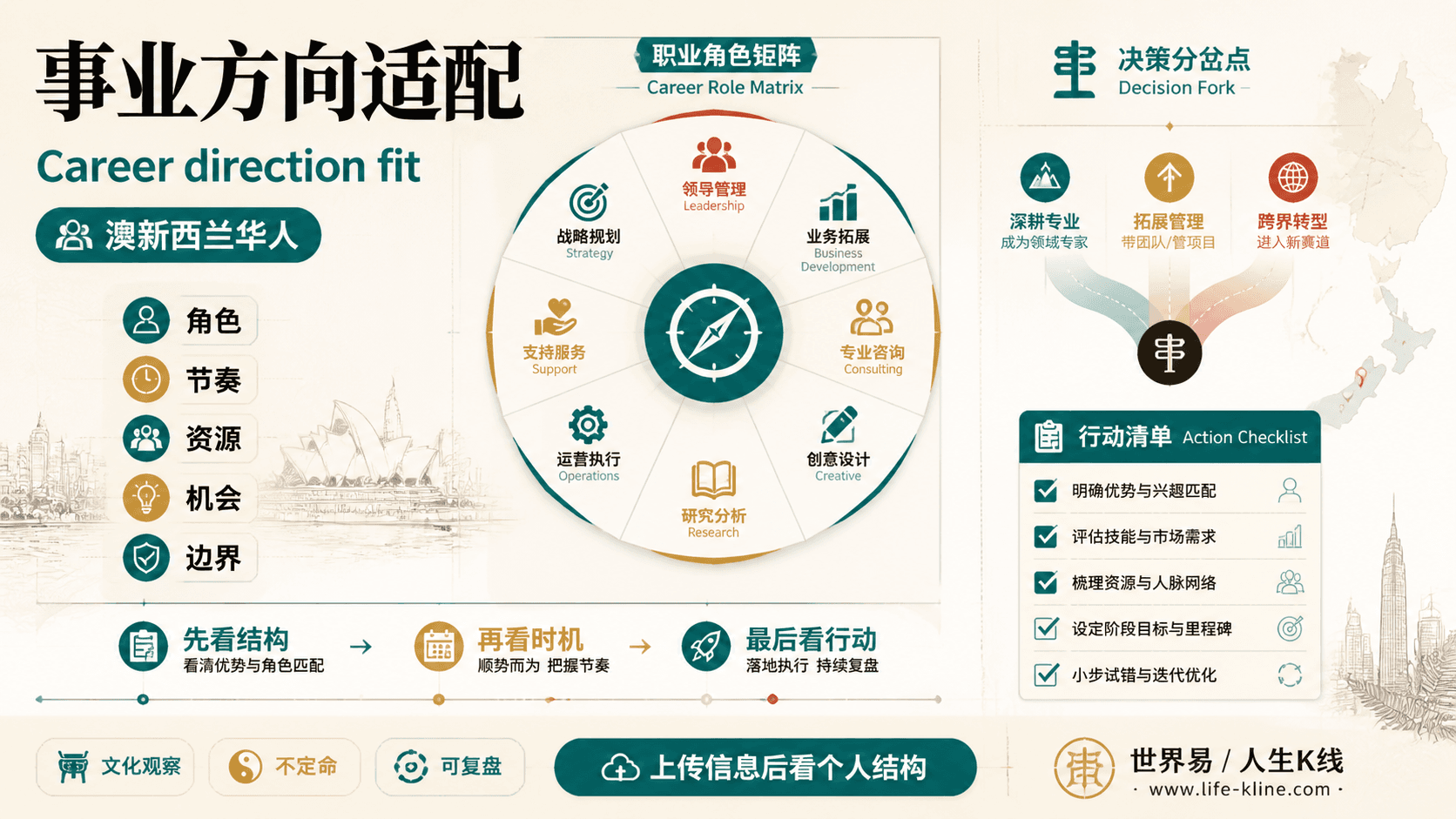
事业方向适配|澳新西兰华人
这张图把《BaZi Analysis and Decision Guidance for Environmental Matching in Migration of Chinese in Australia and New Zealand》里的命理概念转成关系、边界和应用场景,适合先看图建立结构,再回到知识文章正文理解细节。
事业方向适配不应被写成固定结论。更适合澳新西兰华人的读法,是把传统术语翻译成结构、时机、环境、行动和复盘。
查看图片解读