Metaphysical Decision Analysis on Elderly Parental Care and Pre-Death Relationship Closure
把这篇文章落到自己身上验证:先看结构,再进入个人分析,不做泛泛阅读。
Why This Decision Is Especially Difficult in This Scenario
Elderly parental care and related decision-making involve deep family dynamics, often triggering emotional manipulation and psychological inversion phenomena. Adult children frequently struggle between caregiving responsibilities and their own family pressures, with blurred boundaries escalating conflicts. Care methods and medical decision rights become focal points of family power struggles, creating immense emotional stress and hindering rational communication.
At this stage, the emotional attachment structure between parents and children undergoes transformation; existing role definitions (such as parental authority and child dependence) are forced to adjust, amplifying psychological trauma and unresolved emotions. Cultural expectations intertwine with self-worth, forming complex internal conflicts that are difficult to express and resolve directly.
In BaZi structure, the strength of the Day Master, the configuration of Yin (印星, Zheng Yin/Pian Yin) and Bi Jian/Jie Cai stars reflect an individual's emotional energy and support system, while Guan Sha (官杀, Zheng Guan/Qi Sha) and Cai stars (财星, Pian Cai/Zheng Cai) imply family authority and resource distribution pressures. The interaction of Da Yun and Liu Nian reveals the rhythm of key period changes, aiding in identifying emotional fluctuations and decision-making windows.
Therefore, the difficulty of this decision lies in recognizing appropriate timing for “reconciliation,” “farewell,” and “forgiveness” within a complex family emotional environment, balancing responsibility and feelings, and preventing emotional conflicts from further damaging relationships. Metaphysics serves as a rhythm aid and must be combined with psychological counseling and family therapy to avoid sole reliance.
Three Core Dimensions of Metaphysical Judgment
The strength of the Day Master represents an individual's internal energy and coping ability. A relatively strong Day Master often expresses emotions directly and can bear greater pressure; a weaker Day Master tends to be introverted and more susceptible to external influences. Yin stars (印星) usually signify parental or elder support and care; a Pian Yin (偏印) pattern suggests psychological dependence on parental images and potential emotional entanglement.
Bi Jian and Jie Cai stars reflect sibling competition and support, also indicating the strength of self-will and psychological boundaries. Guan Sha stars symbolize authority and rules, often related to medical decision rights and family regulations. Strong Guan Sha can bring intense responsibility pressure and authority conflicts. Cai stars involve resource allocation and practical interests, especially critical in caregiving method choices.
The interaction of Da Yun and Liu Nian reveals current emotional rhythms and external environmental influences. A stable Da Yun favors maintaining the status quo and reduces emotional fluctuations, while Liu Nian introduces the need for flexible adjustments. Paying attention to the clash and combination relationships among Yin stars, Bi Jian/Jie Cai, and Guan Sha in Da Yun and Liu Nian can reveal potential windows for “reconciliation” or “conflict” within family relationships.
Overall, the BaZi structure is not only a reflection of individual energy but also a microcosm of family relational dynamics. For pre-death relationship closure with parents, identifying emotional support and pressure points in the BaZi helps better grasp psychological turning points, assisting rational and emotional balance in decision-making.
Three Real BaZi Case Studies
Case 1 (based on Fact Package 1): This male has a relatively strong Ding Fire (丁, Ding) Day Master, with a Pian Yin (偏印) pattern. His Yong Shen are Water and Metal, and Ji Shen is Wood. He is currently in the Wu Wu (戊午, Wu Wu) Da Yun (ages 28-37) and Bing Wu (丙午, Bing Wu) Liu Nian. The Da Yun is stable and suitable for maintaining status quo, while the Liu Nian requires flexible response. The Pian Yin pattern indicates deep dependence on and emotional connection with parents. The relatively strong Ding Fire Day Master energy reflects his proactive assumption of caregiving responsibilities, but the presence of Ji Shen Wood suggests possible emotional depletion or excessive expectations within the family. In pre-death relationship closure, this individual is prone to amplified emotional burdens, especially when family boundaries are unclear, increasing psychological inversion risks. It is recommended to first assess personal emotional boundaries, integrate psychological counseling to adjust emotional dependence on parents, and seek suitable emotional release and reconciliation windows to avoid tension caused by overburdening.
Case 2 (based on Fact Package 2): This male has a relatively weak Gui Water (癸, Gui) Day Master, with a Zheng Guan (正官) pattern. His Yong Shen is Fire, and Ji Shen is Wood. He is currently in the Yi Hai (乙亥, Yi Hai) Da Yun (ages 29-38) and Bing Wu (丙午, Bing Wu) Liu Nian. The Da Yun is stable and favors maintaining status quo. The Zheng Guan pattern indicates significant pressure from family authority and rules. The weak Water Day Master is easily influenced externally, reflecting a potentially passive or internally conflicted state in caregiving decisions. Under the influence of Ji Shen Wood, internal family emotional conflicts and boundary issues may be aggravated. In pre-death relationship closure, this individual needs to be cautious of psychological resistance and communication barriers caused by Guan Sha pressure. Recommended steps include clarifying self-boundaries, moderately expressing inner needs, and combining professional family therapy to promote genuine dialogue with parents and siblings, thereby alleviating potential conflicts.
Case 3 (based on Fact Package 3): This female has a relatively strong Bing Fire (丙, Bing) Day Master, with a Qi Sha (七杀) pattern. Her Yong Shen are Water and Metal, and Ji Shen is Wood. She is in the Jia Zi (甲子, Jia Zi) Da Yun (ages 20-29) and Bing Wu (丙午, Bing Wu) Liu Nian. The Da Yun is stable and suitable for maintaining status quo. The Qi Sha pattern symbolizes the intertwining of authority and conflict. A relatively strong Day Master indicates she holds strong dominance and emotional expressiveness within the family. The Yong Shen Water and Metal help regulate the pressure brought by Qi Sha, while Ji Shen Wood may exacerbate emotional exhaustion in the family. During caregiving decisions, she may bear significant responsibility and emotional tension, prone to emotional fluctuations in relationship closure. It is advised that she emphasize emotional self-regulation during decision-making, use metaphysical rhythms to identify emotional low periods, and combine psychological counseling to avoid emotional outbursts that could damage reconciliation opportunities, thereby promoting positive family relationship closure.
Common Misjudgments and Blind Spots in This Scenario
A common misjudgment in elderly parental care and decision-making is over-relying on a single family member to bear all caregiving responsibilities, neglecting psychological boundaries and individual energy limits, which leads to emotional breakdowns and family tension. In BaZi, a relatively strong Day Master does not mean unlimited endurance; accumulated pressure may trigger emotional loss of control.
Another blind spot is ignoring the potential risks of emotional manipulation and psychological inversion. Driven by responsibility, children may neglect their own needs, resulting in accumulated psychological trauma. Strong Guan Sha stars in BaZi may bring authority pressure, but without psychological adjustment, internal conflicts and communication barriers easily arise.
Additionally, contradictions between family cultural expectations and actual resource limitations are often underestimated. The combination of Cai stars in BaZi indicates resource allocation issues; if not properly adjusted, it can exacerbate family conflicts and hinder relationship closure. Ignoring metaphysical rhythms signaling emotional fluctuations also causes missed reconciliation windows.
In summary, BaZi can only assist in identifying rhythms and potential risks and should not be used as the sole decision-making basis. Combining metaphysics with professional psychological counseling helps prevent misjudgments and blind spots, promoting healthy family closure.
Practical Judgment Sequence
Step 1: Examine the individual's Day Master strength and Yong Shen/Ji Shen to clarify internal emotional energy and psychological endurance. Combine with current Da Yun and Liu Nian to identify key emotional fluctuation periods. Strong Day Masters should beware of emotional overload; weak ones should focus on psychological defense mechanisms and dependency tendencies.
Step 2: Analyze family support systems, authority pressure, and resource distribution by combining Yin stars, Bi Jian/Jie Cai, Guan Sha, and Cai star configurations. Initially assess family boundary conditions and potential conflict points. Focus on clash and combination relationships between Guan Sha and Cai stars to understand the power struggle over decision authority and caregiving resources.
Step 3: Integrate family psychological counseling and therapy to design communication and regulation strategies based on metaphysical emotional nodes. Clarify timing for “reconciliation,” “farewell,” and “forgiveness” within relationship closure. Avoid forced decisions during emotional peaks; prioritize rational communication during stable periods, gradually repairing boundaries to achieve positive relationship closure.
FAQ
Question 1: Can metaphysics definitively determine that reconciliation will occur before parents’ passing? Answer: Metaphysics can only assist in identifying emotional fluctuations and potential relationship windows; it cannot guarantee reconciliation outcomes. Family relationships are complex and require integration with psychological counseling and family therapy to facilitate positive transformation.
Question 2: Does a relatively strong Day Master mean one can bear more caregiving pressure? Answer: A strong Day Master indicates greater energy but also a higher risk of emotional loss of control due to accumulated pressure. Proper emotional management and boundary setting are more important than mere energy strength.
Question 3: What should be done if there is PUA (psychological abuse) or violence in the family? Answer: Such situations require prioritizing professional legal and psychological assistance. Metaphysics is only an auxiliary tool and must never replace professional intervention. Ensuring the safety of individuals and family members is the foremost priority.
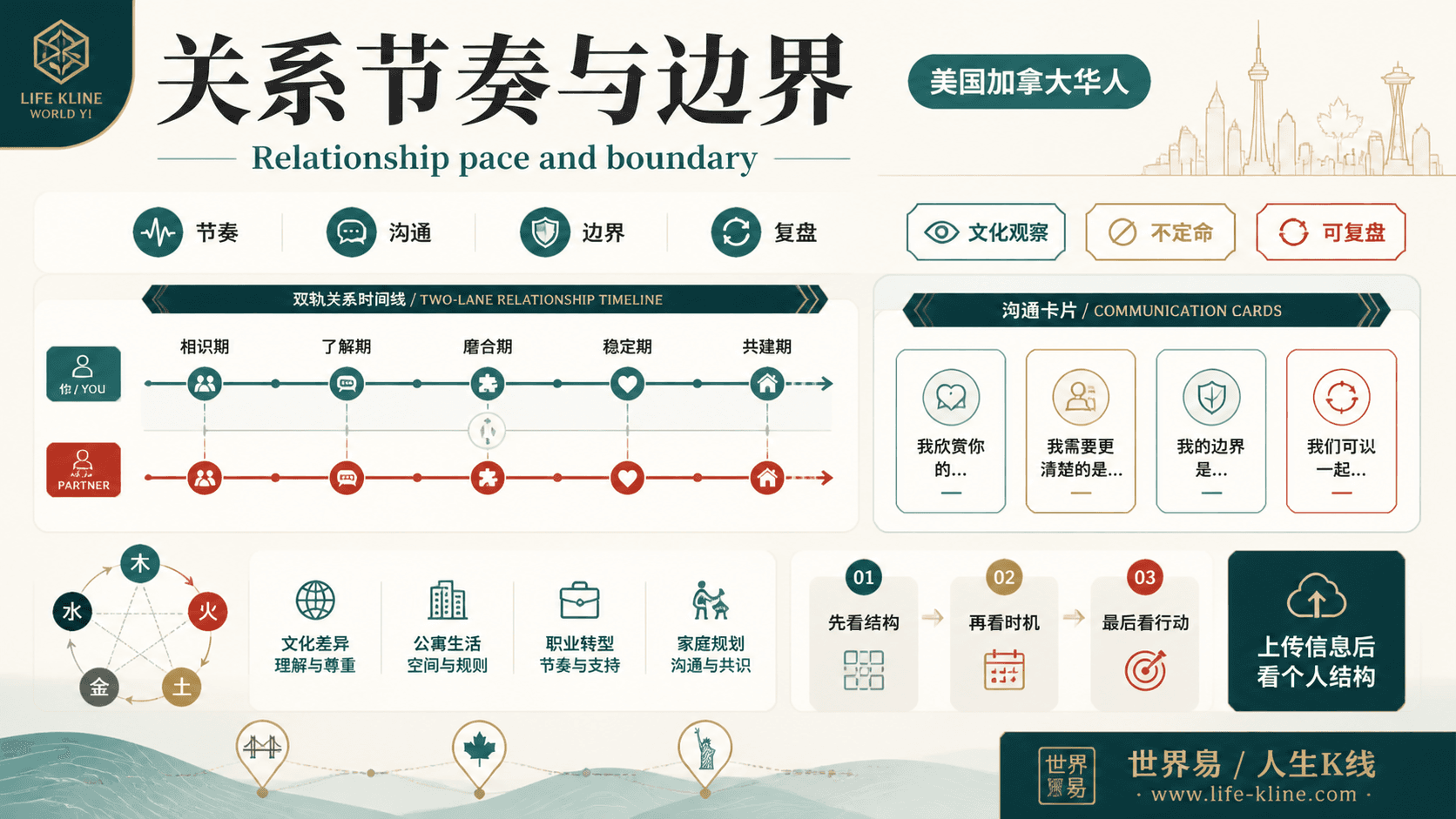
关系节奏与边界|美国加拿大华人
这张图把《Metaphysical Decision Analysis on Elderly Parental Care and Pre-Death Relationship Closure》里的命理概念转成关系、边界和应用场景,适合先看图建立结构,再回到知识文章正文理解细节。
关系节奏与边界不应被写成固定结论。更适合美国加拿大华人的读法,是把传统术语翻译成结构、时机、环境、行动和复盘。
查看图片解读