Complete Guide to Fortune Adjustment: Practical Strategies and Case Studies from a Metaphysical Perspective
把这篇文章落到自己身上验证:先看结构,再进入个人分析,不做泛泛阅读。
What Is Fortune Adjustment
Fortune adjustment refers to using metaphysical methods to analyze the Five Elements configuration, Day Master strength, pattern structure, and changes in Da Yun and Liu Nian within an individual’s BaZi chart, thereby formulating a fortune adjustment strategy suitable for oneself. Its purpose is to seek benefits and avoid harms, balance the Five Elements, strengthen the Yong Shen (favorable element), and weaken the Ji Shen (unfavorable element), thus optimizing overall fortune.
Fortune adjustment originated from ancient Chinese Four Pillars BaZi metaphysics. The ancients discovered that a person’s destiny is influenced by the combination of Heavenly Stems (天干) and Earthly Branches (地支) at birth. Combined with changes in Da Yun and Liu Nian, future fortune can be predicted and adjusted. Over time, adjustment methods have become more diverse, covering aspects such as wearing certain items, Feng Shui, and behavioral choices.
In practice, fortune adjustment is not merely simple prediction of good or bad luck but emphasizes dynamic strategies that combine personal chart characteristics with current Da Yun and Liu Nian. By reasonably utilizing the Yong Shen and avoiding Ji Shen interference, one can effectively enhance stability and development potential in life, career, and health.
Modern metaphysics stresses the integration of science and practicality. Fortune adjustment is regarded as an auxiliary tool to help people face fortune fluctuations more rationally. It does not advocate fatalism but guides specific life choices and behavioral adjustments through deep understanding of metaphysics.
How to View Fortune Adjustment: Core Elements
When performing fortune adjustment in metaphysics, the first step is to clarify the strength of the Day Master (日主). The Day Master is the core of the BaZi chart and represents one’s own energy state. A Day Master that is either too strong or too weak determines the direction of adjustment: those with a strong Day Master need to restrain the Ji Shen (unfavorable elements), while those with a weak Day Master need to support the Yong Shen (favorable elements) to achieve Five Elements balance.
Secondly, the pattern (格局) determines the overall structure and fortune trend of the chart. Different patterns correspond to different Yong Shen and Ji Shen. Understanding the pattern helps identify which Five Elements are beneficial to the Day Master and which should be avoided, enabling precise fortune adjustment.
The Yong Shen is the key Five Element for adjusting fortune, representing the energy needed by the Day Master. By enhancing the Yong Shen, one can improve the stability and developmental potential of overall fortune. The Ji Shen is the Five Element that the Day Master needs to avoid or restrain; reducing its influence helps lessen negative fortune.
Da Yun (decade luck cycle) and Liu Nian (annual fortune) are the time nodes of fortune changes. Da Yun represents long-term trends, while Liu Nian reflects short-term fluctuations. Fortune adjustment requires combining the interaction of Da Yun and Liu Nian, flexibly responding to fortune characteristics at different stages, balancing preservation and adaptability.
In summary, scientific fortune adjustment requires precise BaZi analysis combined with personal circumstances to formulate individualized adjustment plans, rather than blindly following fixed practices.
Three Real BaZi Chart Case Studies
Case One is a female aged 45 to 50, with a Day Master of 戊土 (Wu Earth), which is relatively strong. Her pattern is Shang Guan (伤官) pattern, with Yong Shen being Wood and Water, and Ji Shen being Fire. She is currently in the 5th year of the 丙申 (Bing Shen) Da Yun, which is a stable luck phase suitable for preservation. The Liu Nian is 丙午 (Bing Wu), requiring adaptability. For her fortune adjustment, emphasis should be placed on strengthening Wood and Water energies and avoiding excessive Fire damage. Especially during fire-strong Liu Nian, lifestyle or environmental adjustments should be made to mitigate Fire’s impact, maintaining the stability and preservation of the Da Yun.
Case Two is a male aged 45 to 50, with a Day Master of 甲木 (Jia Wood), which is relatively weak. His pattern is Zheng Cai (正财) pattern, with Yong Shen being Water and Ji Shen being Fire and Earth. He is currently in the 10th year of the 癸巳 (Gui Si) Da Yun, a stable period suitable for preservation. The Liu Nian is 丙午 (Bing Wu), emphasizing adaptability. Since his Day Master is weak, it is important to supplement Water to support Jia Wood, while avoiding excessive intrusion from Fire and Earth. Fortune adjustment should focus on enhancing the Yong Shen Water and reducing the Ji Shen Fire and Earth, combining Da Yun and Liu Nian characteristics to steadily improve overall fortune.
Case Three is a male aged 30 to 35, with a Day Master of 甲木 (Jia Wood), which is relatively strong. His pattern is Zheng Cai (正财) pattern, with Yong Shen being Metal and Earth, and Ji Shen being Water. He is currently in the 6th year of the 丙子 (Bing Zi) Da Yun, overall stable and suitable for preservation. The Liu Nian is 丙午 (Bing Wu), requiring flexible response. Because the Day Master is strong, fortune adjustment should focus on restraining the negative effects of Ji Shen Water while reasonably utilizing Yong Shen Metal and Earth to balance the Five Elements. Adjustment strategies should emphasize steady preservation, avoiding Water interference to ensure smooth fortune.
Common Misconceptions
One common misconception in fortune adjustment is excessive superstition towards Tai Sui (太岁) and related traditional customs. While Tai Sui rituals have psychological calming effects, their essence is to help people maintain rationality and caution rather than possessing magical physical powers to avoid misfortune. Blind reliance on Tai Sui rituals may cause neglect of real issues, thus hindering genuine fortune improvement.
Another misconception is ignoring individual differences in BaZi charts and adopting one-size-fits-all adjustment methods. Different charts have varying Day Master strengths, Yong Shen, and Ji Shen. Fortune adjustment must be personalized; blindly copying others’ experiences may backfire or even exacerbate Ji Shen influence.
Some view fortune adjustment as a universal key, neglecting that metaphysics is only an auxiliary tool. Fortune is influenced by many factors; personal effort and environmental changes are equally important. Relying solely on metaphysical adjustment cannot solve all problems. The correct attitude is to use metaphysics as a reference combined with practical actions to jointly improve fortune.
Practical Suggestions
When performing fortune adjustment, first accurately identify the Yong Shen and Ji Shen in the BaZi chart, and combine the current Da Yun and Liu Nian to formulate targeted adjustment plans. For example, enhancing the energy of the Yong Shen Five Elements can be achieved by wearing corresponding Five Elements accessories, adjusting the Five Elements attributes of living and working environments, or changing lifestyle habits.
Secondly, maintain a calm mindset and avoid excessive anxiety due to fortune fluctuations. Reasonably applying metaphysical knowledge can strengthen inner stability and decision-making ability, enabling flexible response to Liu Nian changes and reducing negative impacts caused by impulsive or blind actions.
Finally, fortune adjustment is a dynamic process that should be continuously updated according to changes in Da Yun and Liu Nian. Regularly reviewing one’s fortune changes and combining metaphysical guidance to continuously optimize life and work strategies can achieve long-term stable fortune development.
FAQ
Question 1: Is the Ben Ming Year (本命年) really prone to misfortune? Answer: The Ben Ming Year is the year when one’s zodiac animal matches the Liu Nian Earthly Branch. Folk belief holds it as “facing Tai Sui,” which affects that year’s fortune mainly by amplifying potential problems. Customs such as wearing red, red strings, and ancestral worship serve as psychological reminders for caution rather than physical measures to avoid misfortune. Therefore, the Ben Ming Year does not necessarily bring disasters but reminds people to pay more attention to their behavior and mindset.
Question 2: Does Hua Tai Sui (化太岁) work? Answer: The core function of Hua Tai Sui is to help people gain inner peace. If you believe Hua Tai Sui can bring a more stable state, it can indeed reduce impulsive decisions and avoid unnecessary risks. Conversely, disbelief will not cause adverse effects. Metaphysics is an auxiliary tool aimed at guiding rationality and caution rather than asserting unchangeable fate.
Question 3: How to adjust fortune according to the Yong Shen? Answer: The Yong Shen is the key element in balancing the Five Elements in the BaZi chart. Fortune adjustment should focus on enhancing the Yong Shen’s strength, such as increasing items of the corresponding Five Elements, improving environmental Qi, or adjusting lifestyle routines to support the Day Master. Avoiding excessive interference from the Ji Shen is equally important to achieve Five Elements balance and stabilize and improve fortune.
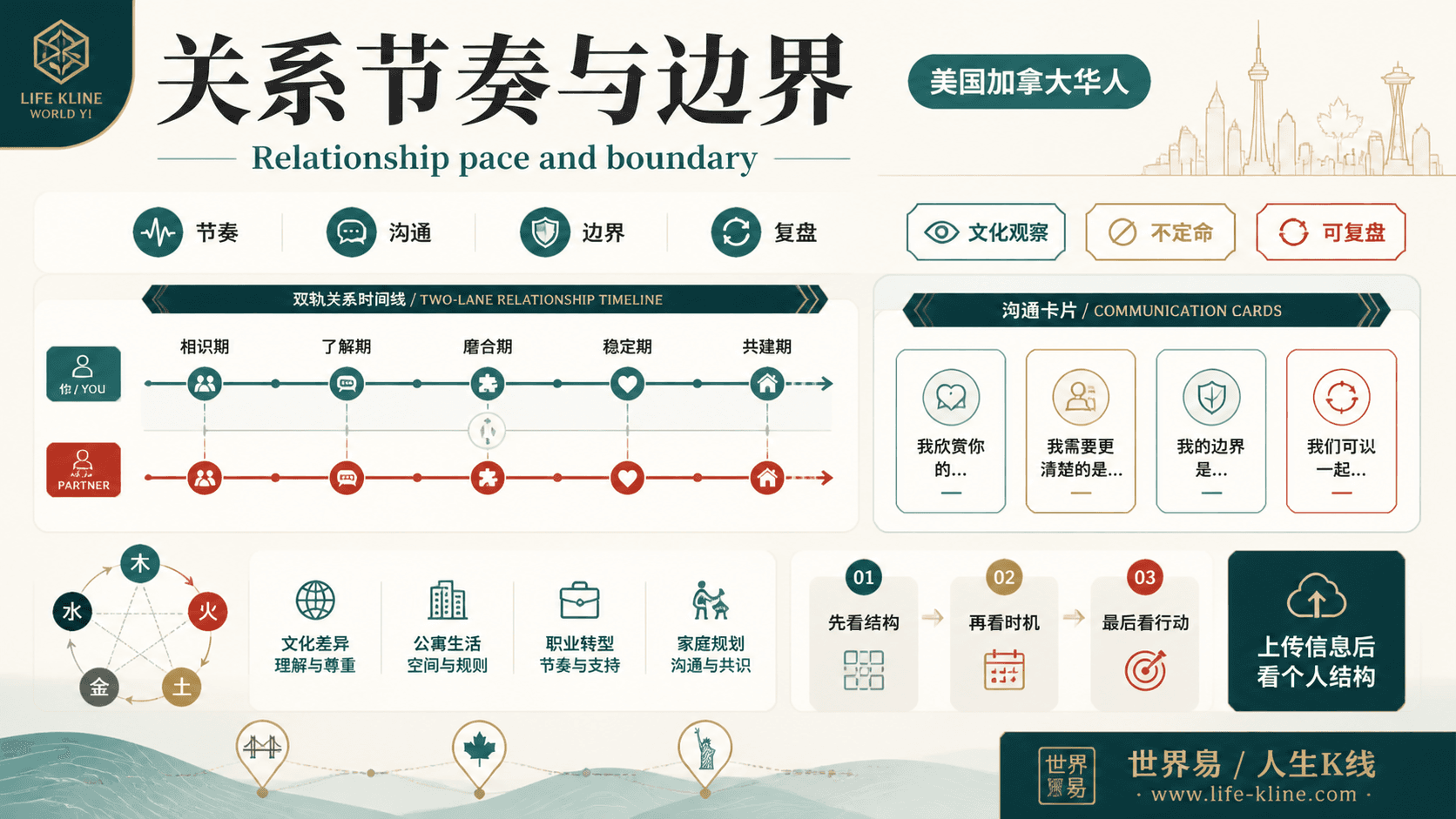
关系节奏与边界|美国加拿大华人
这张图把《Complete Guide to Fortune Adjustment: Practical Strategies and Case Studies from a Metaphysical Perspective》里的命理概念转成关系、边界和应用场景,适合先看图建立结构,再回到知识文章正文理解细节。
关系节奏与边界不应被写成固定结论。更适合美国加拿大华人的读法,是把传统术语翻译成结构、时机、环境、行动和复盘。
查看图片解读