Complete Guide to Choosing Wedding Dates: BaZi Metaphysics and Auspicious Day Selection Analysis
把这篇文章落到自己身上验证:先看结构,再进入个人分析,不做泛泛阅读。
What Is Wedding Date Selection
Wedding date selection is a principle in traditional Chinese culture that chooses an auspicious day for marriage based on the harmony of time, place, and people. It not only concerns the smoothness and joy of the wedding day but is also believed to influence the couple’s future marital happiness and family harmony.
The origin of date selection can be traced back to the combination of ancient astronomy, calendar systems, and the Five Elements and BaZi (Eight Characters) theories. Through Yin-Yang and Five Elements analysis and BaZi calculations, the most favorable timing for the couple’s fortune is determined, reflecting the harmonious unity between humans and nature.
Traditional date selection considers not only the general Huang Li (Chinese Almanac) recommendations but also integrates the BaZi of both parties, the current Liu Nian (annual fortune), and their zodiac signs. The goal is to avoid clashes and punishments (chong and xing), and to select days with suitable Yong Shen (favorable elements) to ensure lasting auspiciousness.
The scientific nature of wedding date selection has gained increasing attention. Modern metaphysics combines tradition with practical needs, emphasizing personalized and precise calculations instead of one-size-fits-all general taboos, thus more effectively ensuring a smooth marriage.
How to View Wedding Date Selection: Core Elements
First, analyze the BaZi metaphysics of both parties to determine the strength of the Day Master, the pattern (ge ju), and the Yong Shen (favorable element) and Ji Shen (unfavorable element). This forms the fundamental basis for date selection. Days with the Yong Shen enhance the Day Master’s fortune, while Ji Shen days should be avoided.
Pay attention to the zodiac signs of both parties and their relationships with the auspicious day, avoiding conflicts such as zodiac clashes (chong), punishments (xing), month breaks (yue po), extinction days (mie men), and days taboo for marriage (jia qu), ensuring no taboos on the wedding day.
Prioritize days with auspicious deities such as Tian De (Heavenly Virtue), Yue De (Monthly Virtue), Tian De He, and Yue De He, which represent auspiciousness and smoothness, benefiting long-lasting marital happiness.
Combine the current Da Yun (decade luck cycle) and Liu Nian (annual fortune) to observe the stability of both parties’ fortunes. Avoid important wedding dates during dangerous Da Yun or unfavorable Liu Nian to safeguard the couple’s safety and marital stability.
If major events conflict, such as moving house or ground-breaking (dong tu), prioritize adjusting the wedding date to avoid clashes in fortune that could negatively affect the wedding’s success.
Three Real BaZi Chart Cases
The first female’s Four Pillars (Si Zhu) are 庚戌 (Geng Xu), 癸未 (Gui Wei), 乙未 (Yi Wei), 辛巳 (Xin Si). The Day Master is Yi Wood, which is relatively weak, with a Pian Yin (partial印) pattern. The Yong Shen is Water, and the Ji Shen are Fire and Earth. She is currently in the Ding Chou (丁丑) unlucky Da Yun, with the Liu Nian being Bing Wu (丙午). The interaction between Da Yun and Liu Nian is weak and requires caution. Wedding date selection should choose auspicious days containing Water deities, avoid Fire and Earth days and conflicts with the Liu Nian, and pay special attention to the dangerous periods within the Da Yun to avoid adverse effects from major changes.
The second male’s Four Pillars are 戊寅 (Wu Yin), 壬戌 (Ren Xu), 丁巳 (Ding Si), 己酉 (Ji You). The Day Master is Ding Fire, relatively strong, with a Zheng Guan (正官) pattern. The Yong Shen are Water and Metal, and the Ji Shen is Wood. He is currently in the Yi Chou (乙丑) stable Da Yun, with the Liu Nian being Bing Wu (丙午). The interaction between Da Yun and Liu Nian is stable. Date selection should favor auspicious days with Water and Metal to assist the Yong Shen, avoid Wood days and conflicts. During stable Da Yun periods, it is suitable to maintain status quo, and wedding date selection is relatively flexible and can be adjusted according to actual circumstances.
The third male’s Four Pillars are 癸亥 (Gui Hai), 癸亥 (Gui Hai), 丙午 (Bing Wu), 丙申 (Bing Shen). The Day Master is Bing Fire, relatively weak, with a Zheng Guan (正官) pattern. The Yong Shen is Wood, and the Ji Shen are Earth and Metal. He is currently in the Wu Wu (戊午) stable Da Yun, with the Liu Nian being Bing Wu (丙午). The interaction between Da Yun and Liu Nian is harmonious. Date selection should prioritize Wood days to supplement the Yong Shen, avoid Earth and Metal Ji Shen days, and coordinate with the stable Da Yun and Liu Nian to benefit the wedding date’s smoothness and marital happiness. Overall, it is advisable to maintain the current status and adjust the wedding date flexibly as needed.
Common Misconceptions
Many people believe that the general auspicious and taboo days listed in the Huang Li (Chinese Almanac) are suitable for everyone’s wedding. In fact, such general auspicious days may not fit an individual’s BaZi, and their accuracy is limited. Ignoring the integration of personal BaZi and zodiac signs often leads to inappropriate date selection, adversely affecting marital fortune.
Some focus solely on auspicious days but neglect the influence of Da Yun and Liu Nian on the wedding date. If one is in an unlucky Da Yun or unfavorable Liu Nian, even the most auspicious day cannot guarantee smoothness. It is essential to consider overall fortune to avoid major mishaps.
Another misconception is choosing the wedding date based only on one party’s BaZi without considering both parties’ metaphysics. Since marriage is a union of two, date selection must consider both parties’ BaZi and zodiac signs to ensure no conflicts or punishments, guaranteeing an auspicious wedding date.
Some overly rely on so-called 'universal auspicious days' without distinguishing between Yong Shen and Ji Shen, leading to date selection errors and negative consequences. Scientific date selection must be personalized and comprehensively calculated based on actual metaphysics.
Practical Suggestions
Wedding date selection should begin with a detailed calculation of both parties’ BaZi, clarifying the strength of the Day Master, the pattern, and the Yong Shen and Ji Shen. Then combine the current Liu Nian and both parties’ zodiac signs to select a day that fits both metaphysics and avoids conflicts.
Prioritize days with auspicious deities such as Tian De, Yue De, Tian De He, and Yue De He, paying special attention to days that correspond to both parties’ Yong Shen to enhance the auspicious atmosphere of the wedding, and avoid Ji Shen days to prevent adverse effects.
Consider the current Da Yun and Liu Nian, especially avoiding major weddings during dangerous Da Yun periods to ensure the couple’s safety and fortune stability. During stable Da Yun periods, wedding dates can be adjusted flexibly as needed.
In practice, if major events such as moving house or ground-breaking conflict with the wedding date, it is recommended to adjust the wedding date to prioritize the wedding’s smoothness and avoid affecting both parties’ fortunes. The date selection process should be guided by a professional metaphysics consultant to ensure accuracy and effectiveness.
FAQ
Question 1: Are the auspicious days in the Huang Dao Ji Ri (Auspicious Calendar) accurate? Answer: The general 'do’s and don’ts' in the Huang Li are based on universal rules such as the Twelve Deities and the Twenty-Eight Mansions, without integrating individual BaZi and zodiac signs, so their accuracy is limited. True wedding date selection must combine both parties’ natal BaZi, the current Liu Nian, and their combined BaZi calculations to precisely find a day suitable for both.
Question 2: What key factors should be considered in wedding date selection? Answer: One must avoid days with zodiac clashes (chong), punishments (xing), month breaks (yue po), extinction days (mie men), and marriage taboos. Priority should be given to days with auspicious deities such as Tian De, Yue De, Tian De He, and Yue De He, as well as days matching both parties’ Yong Shen. If major events conflict (e.g., moving house, ground-breaking), the wedding date should be adjusted to avoid negative impact.
Question 3: How significant are Da Yun and Liu Nian in wedding date selection? Answer: Da Yun and Liu Nian reflect an individual’s current fortune cycle. It is inadvisable to schedule major weddings during dangerous Da Yun or unfavorable Liu Nian to prevent mishaps and bad luck. During stable Da Yun periods, date selection is more flexible. Considering Da Yun and Liu Nian comprehensively enables a more scientific choice of auspicious wedding dates.
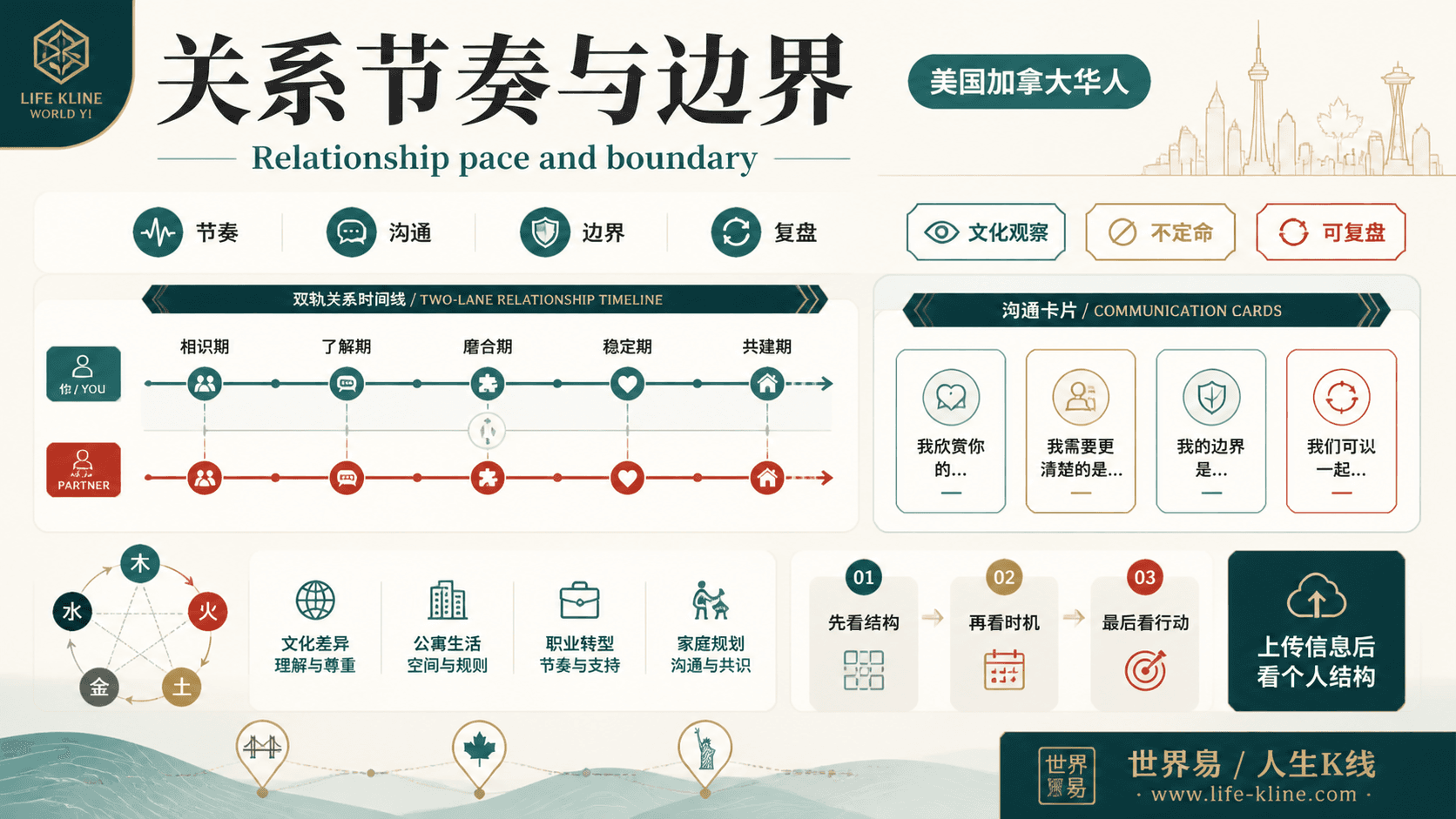
关系节奏与边界|美国加拿大华人
这张图把《Complete Guide to Choosing Wedding Dates: BaZi Metaphysics and Auspicious Day Selection Analysis》里的命理概念转成关系、边界和应用场景,适合先看图建立结构,再回到知识文章正文理解细节。
关系节奏与边界不应被写成固定结论。更适合美国加拿大华人的读法,是把传统术语翻译成结构、时机、环境、行动和复盘。
查看图片解读