Comprehensive Analysis of Methods to Change Luck: A Practical Guide Based on Real BaZi Charts
把这篇文章落到自己身上验证:先看结构,再进入个人分析,不做泛泛阅读。
What Are Methods to Change Luck
Methods to change luck refer to the practice within the framework of Chinese metaphysics where one analyzes a person’s BaZi (Four Pillars: Year Pillar, Month Pillar, Day Pillar, Hour Pillar), identifies the Yong Shen (favorable elements) and Ji Shen (unfavorable elements), as well as the strength of the Day Master and the pattern, then takes corresponding adjustment measures to optimize personal fortune. The core lies in aligning with the timing and environment, maximizing strengths, and minimizing weaknesses by enhancing beneficial elements and weakening unfavorable influences.
The concept of changing luck originated from ancient Chinese metaphysical practices, especially the Four Pillars BaZi theory. The ancients believed that a person’s destiny is constrained by the interactions of the Five Elements (Wood, Fire, Earth, Metal, Water) governed by Heaven and Earth. By scientifically adjusting the balance among the Five Elements, one could improve their fortune. Changing luck involves not only external environmental adjustments but also emphasizes the cooperation of inner attitude and behavior.
Modern methods to change luck increasingly integrate psychology and practical life approaches, such as adjusting mindset, rationally planning life stages, and choosing auspicious times and places for actions. Changing luck is not mere superstition but a reference based on metaphysical structure to help people avoid harm and seek benefit, achieving positive life transformations.
Core Elements in Understanding Methods to Change Luck
The first step in changing luck is accurately identifying the strength of the Day Master. The strength of the Day Master determines the overall balance of the BaZi chart and the focus of adjustment. A relatively weak Day Master generally requires Yong Shen to supplement it, while a relatively strong Day Master needs to control the Ji Shen. The definition of Yong Shen and Ji Shen directly influences the direction and methods of changing luck.
Next, the pattern type, such as Shang Guan (Hurting Officer) pattern, Zheng Guan (Proper Officer) pattern, or Cong Cai (Following Wealth) pattern, is key to judging the characteristics of the chart’s operation. Different patterns require different methods and focuses for changing luck. For example, the Shang Guan pattern emphasizes harmonizing Water, while the Zheng Guan pattern favors Earth, reflecting the principle of mutual generation and restriction among the Five Elements.
Da Yun (decade luck cycles) and Liu Nian (annual fortunes) are important timing nodes for changing luck. Da Yun represents the trend of luck over a longer period, while Liu Nian reflects the specific performance each year. By combining the interaction between Da Yun and Liu Nian, one can judge the auspiciousness of the current year and formulate corresponding strategies. During stable periods, it is advisable to maintain status quo; during fortunate periods, one should actively advance; during weaker periods, caution and prevention are necessary.
Finally, changing luck does not rely solely on metaphysical analysis but must also consider the individual’s specific circumstances and psychological state. Maintaining a positive mindset and rationally planning goals, combined with metaphysical advice, can achieve the best results in changing luck.
Three Real BaZi Chart Cases
Case 1: This male is aged between 35 and 40 years old. His Day Master is 乙木 (Yi Wood), relatively weak, belonging to the Shang Guan (Hurting Officer) pattern. The Yong Shen is Water, and the Ji Shen are Fire and Earth. He is currently in the first year of the 庚申 (Geng Shen) Da Yun, with the Liu Nian being 丙午 (Bing Wu). The overall Da Yun is stable and suitable for maintaining achievements, while the Liu Nian 丙午 requires flexible adaptation. The method to change luck should focus on enhancing Water energy, avoiding excessive Fire and Earth, and maintaining flexible adjustments during the Liu Nian to reduce conflicts and steadily improve fortune.
Case 2: This male is aged between 40 and 45 years old. His Day Master is 乙木 (Yi Wood), relatively weak, with a Zheng Guan (Proper Officer) pattern. The Yong Shen is Earth, and the Ji Shen is Fire. He is in the eighth year of the 甲戌 (Jia Xu) Da Yun, with the Liu Nian being 丙午 (Bing Wu). The Da Yun is auspicious, favorable for career and wealth development, and the Liu Nian aligns with this trend. The focus of changing luck is to strengthen the Earth element and restrain the influence of Fire, while actively expanding career and wealth during this fortunate period, leveraging the stability of the Zheng Guan pattern to steadily enhance overall fortune.
Case 3: This male is aged between 45 and 50 years old. His Day Master is 乙木 (Yi Wood), balanced, belonging to the Cong Cai (Following Wealth) pattern. The Yong Shen are Earth and Fire, and the Ji Shen are Water and Wood. He is currently in the first year of the 壬申 (Ren Shen) Da Yun, with the Liu Nian being 丙午 (Bing Wu). The Da Yun is relatively weak, requiring caution during the Liu Nian. The strategy to change luck should focus on strengthening Earth and Fire, suppressing unfavorable Water and Wood factors, avoiding risks, and maintaining steady actions to reduce hazards. This stage is suitable for emphasizing inner cultivation and environmental adjustments to steadily accumulate a foundation for fortune.
Common Misconceptions
Many people mistakenly believe that changing luck is simply about wearing certain auspicious items or performing simple Feng Shui arrangements to alter destiny, neglecting the complexity of metaphysics itself. Changing luck is more about understanding the structure of the BaZi chart and making systematic adjustments based on actual circumstances, rather than relying on a single object as a superstitious crutch.
Another misconception is completely denying the influence of Liu Nian or Da Yun, thinking that destiny is fixed and unchangeable. In fact, fluctuations and changes in fortune are natural laws. Methods to change luck utilize these cyclical changes to adjust life direction, achieving the goal of avoiding harm and seeking benefit.
Some people panic excessively about their Ben Ming Nian (the year of their own zodiac sign), believing it inevitably brings major misfortune. In reality, the Ben Ming Nian is simply a year of energy intersection, reminding people to act cautiously. Adjusting mindset and behavior is more effective than blind fear. Changing luck should focus on scientific and rational analysis and actions.
Practical Suggestions
When applying methods to change luck, first accurately analyze the individual’s BaZi chart to clarify the strength of the Day Master, Yong Shen, and Ji Shen. According to the needs of the Yong Shen, adjust the living environment and behavioral habits, such as increasing the colors, elements, or activities related to the favorable Five Elements, and reducing the influence of the Ji Shen.
Secondly, combine the current Da Yun and Liu Nian to formulate phased goals and plans. During auspicious periods, actively take initiative to promote career and life progress; during weaker periods, exercise caution, avoid major changes, and steadily accumulate energy to prepare for future opportunities.
Finally, maintain a good mindset and healthy lifestyle, avoiding impulsive and blind decisions. Changing luck is not only an adjustment in metaphysics but also a comprehensive improvement in psychology and actions. Only by cultivating both internally and externally can one truly achieve an enhancement in fortune.
FAQ
Question 1: Is it true that the Ben Ming Nian (zodiac year of birth) is prone to accidents? Answer: The Ben Ming Nian is the year when the zodiac Earthly Branch matches one’s own birth branch, commonly called “Zhi Tai Sui” in folk belief. It does indeed affect the year’s fortune because the energies overlap, potentially amplifying hidden issues. Traditional customs such as wearing red, red strings, and ancestor worship serve as psychological reminders to help people maintain caution and stability, rather than direct methods to avoid misfortune.
Question 2: Does Hua Tai Sui (neutralizing Tai Sui) work? Answer: Hua Tai Sui essentially aids fortune through psychological reassurance. If you believe that Hua Tai Sui helps you remain calm and reduces impulsiveness, then it has a positive effect. Conversely, disbelief means no effect. Metaphysical tools are auxiliary rather than absolute determinants of destiny. Viewing Hua Tai Sui scientifically and rationally, combined with practical actions, can achieve real results.
Question 3: Should methods to change luck be frequently changed? Answer: Methods to change luck should be adapted according to the Yong Shen and the changes in Da Yun and Liu Nian, applying the principle of timing. Since Da Yun cycles last about ten years, strategies should remain relatively stable, but adjustments can be made for special Liu Nian changes. Frequent changes may cause disorder in actions and negatively affect results. Reasonable planning and gradual progress are key to effective changing luck.
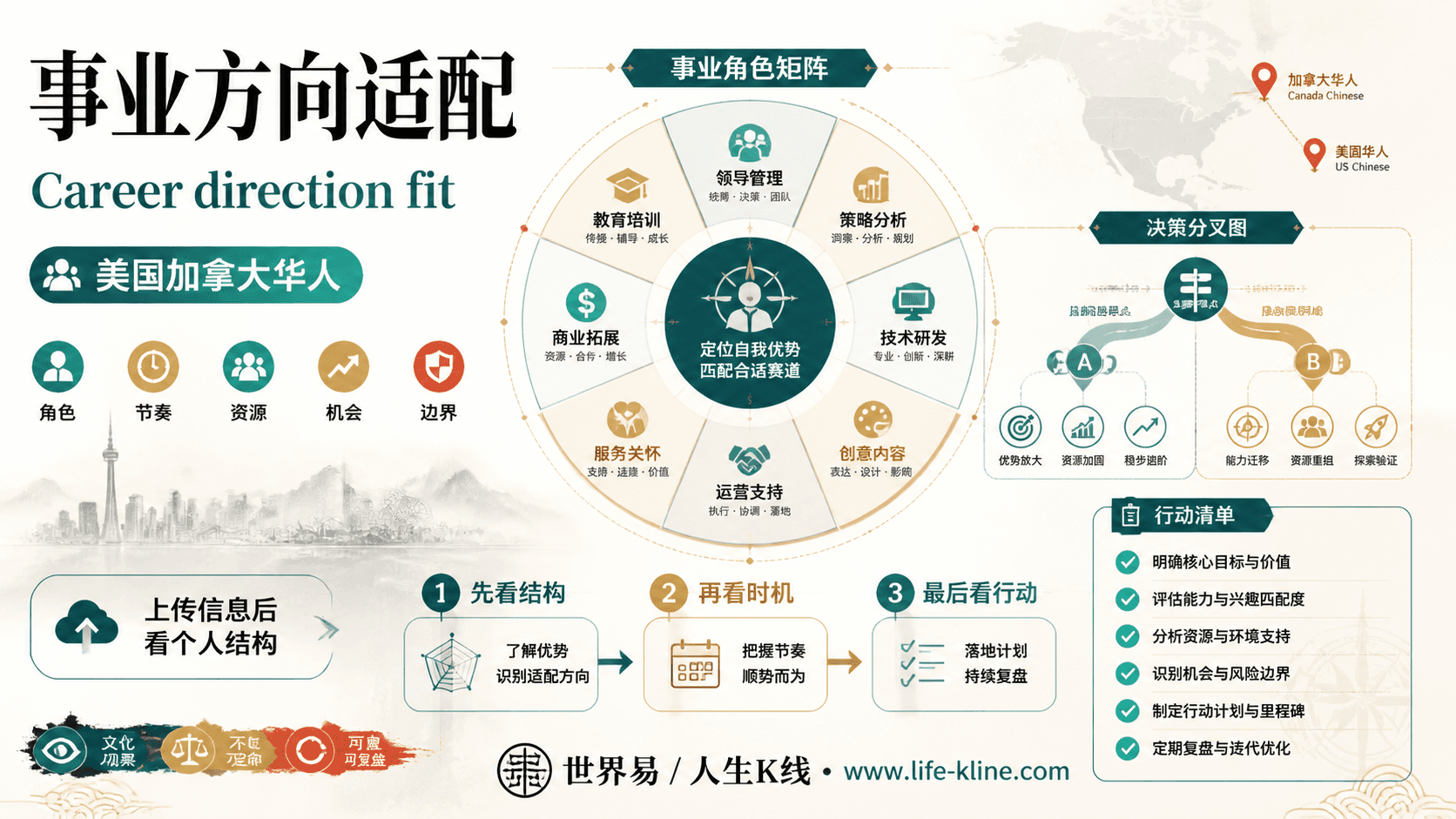
事业方向适配|美国加拿大华人
这张图把《Comprehensive Analysis of Methods to Change Luck: A Practical Guide Based on Real BaZi Charts》里的命理概念转成关系、边界和应用场景,适合先看图建立结构,再回到知识文章正文理解细节。
事业方向适配不应被写成固定结论。更适合美国加拿大华人的读法,是把传统术语翻译成结构、时机、环境、行动和复盘。
查看图片解读