Complete Guide to Choosing Moving Dates: BaZi Patterns and Yong Shen Explained
把这篇文章落到自己身上验证:先看结构,再进入个人分析,不做泛泛阅读。
What Is Moving Date Selection
Moving date selection is an important timing method in traditional metaphysics, aiming to analyze an individual's BaZi chart by combining the current year's Liu Nian and Da Yun trends to choose auspicious days suitable for relocation. The core purpose is to coordinate the timing and environment to promote a smooth and harmonious life in the new residence while minimizing adverse influences.
The theoretical foundation of date selection originates from the ancient Chinese Heavenly Stems (天干) and Earthly Branches (地支) system, the Five Elements (Wood, Fire, Earth, Metal, Water) cycles of generation and restriction, as well as rules from the Huang Li (Chinese Almanac) such as the Twelve Gods of Construction and Destruction and the Twenty-Eight Mansions. Unlike general Huang Li recommendations, moving date selection emphasizes a personalized approach based on the individual's BaZi Day Master strength, pattern, and Yong Shen (favorable elements) and Ji Shen (unfavorable elements) preferences to select the optimal timing.
Moving date selection not only considers personal metaphysics but also takes into account the auspiciousness and inauspiciousness of the current Liu Nian and Da Yun to ensure the chosen time harmonizes with the individual's overall luck trend, maximizing the positive effects of the auspicious day. Through scientific date selection, the stability and happiness of life in the new home can be enhanced.
Additionally, moving date selection must avoid days that clash with the Day Master's Ji Shen to reduce negative impacts. Proper date selection can neutralize potential Sha Qi (negative energy), strengthen the individual's fortune, and create a favorable beginning for life after relocation.
How to View Moving Date Selection: Core Elements
The first step in moving date selection is to clarify the Day Master's attribute and its strength, understand the associated pattern type, and thereby determine the Yong Shen (favorable elements) and Ji Shen (unfavorable elements). Yong Shen represents the Five Elements beneficial to the Day Master and should be enhanced during moving, while Ji Shen should be avoided to prevent adverse clashes.
Next, the overall luck trend must be assessed by combining the current Da Yun (10-year luck cycle) and Liu Nian (annual fortune). Da Yun reflects the trend over a decade, while Liu Nian indicates the specific influence of the current year. When choosing a moving date, priority should be given to periods where Da Yun is auspicious and Liu Nian is favorable to ensure the timing aligns with the individual's positive luck phase.
During date selection, days with conflicts such as Chong Ri (clashing days), Xing Ri (punishing days), and Yue Po Ri (month-breaking days) that are unsuitable for moving should be avoided. At the same time, days whose Heavenly Stems and Earthly Branches harmonize with or generate the Yong Shen should be selected to enhance the auspiciousness of the moving day.
Finally, general Huang Li rules such as the Twelve Gods of Construction and Destruction and the Twenty-Eight Mansions can be referenced as supplementary guidance but should never replace precise date selection tailored to the individual's BaZi. Only through comprehensive consideration can one scientifically and reasonably select the most suitable auspicious moving day.
Three Real BaZi Case Studies
Case 1 involves a male aged 25-30 with the Four Pillars (Si Zhu) of Ji Mao (己卯), Ding Chou (丁丑), Gui Wei (癸未), and Xin You (辛酉). The Day Master is Gui Water (癸水) and is relatively weak, with a Pian Cai (偏财) pattern. His Yong Shen is Metal, and Ji Shen are Wood and Fire. He is currently in the 10th year of the Yi Hai (乙亥) Da Yun, which is stable, and the Liu Nian is Bing Wu (丙午). For moving date selection, days that support Metal should be prioritized, while avoiding clashes from Wood and Fire. Although the Da Yun is stable, the Bing Wu Liu Nian is Fire-strong, so days with strong Fire should be avoided. Choosing times when Metal is strong will enhance the Yong Shen effect and ensure a smooth move.
Case 2 concerns a female aged 50-55 with the Four Pillars of Jia Yin (甲寅), Ding Mao (丁卯), Ding Wei (丁未), and Ding Wei (丁未). The Day Master is Ding Fire (丁火) and is relatively strong, with a Bi Jian (比肩) pattern. Her Yong Shen are Water and Metal, and Ji Shen is Wood. She is currently in the 2nd year of the Xin You (辛酉) Da Yun, which is very auspicious, and the Liu Nian is Bing Wu (丙午), which aligns well. When selecting a moving date, days favorable to Water and Metal should be chosen, avoiding Wood interference. The auspicious Xin You Da Yun combined with the favorable Bing Wu Liu Nian means days avoiding Wood dominance and supporting Water and Metal will maximize the positive effects and ensure a smooth and safe move.
Case 3 is a female aged 40-45 with the Four Pillars Ren Xu (壬戌), Wu Shen (戊申), Ji Si (己巳), and Ji Si (己巳). The Day Master is Ji Earth (己土), relatively strong, with a Jie Cai (劫财) pattern. Her Yong Shen are Wood and Water, and Ji Shen is Fire. She is currently in the 3rd year of the Gui Mao (癸卯) Da Yun, which is very auspicious, and the Liu Nian is Bing Wu (丙午), which aligns well. For moving date selection, days favorable to Wood and Water should be chosen, avoiding Fire-strong days as Fire is the Ji Shen. Given the auspicious Da Yun and Liu Nian, focusing on strengthening the Yong Shen Wood and Water while avoiding Fire will maximize the positive influence of the moving day and promote harmony and smoothness in life after relocation.
Common Misconceptions
Many people believe that simply using the 'suitable for moving' days listed in the general Huang Li is sufficient, ignoring the differences in individual BaZi and personal luck trends. In reality, the Huang Li's suitability is based on general rules and does not consider the individual's BaZi Day Master, Yong Shen, Ji Shen, or Da Yun and Liu Nian, resulting in limited accuracy and potentially selecting dates that do not align with the individual's metaphysics, which can negatively affect moving luck.
Another misconception is neglecting the existence of Ji Shen and focusing only on enhancing Yong Shen. If moving occurs on days when Ji Shen is strong, it may cause misfortune and disrupt a good start. Scientific date selection must balance both strengthening Yong Shen and avoiding Ji Shen to achieve auspicious outcomes.
Some also think Da Yun and Liu Nian are irrelevant and choose dates arbitrarily. However, Da Yun and Liu Nian are key cycles of the individual's fortune. Ignoring these when selecting a moving date may result in choosing days that clash with the person's luck, causing difficulties after moving.
Lastly, some confuse date selection with time selection, believing that choosing the correct date alone is enough and ignoring the impact of specific time periods. Moving date selection should be precise down to the specific hour to ensure the Yong Shen is supported and Ji Shen is restrained, enhancing the effectiveness of the auspicious day.
Practical Advice
When selecting a moving date in practice, it is essential first to accurately analyze the individual's BaZi to determine the Day Master's strength, pattern type, and the Yong Shen and Ji Shen. Only by clarifying these core elements can one filter through many dates to find truly suitable auspicious days.
Combine the current Da Yun and Liu Nian to assess the overall luck trend and choose moving periods where Da Yun is auspicious and Liu Nian is favorable. This allows leveraging the timing to enhance moving success and avoid adverse effects during low luck phases.
Avoid days that clash with Ji Shen, especially during hours when Ji Shen is strong. Prioritize days and hours that generate or support the Yong Shen to strengthen the individual's beneficial Five Elements, promoting stability and harmony after moving. When necessary, consult a professional metaphysics expert to obtain precise date selection advice tailored to the personal BaZi.
FAQ
Question 1: Are the auspicious dates in the zodiacal calendar accurate? Answer: The general Huang Li's 'suitability and avoidance' are based on universal rules such as the Twelve Gods of Construction and Destruction and the Twenty-Eight Mansions, without considering individual BaZi and zodiac signs. Therefore, their accuracy is limited. True date selection must combine personal BaZi, Liu Nian, and the BaZi of related persons to ensure the chosen date fits the metaphysical requirements and maximizes effectiveness.
Question 2: What elements should be considered when selecting a wedding date? Answer: Wedding date selection usually requires avoiding days that clash or punish the zodiac signs of both parties, month-breaking days, days of family extinction, and other unfavorable days for marriage. Priority is given to days with Tian De, Yue De, Tian De He, Yue De He, and days where both parties' Yong Shen harmonize. If major events like moving or groundbreaking coincide, conflicts should yield to the wedding date to ensure a smooth and auspicious ceremony.
Question 3: What is the difference between moving date selection and general Huang Li? Answer: Moving date selection not only references the general Huang Li's suitability but more importantly combines the individual's BaZi Day Master, pattern, Yong Shen, and current Da Yun and Liu Nian to precisely choose dates that fit the individual's metaphysics. Such dates are more targeted and effective, helping improve luck and quality of life after moving.
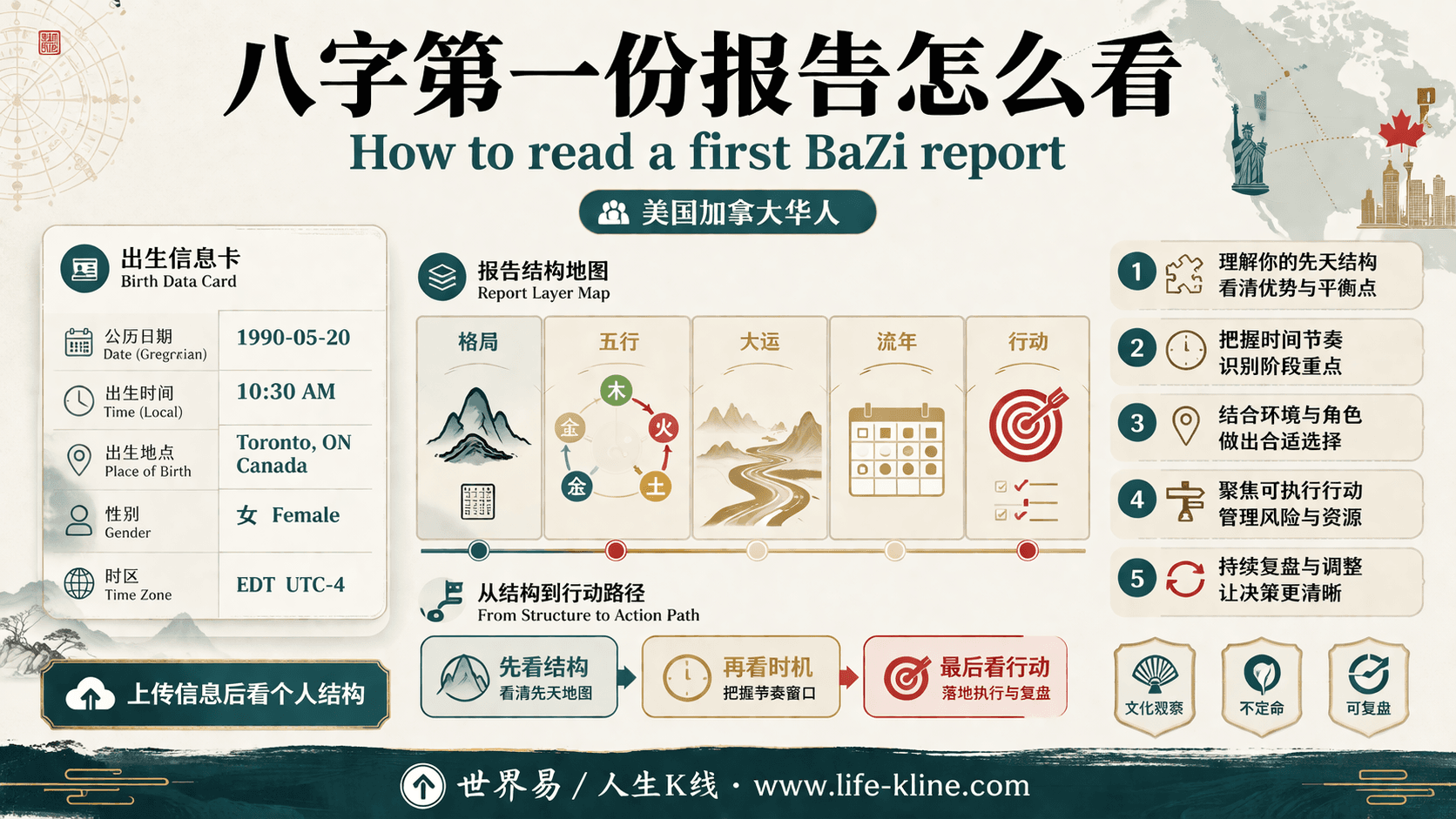
八字第一份报告怎么看|美国加拿大华人
这张图把《Complete Guide to Choosing Moving Dates: BaZi Patterns and Yong Shen Explained》里的命理概念转成关系、边界和应用场景,适合先看图建立结构,再回到知识文章正文理解细节。
八字第一份报告怎么看不应被写成固定结论。更适合美国加拿大华人的读法,是把传统术语翻译成结构、时机、环境、行动和复盘。
查看图片解读