Complete Guide to Qimen Prediction: Core Principles and Real Chart Analysis
把这篇文章落到自己身上验证:先看结构,再进入个人分析,不做泛泛阅读。
What is Qimen Prediction
Qimen prediction is an important forecasting technique within the Qimen Dunjia system, originating from the combination of ancient Chinese imperial military strategy and astronomical calendrical science. It deduces future auspicious and inauspicious changes for individuals or matters by precisely dividing time and space, integrating Heavenly Stems (天干), Earthly Branches (地支), Eight Gates, and Nine Stars.
Qimen prediction emphasizes the analysis of patterns, Yong Shen (favorable elements), and Ji Shen (unfavorable elements). Through comprehensive analysis of the Four Pillars BaZi, it explores beneficial and adverse factors in a person’s destiny to provide decision-making support. Its core philosophy is to align with the timing and geographical advantages, capturing critical nodes of change.
In ancient times, due to its complex structure and difficulty of interpretation, Qimen prediction was known as the “imperial study,” serving national affairs and military deployment. In modern times, it is widely applied in business investment, selecting auspicious dates, negotiation strategies, and other fields, demonstrating strong practical value.
How to Read Qimen Prediction: Core Elements
The core elements of Qimen prediction include the strength of the Day Master (日主), pattern types, determination of Yong Shen (favorable elements) and Ji Shen (unfavorable elements), and the interaction between Da Yun (decade luck cycles) and Liu Nian (annual fortune). The Day Master is the Heavenly Stem of the Day Pillar in the BaZi chart, representing the individual; its strength determines the overall energy and the Five Elements that need balancing.
Patterns summarize the overall combination of the BaZi, such as Qi Sha pattern, Pian Yin pattern, Shi Shen pattern, etc. Different patterns reflect the personality traits and destiny trends of the individual. Yong Shen are the Five Elements that need to be supported to balance the Day Master’s strength, while Ji Shen are those to avoid to prevent harm to the destiny.
Da Yun represents different life stages’ luck cycles, while Liu Nian refers to the yearly changing fortunes. Qimen prediction pays close attention to the interaction between Da Yun and Liu Nian, analyzing their auspicious or inauspicious combinations to judge fluctuations in yearly luck and corresponding strategies.
Judging the auspiciousness of the Eight Gates is also an important aspect of Qimen prediction. The Open (开), Rest (休), Life (生) gates are auspicious; Hurt (伤), Stop (杜), and Scenery (景) gates are neutral to slightly inauspicious; Death (死) and Shock (惊) gates are very inauspicious. However, specific auspiciousness must be combined with the palace location of the gate symbol and the overall pattern to avoid misleading conclusions from single factors.
Three Real Chart Cases
Case One is a female aged 45 to 50, with Four Pillars: 戊午 (Wu Wu), 乙卯 (Yi Mao), 己巳 (Ji Si), 庚午 (Geng Wu). The Day Master is 己土 (Ji Earth), moderately strong, with a Qi Sha pattern. Her Yong Shen are Wood and Water; Ji Shen is Fire. Her current Da Yun is 庚戌 (Geng Xu), a stable phase suggesting maintaining the status quo. The Liu Nian is 丙午 (Bing Wu). The interaction between Liu Nian and Da Yun is stable but requires adaptability. In Qimen prediction, this combination indicates the individual should respond steadily to external changes, avoid impulsive actions, and use Yong Shen Wood and Water to harmonize the Fire Ji Shen, ensuring overall stability.
Case Two is a female aged 35 to 40, with Four Pillars: 戊辰 (Wu Chen), 丁巳 (Ding Si), 己巳 (Ji Si), 甲戌 (Jia Xu). The Day Master is 己土 (Ji Earth), moderately strong, with a Pian Yin pattern. Yong Shen are Wood and Water; Ji Shen is Fire. The Da Yun is 癸丑 (Gui Chou), considered auspicious, with career and financial progress. The Liu Nian is 丙午 (Bing Wu), and the interaction with Da Yun follows the trend. Qimen prediction suggests the individual’s luck is good in this phase, advising to adapt to environmental changes, utilize Yong Shen Wood and Water to enhance advantages, prevent negative impact from Ji Shen Fire, and seize opportunities for development.
Case Three is a male aged 40 to 45, with Four Pillars: 壬戌 (Ren Xu), 癸丑 (Gui Chou), 辛丑 (Xin Chou), 甲午 (Jia Wu). The Day Master is 辛金 (Xin Metal), moderately strong, with a Shi Shen pattern. Yong Shen are Fire and Wood; Ji Shen is Earth. His current Da Yun is 丁巳 (Ding Si), a very auspicious luck cycle with smooth affairs. The Liu Nian is 丙午 (Bing Wu), and its interaction with Da Yun is favorable. In Qimen prediction, this chart indicates excellent luck; the individual should act proactively, use Yong Shen Fire and Wood to stimulate potential, guard against Ji Shen Earth obstacles, and seize momentum to achieve goals.
Common Misconceptions
Although Qimen prediction has a complex structure, it is often misunderstood as relying solely on the auspiciousness of the Eight Gates to judge fortune, neglecting the comprehensive analysis of patterns and Yong Shen. In reality, the auspiciousness of the Eight Gates must be combined with the palace location of the gate symbol and the overall pattern; judging gates separately can lead to errors.
Another misconception is inaccurate judgment of the Day Master’s strength, resulting in incorrect selection of Yong Shen and Ji Shen. The strength of the Day Master is the foundation of Qimen prediction; misunderstanding it affects the entire chart interpretation and misguides decision-making.
The interaction between Da Yun and Liu Nian is sometimes viewed simplistically as independent good or bad luck, ignoring their relationship. Qimen prediction emphasizes the coordination between Da Yun and Liu Nian; only by following the trend or making appropriate adjustments can the Yong Shen’s effect be maximized to avoid misfortune.
Practical Recommendations
When applying Qimen prediction in practice, first accurately identify the Five Elements and strength of the Day Master, clarifying Yong Shen and Ji Shen. This lays the foundation for subsequent analysis. Then combine with pattern types to understand the individual’s personality and destiny trends.
Secondly, pay attention to the interaction between Da Yun and Liu Nian, analyzing the impact of the current year’s fortune on the chart to guide daily decisions. When facing unfavorable Liu Nian, adjust strategies flexibly and avoid impulsiveness.
Finally, integrate the auspiciousness of the Eight Gates with the palace location of the gate symbol for a comprehensive judgment, avoiding misleading conclusions from single factors. In practice, consult multiple real chart cases to improve the accuracy and practicality of Qimen prediction.
FAQ
Question 1: Why is Qimen Dunjia called the “Imperial Study”? Answer: Qimen Dunjia is called the “Imperial Study” because of its complex structure and difficulty in interpretation. Historically, it was mainly used for military deployment and major decisions, serving emperors and generals. As the foremost of the Three Methods (Tai Yi, Qimen, Liu Ren), it integrates astronomy, geography, and time factors to help commanders control the overall situation. Modern Qimen is applied in business judgment, timing selection, and interpersonal negotiation, continuing its authoritative and practical value.
Question 2: How to judge the auspiciousness of the Eight Gates? Answer: The Eight Gates include Open (开), Rest (休), Life (生), Hurt (伤), Stop (杜), Scenery (景), Death (死), and Shock (惊). Open, Rest, and Life gates are auspicious; Hurt, Stop, and Scenery gates are neutral to slightly inauspicious; Death and Shock gates are very inauspicious. However, the auspiciousness must be analyzed in combination with the palace location of the gate symbol and the overall chart pattern. Judging the gates alone can easily lead to misjudgment; a holistic approach is necessary.
Question 3: How does Qimen prediction combine Da Yun and Liu Nian? Answer: In Qimen prediction, Da Yun represents a longer-term luck cycle, while Liu Nian refers to the annual fortune. Their interaction determines the current auspicious or inauspicious trends. Favorable Da Yun combined with supportive Liu Nian enables smooth development; otherwise, caution is advised. Accurate judgment of the coordination between Da Yun and Liu Nian is key to successful Qimen prediction.
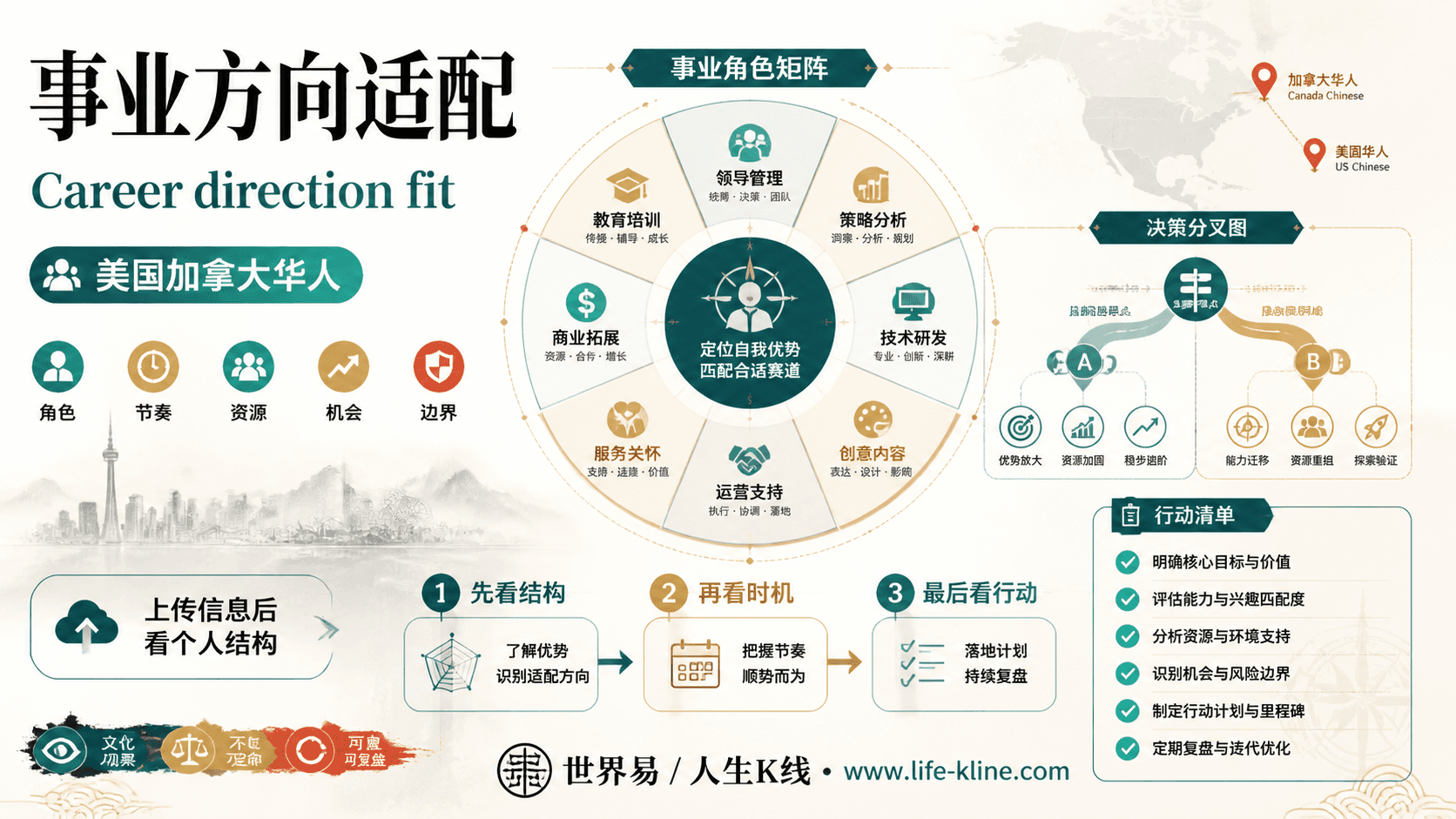
事业方向适配|美国加拿大华人
这张图把《Complete Guide to Qimen Prediction: Core Principles and Real Chart Analysis》里的命理概念转成关系、边界和应用场景,适合先看图建立结构,再回到知识文章正文理解细节。
事业方向适配不应被写成固定结论。更适合美国加拿大华人的读法,是把传统术语翻译成结构、时机、环境、行动和复盘。
查看图片解读