Complete Guide to Qimen Dunjia: Origins, Core Elements, and Real Case Analyses
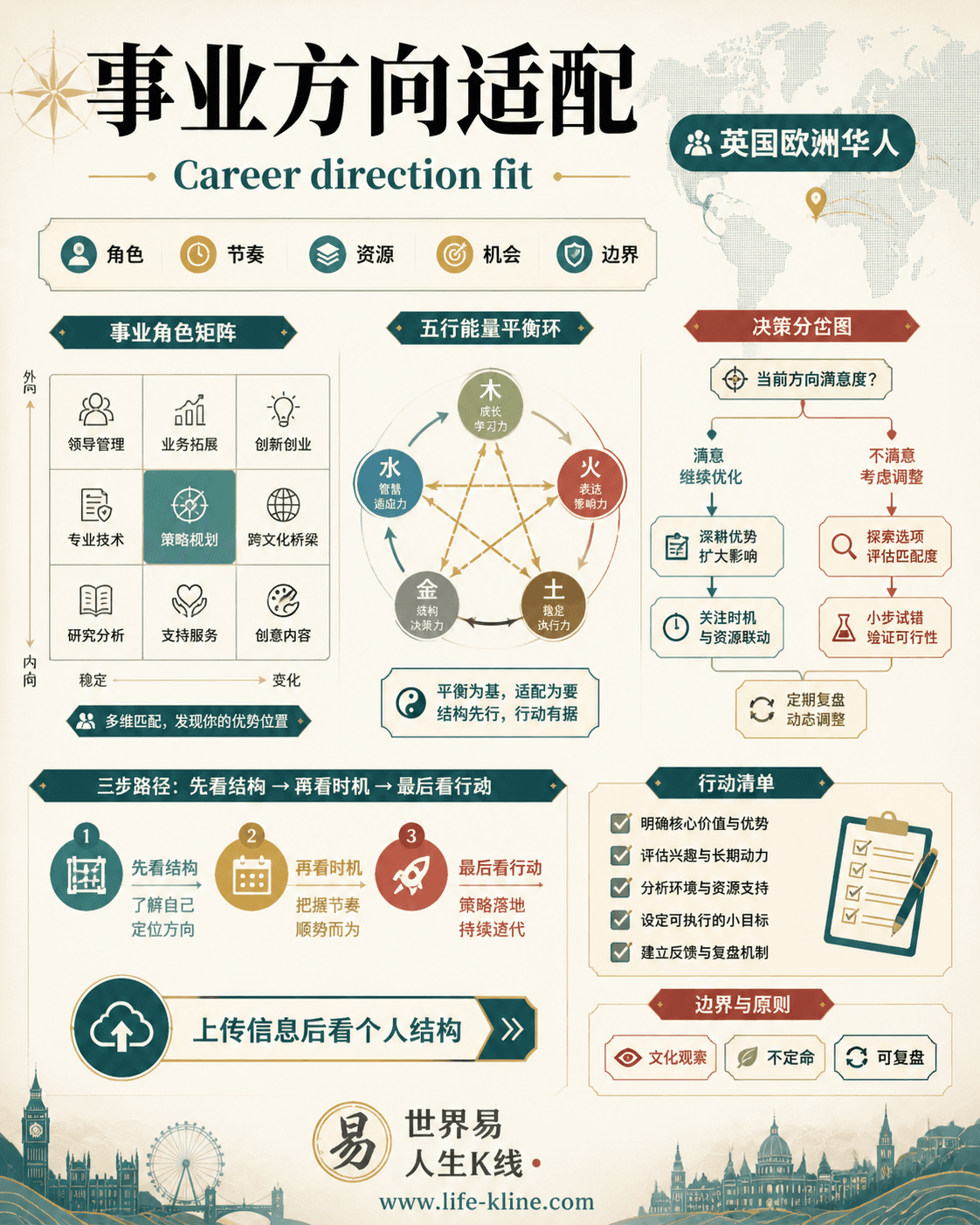
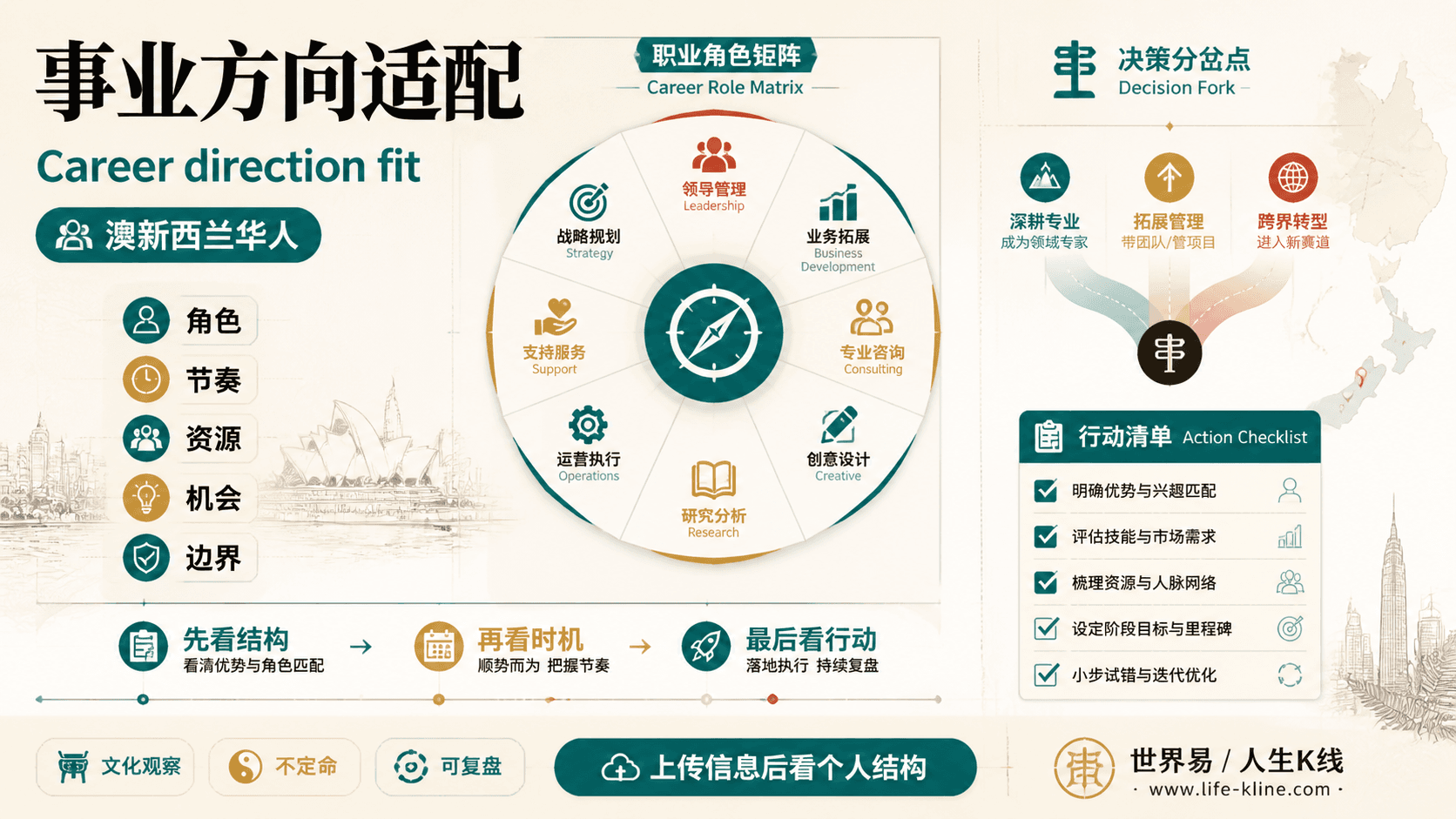
把这篇文章落到自己身上验证:先看结构,再进入个人分析,不做泛泛阅读。
What is Qimen Dunjia
Qimen Dunjia is one of the important ancient Chinese divination methods, ranking first among the traditional Three Styles (San Shi) of prediction. It has a long history, originating from the integration of ancient military strategy and astronomical calendar systems. It constructs a complex situation using elements such as Heavenly Stems (Tiangan), Earthly Branches (Dizhi), Eight Doors, and Eight Spirits, helping decision-makers perceive changes and trends in time and space.
Due to its high systematization and complexity, this art was used in ancient times for military deployment, battle simulation, and major decision-making, earning the honorable title of "The Imperial Study". Qimen Dunjia emphasizes not only timing but also multi-dimensional information synthesis.
With the development of times, the application scope of Qimen Dunjia has expanded from ancient military to modern business timing, interpersonal relationships, and risk management. By analyzing the heavenly plate information at specific time points, it assists users in formulating optimal action plans.
The core of Qimen Dunjia lies in constructing a situational map under spatiotemporal coordinates, revealing auspicious and inauspicious outcomes through the combination of Eight Doors, Nine Stars, Eight Spirits, and other factors to provide decision support. Its theoretical system is vast, requiring a high level of metaphysical knowledge for learning and application.
How to Read Qimen Dunjia: Core Elements
The interpretation of Qimen Dunjia mainly revolves around the Eight Doors, Nine Stars, Eight Spirits, the Heavenly Plate, and the Earthly Plate. Among these, the judgment of auspiciousness and inauspiciousness of the Eight Doors is one of the cores. The Eight Doors include Kai (Open), Xiu (Rest), Sheng (Life), Shang (Harm), Du (Obstacle), Jing (Scenery), Si (Death), and Jing (Shock). Traditionally, Kai, Xiu, and Sheng are considered auspicious doors; Shang, Du, and Jing are neutral to slightly inauspicious; while Si and Jing are highly inauspicious.
However, the judgment of the Eight Doors' auspiciousness cannot be done in isolation. It must be combined with the palace where the door sign is located, the Day Master, and the overall pattern (Ge Ju) for comprehensive analysis. The pattern determines the overall strength configuration and the selection of Yong Shen (favorable elements) and Ji Shen (unfavorable elements), thus affecting the specific interpretation and application strategy of the Eight Doors.
The strength of the Day Master is an important reference in Qimen Dunjia. A Day Master that is either too strong or too weak determines the choice of Yong Shen and Ji Shen, which in turn influences the auspiciousness and inauspiciousness of the Da Yun (decade luck cycle) and Liu Nian (annual fortune). Yong Shen refers to elements beneficial for balancing the Day Master’s Five Elements, while Ji Shen are elements to be avoided.
Da Yun and Liu Nian reflect the evolution of fortune over time. They are closely related to the Day Master, pattern, and Yong Shen. Da Yun usually represents longer-term trends, while Liu Nian reflects the specific fortune of the year. Their interaction determines the stability or fluctuation of overall luck.
By integrating the above elements, Qimen Dunjia constructs a dynamic relationship of the entire chart, providing users with adaptive strategic advice. It especially emphasizes acting according to the trend and maintaining stability to achieve the goal of seeking auspiciousness and avoiding misfortune.
Three Real BaZi Case Studies
Case One involves a female aged between 30 and 35, with a Day Master of Yi Wood (乙木, Yi). Her Day Master is relatively strong, and her pattern is Jie Cai (劫财) pattern. Her Yong Shen are Metal and Earth, while her Ji Shen is Water. She is currently in the 8th year of the Ding Si (丁巳, Ding Si) Da Yun, which is considered a stable luck cycle, suitable for maintaining achievements. The Liu Nian is Bing Wu (丙午, Bing Wu) year, which coordinates well with the Da Yun, allowing for adaptive responses. This chart illustrates the application of the Jie Cai pattern in Qimen Dunjia, emphasizing the regulating role of Yong Shen Metal and Earth to help the Yi Wood Day Master develop steadily through the Da Yun and Liu Nian, reflecting Qimen Dunjia’s precise control of spatiotemporal situations.
Case Two is a male aged between 35 and 40, with a Day Master of Ji Earth (己土, Ji). His Day Master is relatively strong, and his pattern is Zheng Guan (正官) pattern. His Yong Shen are Wood and Water, and his Ji Shen is Fire. His current Da Yun is Wu Wu (戊午, Wu Wu) in the 6th year, also a stable luck cycle suitable for maintaining achievements. The Liu Nian is Bing Wu (丙午, Bing Wu) year, which coordinates well with the Da Yun, demonstrating adaptive capacity in the annual fortune. The Zheng Guan pattern symbolizes discipline and authority. In this chart, Qimen Dunjia uses Yong Shen Wood and Water to assist and balance the Ji Earth Day Master’s strength, guiding the user to act steadily during the Da Yun and Liu Nian, enhancing the scientific nature of decision-making.
Case Three concerns a female aged between 25 and 30, with a Day Master of Xin Metal (辛金, Xin). Her Day Master is balanced, and her pattern is Bi Jian (比肩) pattern. Her Yong Shen is Earth, and her Ji Shen is Fire. She is currently in the 7th year of the Jia Xu (甲戌, Jia Xu) Da Yun, which is also a stable luck cycle suitable for maintaining achievements. The Liu Nian is Bing Wu (丙午, Bing Wu) year, interacting with the Da Yun to keep the overall trend stable. The Bi Jian pattern emphasizes self-strength and support. Through the regulation of Yong Shen Earth, Qimen Dunjia strengthens the stability of the Xin Metal Day Master, guiding the individual to maintain balance and adaptability amid the changing Liu Nian.
These three real cases all reflect the comprehensive application of Qimen Dunjia in metaphysical judgment regarding the Day Master, pattern, Yong Shen, Ji Shen, and the interaction of Da Yun and Liu Nian, demonstrating its practical value and effectiveness across different genders and age groups.
Common Misconceptions
Many people misunderstand Qimen Dunjia as merely a simple tool for judging auspiciousness and inauspiciousness. In fact, it is a complex system of spatiotemporal information synthesis that requires comprehensive judgment combining the Day Master, pattern, Yong Shen, Ji Shen, and Da Yun and Liu Nian. Judging only the auspiciousness of the Eight Doors alone can easily lead to incorrect conclusions.
Another common misconception is neglecting the role of the Day Master’s strength and the function of Yong Shen and Ji Shen. Qimen Dunjia emphasizes the balance and dynamic adjustment of the Five Elements. Without fully considering the Day Master’s strength and the regulatory effects of Yong Shen and Ji Shen, it is difficult to accurately understand the indicated auspicious and inauspicious changes in the chart.
Some also think that Da Yun and Liu Nian are merely simple time markers, ignoring their interactive relationship. In reality, Da Yun represents long-term trends, while Liu Nian reflects specific annual changes. Their synergy determines the fluctuations in overall fortune. Ignoring this point can lead to mistakes in strategy selection.
Additionally, some mistakenly limit Qimen Dunjia to ancient military use only, overlooking its applications in modern business, timing selection, and interpersonal relationships, which restricts its practical value.
Practical Suggestions
When learning Qimen Dunjia, one should first master the identification of the Day Master, pattern analysis, and determination of Yong Shen and Ji Shen. These are the foundations for understanding the auspiciousness of the Eight Doors and the interaction of Da Yun and Liu Nian. Only with a comprehensive grasp of these core elements can one accurately interpret chart information.
In practical application, it is recommended to combine specific time points and environmental factors, flexibly utilizing Qimen Dunjia’s spatiotemporal coordinate system to adapt to changes and act according to the trend. Especially when Da Yun is a stable luck cycle, maintaining achievements is advisable to avoid rash advancement.
Moreover, learning and practicing Qimen Dunjia requires continuous accumulation of cases and experience. By integrating with modern life realities, its application in business decision-making, timing arrangements, and interpersonal communication can be expanded, enhancing the practical value of prediction and guidance.
FAQ
Question 1: Why is Qimen Dunjia called "The Imperial Study"? Answer: Qimen Dunjia is called "The Imperial Study" because of its complex structure and high requirements for practitioners. In ancient times, it was mainly used for military deployment and major decisions serving emperors and generals. It is ranked first among the Three Styles (San Shi). In modern times, it is widely applied in business judgment, timing selection, and interpersonal negotiation.
Question 2: How to judge the auspiciousness of the Eight Doors? Answer: The Eight Doors include Kai (Open), Xiu (Rest), Sheng (Life), Shang (Harm), Du (Obstacle), Jing (Scenery), Si (Death), and Jing (Shock). Kai, Xiu, and Sheng are the three auspicious doors; Shang, Du, and Jing are neutral to slightly inauspicious; Si and Jing are highly inauspicious. However, the judgment of the Eight Doors must be combined with the palace where the door sign falls and the overall pattern. Judging the doors alone is insufficient.
Question 3: How do Da Yun and Liu Nian affect judgment in Qimen Dunjia? Answer: Da Yun represents longer-term trends, while Liu Nian reflects specific changes in the year. Their interaction determines the fluctuations in overall fortune. Stable Da Yun suggests maintaining achievements, while Liu Nian requires adaptive responses. Combining both allows for more accurate grasp of auspicious and inauspicious changes.
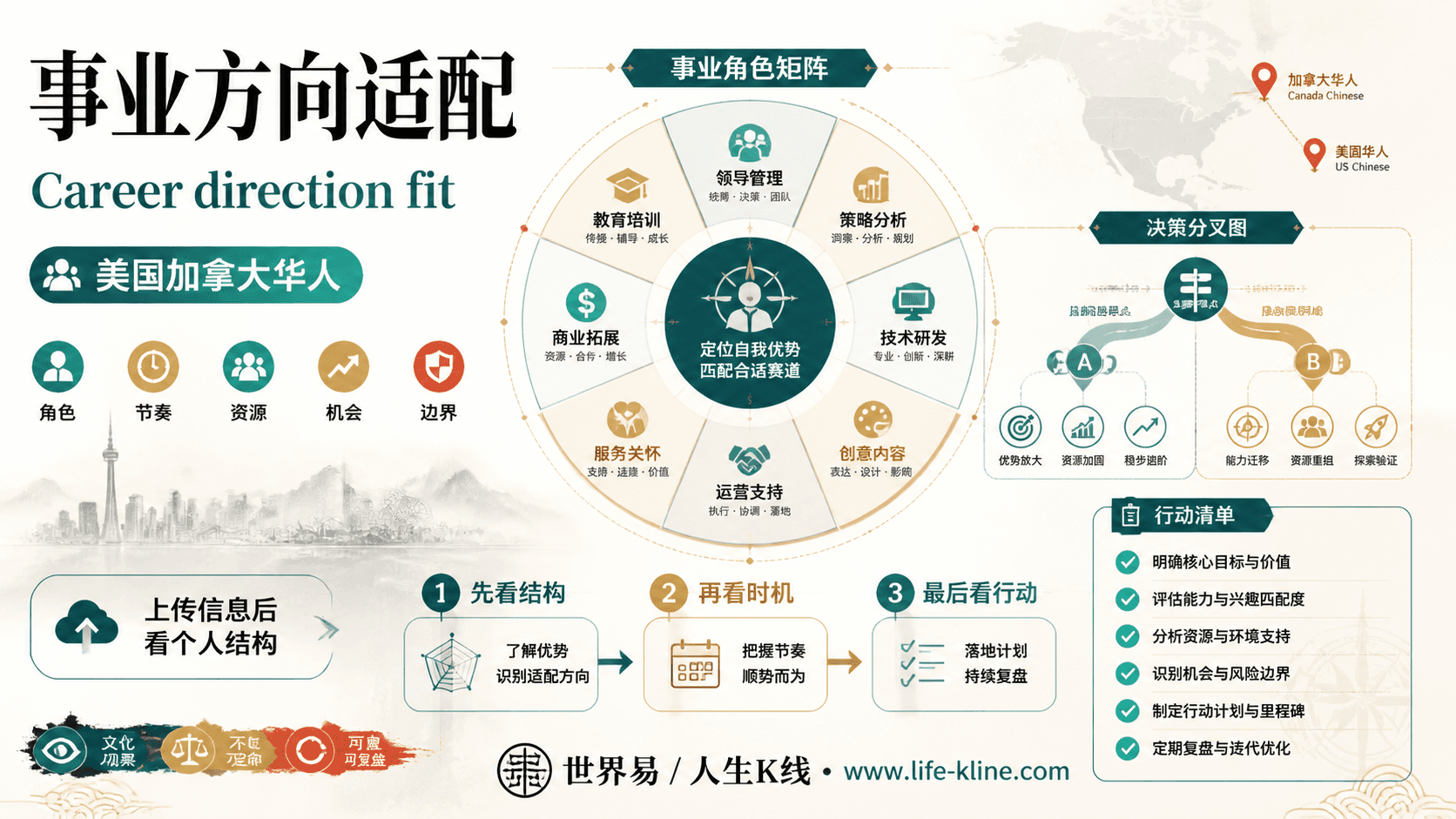
事业方向适配|美国加拿大华人
这张图把《Complete Guide to Qimen Dunjia: Origins, Core Elements, and Real Case Analyses》里的命理概念转成关系、边界和应用场景,适合先看图建立结构,再回到知识文章正文理解细节。
事业方向适配不应被写成固定结论。更适合美国加拿大华人的读法,是把传统术语翻译成结构、时机、环境、行动和复盘。
查看图片解读