Detailed Explanation of Qi Men Qi Ju: Complete Guide to Patterns, Yong Shen, and Da Yun & Liu Nian Integrated Analysis
把这篇文章落到自己身上验证:先看结构,再进入个人分析,不做泛泛阅读。
What is Qi Men Qi Ju
Qi Men Qi Ju is an important step in the study of Qi Men Dun Jia, referring to determining the Qi Men chart’s start time and configuration based on an individual’s Four Pillars BaZi (Heavenly Stems and Earthly Branches) and Da Yun (decade luck cycle) and Liu Nian (annual fortune). It combines elements such as the nine palaces, eight gates, and eight spirits of the Qi Men chart to conduct predictions and make decisions. The core lies in accurately identifying the natal chart’s pattern and Yong Shen, thereby adjusting the Qi Men chart’s setup strategy to enhance prediction accuracy.
Qi Men Dun Jia originated in ancient China and has developed over thousands of years. Initially, it mainly served military formations and major imperial decisions, thus being honored as the “Emperor’s Study.” Qi Men Qi Ju is not merely a matter of timing selection but also a grasp of the overall energy flow within the natal chart, reflecting the profound philosophy of Yin-Yang and the mutual generation and restriction among the Five Elements.
During the Qi Men Qi Ju process, it is necessary to combine the Day Master’s strength, pattern type, and specific Yong Shen and Ji Shen conditions of the Four Pillars, to assess the influence of the current Da Yun and Liu Nian on the natal chart. This then determines the Qi Men chart’s starting direction and gate talisman arrangement, achieving predictions that follow the trend and maximize effectiveness.
How to View Qi Men Qi Ju: Core Elements
First, identifying the strength of the Day Master is fundamental to Qi Men Qi Ju. The Day Master’s strength determines the nature of the pattern, which in turn influences the choice of Yong Shen. For example, if the Day Master is relatively weak, it may require support or suppression of certain Five Elements as Yong Shen; conversely, if strong, the approach differs. This plays a key role in arranging the gate talismans within the Qi Men chart.
Second, pattern types such as Cong Sha (From Qi Sha) pattern, Zhuan Wang (Exclusive Strength) pattern, Zheng Yin (Proper Seal) pattern, etc., reflect the overall structure and power distribution of the natal chart. Under different patterns, the focus on specific Five Elements during Qi Men Qi Ju varies, directly affecting the application strategy of the eight gates and eight spirits in the Qi Men chart.
Third, the judgment of Yong Shen and Ji Shen is particularly important. Yong Shen is the key element for harmonizing the natal chart; during Qi Men Qi Ju, ensuring the energy flow of Yong Shen is prioritized, while Ji Shen must be carefully controlled to avoid negative impacts on the situation. The Qi Men chart’s formation often centers around Yong Shen, embodying the principle of seeking benefit and avoiding harm.
Finally, the interaction between the current Da Yun and Liu Nian also affects the timing and direction of Qi Men Qi Ju. Da Yun represents long-term trends, while Liu Nian reflects annual changes. Qi Men Qi Ju should integrate both, adapting to the stability or changes of Da Yun and flexibly adjusting the chart layout to improve the practical effectiveness of predictions.
Three Real Natal Chart Cases
Case One involves a male aged between 45 and 50, with a Day Master of 癸 (Gui) Water, balanced but tending toward a Cong Sha pattern, mainly using Earth and Fire as Yong Shen, and avoiding Metal and Water as Ji Shen. He is currently in the 10th year of the 庚午 (Geng Wu) Da Yun, with the Liu Nian being 丙午 (Bing Wu). The overall Da Yun is stable, and the Liu Nian requires flexible adaptation. During Qi Men Qi Ju, emphasis should be placed on ensuring the energy flow of the Earth and Fire Yong Shen, while avoiding interference from the Metal and Water Ji Shen. Such a Qi Men setup strategy helps maintain natal chart stability, aligns with the stable characteristics of Da Yun and Liu Nian, and enhances control over the situation.
Case Two concerns a male of the same age group, with a Day Master 己 (Ji) Earth that is relatively strong, a Zhuan Wang (Exclusive Strength) pattern, Yong Shen being Metal, and Ji Shen being Fire. He is in the 8th year of the 甲申 (Jia Shen) Da Yun, with the Liu Nian also being 丙午 (Bing Wu). The overall Da Yun is relatively stable. During Qi Men Qi Ju, the focus should be on strengthening the Metal energy to assist the Day Master, while guarding against the negative influence of Fire. Considering the stable trend of Da Yun and Liu Nian, the chart layout can be arranged reasonably with gates and spirits to ensure the stable function of Yong Shen and enhance the natal chart’s ability to maintain achievements.
Case Three is a female aged between 40 and 45, with a Day Master 丙 (Bing) Fire that is relatively weak, a Zheng Yin (Proper Seal) pattern, mainly using Wood as Yong Shen, and avoiding Earth and Metal as Ji Shen. She is currently in the 9th year of the 辛未 (Xin Wei) Da Yun, with the Liu Nian being 丙午 (Bing Wu). The overall Da Yun is weak and somewhat dangerous, and the Liu Nian requires cautious handling. During Qi Men Qi Ju, emphasis should be placed on supporting the Wood Yong Shen and suppressing the intrusion of Earth and Metal Ji Shen. Due to the weak Da Yun and uncertain Liu Nian, Qi Men Qi Ju should focus more on flexibility and protection, avoiding major mishaps and ensuring a stable transition of the situation.
Common Misconceptions
Qi Men Qi Ju is often mistakenly regarded as merely a simple timing technique. In reality, it is a complex systematic project that requires comprehensive consideration of the Day Master’s strength, pattern, Yong Shen and Ji Shen, as well as Da Yun and Liu Nian. Omitting any of these elements may lead to inaccurate predictions.
Another common misconception is focusing only on the auspiciousness or inauspiciousness of the eight gates while neglecting the relationship between the gate talismans’ palace placement and the overall pattern. Although the eight gates individually have distinctions of good or bad fortune, accurate judgment of the situation’s auspiciousness requires integrating the gate talismans and palace positions.
Additionally, some people mistakenly think that Da Yun and Liu Nian are merely time markers. In fact, they have important energy guidance roles within the natal chart. Qi Men Qi Ju must fully consider the interaction between Da Yun and Liu Nian, adapting to their changes to maximize the efficacy of Qi Men Dun Jia.
Practical Recommendations
In practical Qi Men Qi Ju operations, it is essential first to accurately analyze the Four Pillars, clarify the Day Master’s strength and pattern type, and determine Yong Shen and Ji Shen. Then, combine the current Da Yun and Liu Nian for a comprehensive evaluation to formulate a scientific and reasonable Qi Men setup plan.
It is recommended that when arranging the Qi Men chart, priority be given to ensuring the energy flow of Yong Shen and avoiding interference from Ji Shen. Especially when there is conflict between Liu Nian and Da Yun, flexible adjustments to gate talismans and spirit configurations are necessary to adapt to environmental changes.
Moreover, Qi Men Qi Ju should be combined with specific application scenarios such as military, business, or personal decision-making. Flexibly selecting the start time and direction of the chart can achieve auspiciousness and avoid misfortune, thereby improving the success rate of decisions. Continuous accumulation of practical experience helps better understand the integration of theory and practice.
FAQ
Question 1: Why is Qi Men Dun Jia called the “Emperor’s Study”? Answer: In ancient times, Qi Men Dun Jia was mainly used for military deployment and major decisions. Due to its complex structure and the need for skilled practitioners to interpret it, it was ranked first among the “Tai Yi, Qi Men, Liu Ren” three methods and often served emperors and generals. In modern times, Qi Men is widely used in business judgment, timing selection, interpersonal negotiation, and various other scenarios, still reflecting its noble and practical value.
Question 2: How to judge the auspiciousness of the eight gates? Answer: The eight gates include Kai (Open), Xiu (Rest), Sheng (Life), Shang (Harm), Du (Obstruction), Jing (Scenery), Si (Death), and Jing (Shock). Kai, Xiu, and Sheng gates are generally considered the three auspicious gates; Shang, Du, and Jing gates tend to be neutral or slightly inauspicious; Si and Jing gates are major inauspicious gates. However, the judgment of the eight gates’ auspiciousness must be combined with the palace positions of the gate talismans and the overall pattern for comprehensive analysis. Judging solely by gate names cannot fully determine auspiciousness.
Question 3: How to combine Da Yun and Liu Nian during Qi Men Qi Ju? Answer: Da Yun represents the long-term trend of the natal chart, while Liu Nian reflects the environmental changes of the year. Qi Men Qi Ju must comprehensively consider the interaction between Da Yun and Liu Nian, conform to the stability or variation of Da Yun, and combine with the flexible adaptation of Liu Nian to adjust the Qi Men setup strategy, ensuring the situation remains stable and can flexibly respond to external changes.
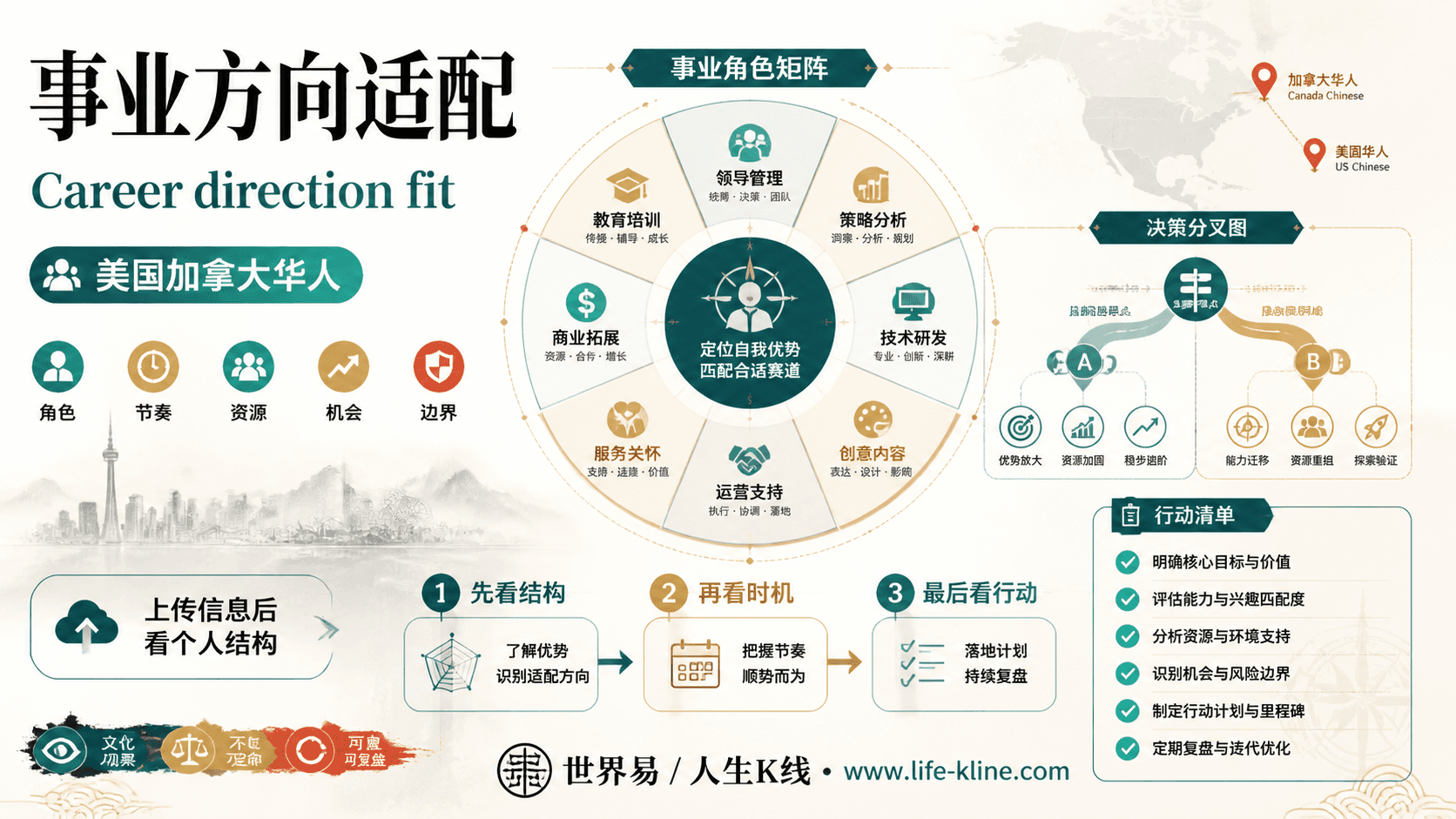
事业方向适配|美国加拿大华人
这张图把《Detailed Explanation of Qi Men Qi Ju: Complete Guide to Patterns, Yong Shen, and Da Yun & Liu Nian Integrated Analysis》里的命理概念转成关系、边界和应用场景,适合先看图建立结构,再回到知识文章正文理解细节。
事业方向适配不应被写成固定结论。更适合美国加拿大华人的读法,是把传统术语翻译成结构、时机、环境、行动和复盘。
查看图片解读