Complete Guide to Tarot Divination: Core Principles and Integration with Chinese Metaphysics
把这篇文章落到自己身上验证:先看结构,再进入个人分析,不做泛泛阅读。
What is Tarot Divination
Tarot divination is a predictive method that reveals answers and future trends by drawing specific Tarot cards. It originated in medieval Europe, combining symbolic semiotics and psychological elements, aiming to interpret subconscious information through imagery to assist people in making decisions.
A Tarot deck usually consists of 78 cards, divided into the Major Arcana and Minor Arcana. Each card carries rich symbolic meanings. The diviner shuffles and draws cards to map their inner questions onto the cards, using the card meanings and spread structures to gain insights and guidance.
Modern Tarot divination not only focuses on fate but also emphasizes the querent's concentration and clarity of questions. It is a supportive tool that helps people clarify their thoughts and discover potential possibilities rather than simply predicting fixed destinies.
How to Read Tarot Divination: Core Elements
The accuracy of Tarot divination depends on three key factors: the clarity of the question, the experience level of the reader, and the focus during card drawing. Clear and specific questions enable card meanings to be more relevant, while vague questions often result in difficult-to-interpret outcomes.
The reader’s experience affects the depth and breadth of interpretation. Familiarity with card meanings and various spreads helps the reader better integrate the querent’s background information to provide personalized answers.
Focus determines the energy connection during card drawing. Concentrated divination reduces external interference, allowing the subconscious to be more accurately reflected on the cards, thereby increasing the reference value of the reading.
Three Real BaZi Cases
Case One is a woman aged 40 to 45, with a Day Master of Ji (己, Earth), moderately strong. Her BaZi pattern is Yang Ren (羊刃) pattern, with Yong Shen (favorable elements) being Wood and Water, and Ji Shen (unfavorable element) being Fire. She is currently in the Wu Zi (戊子) Da Yun (decade luck cycle), advised to maintain stability, and the Liu Nian (annual fortune) is Bing Wu (丙午). The Yang Ren pattern indicates a resolute personality, and the moderately strong Earth Day Master is balanced by the Wood and Water Yong Shen. When combined with Tarot divination, understanding her metaphysical background helps interpret symbols related to Earth and Wood on the cards, enhancing guidance for her decisions.
Case Two is a man aged 35 to 40, with a Day Master of Xin (辛, Metal), in a balanced state. His BaZi pattern is Zheng Guan (正官) pattern, with Yong Shen being Earth and Ji Shen being Fire. He is currently in the Ren Shen (壬申) Da Yun, with the Liu Nian being Bing Wu (丙午), overall stable and advised to maintain status quo. The Zheng Guan pattern shows he has a strong sense of responsibility and discipline. In Tarot reading, the interpreter can focus on card elements related to Metal and Earth, and considering his stable Da Yun, provide specific advice on career and interpersonal relationships.
Case Three is a man aged 20 to 25, with a Day Master of Yi (乙, Wood), relatively weak. His BaZi pattern is Jie Cai (劫财) pattern, with Yong Shen being Water, and Ji Shen being Fire and Earth. He is currently in the Ren Wu (壬午) Da Yun’s eighth year, with the Liu Nian also Bing Wu (丙午), and the Da Yun is stable. The Jie Cai pattern suggests potentially complex interpersonal relationships; the weak Day Master and Water Yong Shen indicate the need to rely on fluid and gentle forces. When combined with Tarot divination, emphasis can be placed on Water-related card meanings to help mitigate the adverse effects of Ji Shen, offering references for emotions and career.
These three cases demonstrate that integrating BaZi analysis helps deepen the effectiveness of Tarot interpretation. By understanding the Day Master’s strength, pattern, and Yong Shen, the reader can more accurately grasp the querent’s internal needs and external environment, thus improving the accuracy and practicality of the divination.
Common Misconceptions
Many people mistakenly believe Tarot divination can provide absolutely accurate future predictions. In reality, Tarot mainly offers references to trends and possibilities, with results limited by question formulation and reader ability.
Another common misconception is repeatedly drawing cards casually, thinking more draws lead to better accuracy. According to traditional rules, repeatedly drawing cards for the same question within 24 hours causes subconscious confusion. It is recommended to wait a week or ask from a different perspective.
Some also overlook the influence of environment and mindset on divination results. If the mind is unsettled or the question unclear during card drawing, the resulting card information often fails to accurately reflect the true situation.
Practical Suggestions
Before performing Tarot divination, clearly define specific questions and avoid vague or ambiguous inquiries. This helps draw more targeted cards and enhances interpretive value.
Readers should continuously improve their understanding of Tarot card meanings and spreads, and integrate the querent’s metaphysical information such as Day Master, pattern, and Yong Shen for comprehensive analysis, making results more personalized and relevant.
Maintaining a good mindset and focus while avoiding external distractions is key to ensuring divination accuracy. Also, arrange divination frequency reasonably and avoid repeated draws for the same question in a short period to prevent confusing information.
FAQ
Question 1: Is Tarot divination accurate? Answer: The accuracy of Tarot divination highly depends on three factors: question clarity, reader experience, and focus during card drawing. Drawing a card casually with a vague question usually yields inaccurate results; however, focusing on a specific choice (e.g., whether to choose A or B) and drawing three cards in a 'Past-Present-Future' spread significantly increases reference value.
Question 2: Can the same question be drawn repeatedly? Answer: Traditional Tarot rules advise against repeatedly drawing cards for the same question within 24 hours, as the first draw affects the subconscious, causing confusion in subsequent results. It is recommended to wait at least a week or rephrase the question from a different angle to obtain clearer guidance.
Question 3: How to integrate Chinese metaphysics to enhance Tarot interpretation? Answer: Combining BaZi elements such as Day Master, pattern, and Yong Shen helps the reader more accurately understand the querent’s internal character and external environment. For example, knowing the Day Master’s strength and Ji Shen can guide the reader to focus on corresponding symbolic elements in the cards, making Tarot interpretation more targeted and profound.
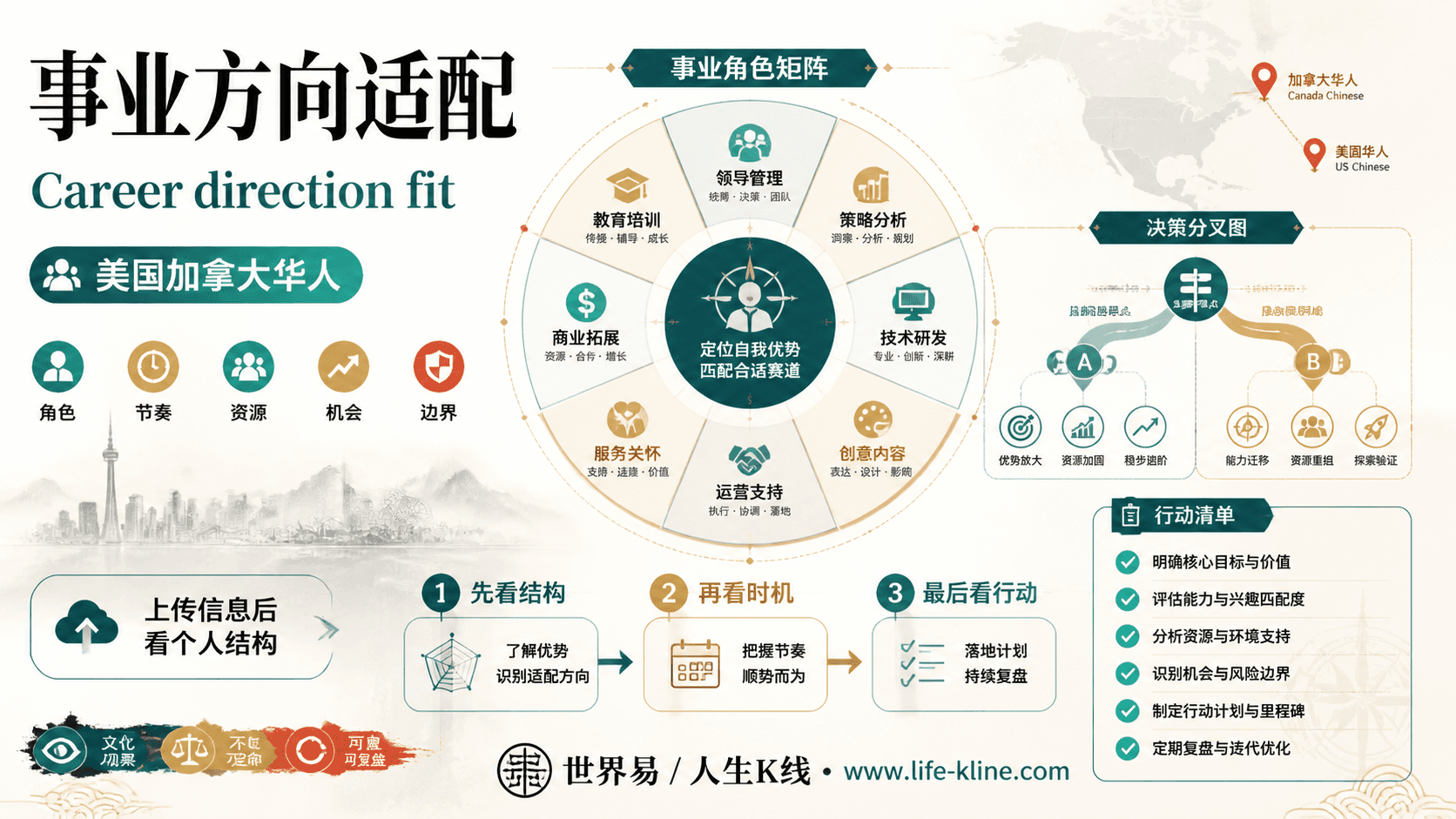
事业方向适配|美国加拿大华人
这张图把《Complete Guide to Tarot Divination: Core Principles and Integration with Chinese Metaphysics》里的命理概念转成关系、边界和应用场景,适合先看图建立结构,再回到知识文章正文理解细节。
事业方向适配不应被写成固定结论。更适合美国加拿大华人的读法,是把传统术语翻译成结构、时机、环境、行动和复盘。
查看图片解读