A Complete Guide to BaZi Analysis and Practical Application in Tarot Career
把这篇文章落到自己身上验证:先看结构,再进入个人分析,不做泛泛阅读。
What Is a Tarot Career
A Tarot career refers to professional activities centered around Tarot card divination, interpretation, and related consulting services. As an ancient and widely used divination tool, Tarot cards use symbolic images and card spread structures to help people explore the subconscious, predict future trends, and assist decision-making.
In recent years, the Tarot career has gradually evolved from purely mystical domains toward professionalization and diversification, involving personal consultations, psychological counseling, spiritual growth, and more. Its development relies on referencing and integrating traditional wisdom from metaphysics such as BaZi Four Pillars.
By combining BaZi theory elements like the Day Master, pattern, and Yong Shen, one can gain a deeper understanding of an individual's personality traits, potential strengths, and career directions, thereby enhancing the relevance and accuracy of Tarot career services and increasing client trust and satisfaction.
Core Elements for Understanding a Tarot Career
To accurately interpret the development potential of a Tarot career, one must first clarify the Day Master attribute and its strength. The Day Master represents the individual's core energy and essential traits; whether it is strong or weak influences career initiative and adaptability.
Secondly, the pattern type reveals the career model and resource allocation of the individual. For example, the Pian Cai (偏财) pattern suits flexible management, Zheng Guan (正官) emphasizes discipline and rules, while the Yang Ren (羊刃) pattern provides drive and breakthrough power. Understanding the pattern helps determine career development strategies.
Yong Shen (用神) and Ji Shen (忌神) are key in BaZi judgment, indicating which Five Elements need support or avoidance. Proper use of Yong Shen can regulate unfavorable factors in the career environment, enhancing the stability and growth of Tarot business.
Da Yun (大运) and Liu Nian (流年) reflect fortune changes over different time periods. The auspiciousness of the current Da Yun and its interaction with the Liu Nian affect career smoothness and the ability to handle challenges, reminding practitioners to seize opportunities and adjust plans timely.
By integrating these BaZi elements with the symbolic meanings of Tarot cards and card spread interpretations, one can form a more comprehensive and dynamic understanding of the Tarot career, aiding practitioners in scientifically planning future development.
Three Real BaZi Chart Cases
Case 1 involves a male aged 40 to 45, with a Ji (己, Earth) Day Master that is relatively weak, a Pian Cai (偏财) pattern, Yong Shen is Fire, and Ji Shen are Metal and Water. He is currently in the Wu Yin (戊寅) Da Yun (ages 42-51), which is stable and suitable for consolidation, with the Liu Nian being Bing Wu (丙午). This chart indicates a career suitable for steady development; the Pian Cai pattern suggests good financial opportunities, but due to the weak Day Master, reliance on the Fire Yong Shen to activate energy is necessary while avoiding the adverse effects of Metal and Water. In the context of a Tarot career, it is recommended to emphasize flexibility and creativity in management, using the stable Da Yun period to steadily improve professional skills and client base.
Case 2 is a female aged 50 to 55, with an Yi (乙, Wood) Day Master that is relatively weak, a Zheng Guan (正官) pattern, Yong Shen is Water, and Ji Shen are Fire and Earth. She is currently in the Yi Chou (乙丑) Da Yun (ages 47-56), which is stable and suitable for consolidation, with the Liu Nian also being Bing Wu (丙午). The Zheng Guan pattern emphasizes rules and authority, suitable for engaging in more regulated Tarot consulting work. The Water Yong Shen helps nourish the Yi Wood, enhancing career flexibility and communication skills, while the Ji Shen Fire and Earth warn against excessive emotionality or oppressive environments. Overall, this chart suits gaining client trust through professional image and meticulous service, leveraging the stable Da Yun period to deepen industry experience.
Case 3 involves a female aged 40 to 45, with a Ji (己, Earth) Day Master that is relatively strong, a Yang Ren (羊刃) pattern, Yong Shen are Wood and Water, and Ji Shen is Fire. She is currently in the Ren Yin (壬寅) Da Yun (ages 36-45), a highly auspicious luck cycle, with the Liu Nian being Bing Wu (丙午). The Yang Ren pattern endows the Day Master with strong ambition and breakthrough ability, suitable for actively expanding the career. The Wood and Water Yong Shen help soften the rigidity of Earth, benefiting teamwork and adaptability. The auspicious Da Yun portends smooth career development. In a Tarot career context, this suggests suitability for bold innovation and actively promoting personalized services, following the Liu Nian trend to achieve remarkable results.
Common Misconceptions
Many people mistakenly believe Tarot card interpretation relies entirely on intuition and random card draws, neglecting precise question formulation and the interpreter's professional experience, resulting in vague and impractical outcomes. In fact, clear and specific questions are fundamental to accurate divination.
Another misconception is repeatedly drawing cards for the same question, hoping multiple draws will yield a more accurate answer. Traditional Tarot rules recommend waiting at least one week before re-asking the same question; otherwise, subconscious interference can cause confusion in results.
When combining BaZi analysis with Tarot career interpretation, misusing or arbitrarily altering the Day Master, pattern, or Yong Shen in the Four Pillars can easily lead to inaccurate judgments. BaZi assessments must strictly follow the Four Pillars facts, as any deviation affects the scientific validity and effectiveness of career planning.
Practical Recommendations
In practical Tarot career work, it is recommended that the diviner first clarifies the client's specific questions, then combines the BaZi Four Pillars Day Master, pattern, and Yong Shen to assess career strengths and bottlenecks, thereby formulating personalized card spreads and interpretation strategies.
When managing a Tarot career, close attention should be paid to the current Da Yun and Liu Nian fortunes, applying the principle of following the trend to adjust service content and marketing direction. Avoid rushing during periods heavily affected by Ji Shen, maintaining steady career development.
Additionally, Tarot practitioners should continuously improve their professional skills and mental focus to avoid compromised divination accuracy caused by impatience or lack of experience. Integrating BaZi and Tarot analyses will greatly enhance client trust and satisfaction.
FAQ
Question 1: Is Tarot divination accurate? Answer: The accuracy of Tarot divination highly depends on three factors: the clarity of the question, the interpreter's experience, and concentration during card drawing. If the question is vague and cards are drawn casually, results are often inaccurate; however, focusing on specific decisions and drawing the "Past-Present-Future" three-card spread significantly improves reference value.
Question 2: Can the same question be drawn repeatedly? Answer: Traditional Tarot rules advise against repeatedly drawing cards for the same question within 24 hours because the first draw already influences the subconscious, potentially causing confusion. It is recommended to wait at least one week before re-asking or to approach the question from a different angle for clearer answers.
Question 3: How to combine BaZi to improve a Tarot career? Answer: Combining BaZi elements such as the Day Master, pattern, Yong Shen, and Da Yun and Liu Nian helps Tarot practitioners grasp their career strengths and development phases, scientifically plan business directions, and enhance the relevance and practicality of divination, thereby better serving clients and promoting career growth.
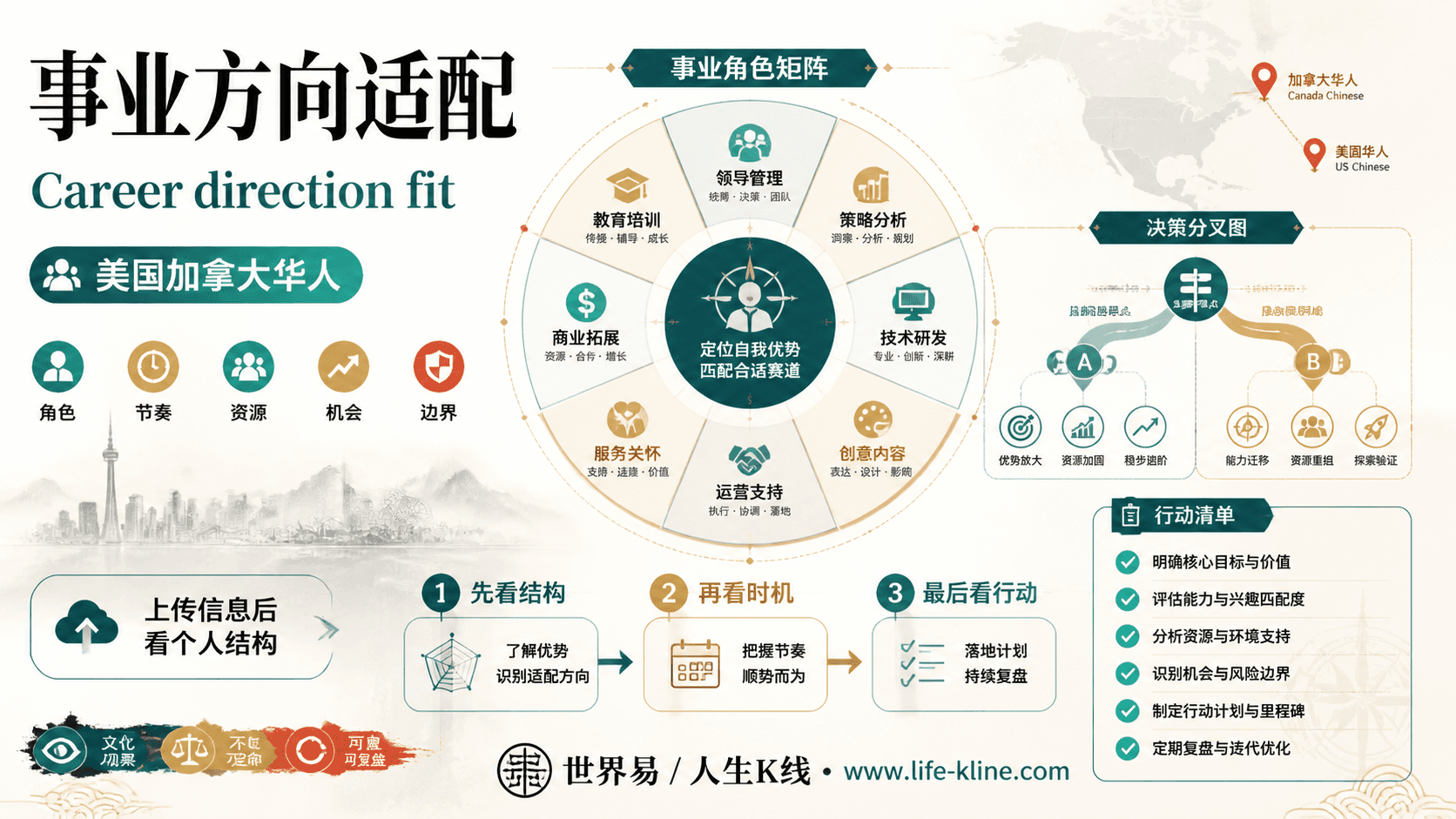
事业方向适配|美国加拿大华人
这张图把《A Complete Guide to BaZi Analysis and Practical Application in Tarot Career》里的命理概念转成关系、边界和应用场景,适合先看图建立结构,再回到知识文章正文理解细节。
事业方向适配不应被写成固定结论。更适合美国加拿大华人的读法,是把传统术语翻译成结构、时机、环境、行动和复盘。
查看图片解读