Complete Guide to Kitchen Feng Shui: Layout and Adjustments from a Metaphysical Perspective
把这篇文章落到自己身上验证:先看结构,再进入个人分析,不做泛泛阅读。
What is Kitchen Feng Shui
Kitchen Feng Shui is an important component of Feng Shui studies, mainly focusing on how the kitchen's layout, orientation, and energy field affect the health, wealth, and overall fortune of family members. As the place for cooking and dining, the kitchen's energy directly relates to family harmony and vitality. A reasonable kitchen Feng Shui layout can promote the circulation and balance of Qi (energy).
Traditional Feng Shui considers the kitchen as belonging to the Fire element, with strong fire energy. Therefore, its location and layout must harmonize with the overall Five Elements of the residence, avoiding excessive fire that suppresses other important elements. The kitchen’s orientation, stove placement, and the interaction between water and fire are core topics in kitchen Feng Shui research.
Modern metaphysics integrates the Day Master and Yong Shen theories from the Four Pillars (BaZi) to further refine personalized kitchen Feng Shui adjustments. By analyzing the owner's metaphysical likes and dislikes, the kitchen layout can be specifically adjusted to the Five Elements’ energy field to supplement the Yong Shen and restrain the Ji Shen (unfavorable elements), thereby enhancing the resident’s fortune and health.
How to Assess Kitchen Feng Shui: Core Elements
The core elements of kitchen Feng Shui first require combining the resident’s BaZi, especially the Day Master’s Five Elements attribute, pattern type, as well as the Yong Shen and Ji Shen. The Day Master represents the resident’s own attribute; the Yong Shen is the favorable element that needs supplementation, while the Ji Shen is the element that should be avoided if overly strong. In kitchen Feng Shui, the proportions of Fire, Water, Wood, Metal, and Earth should be adjusted according to the Yong Shen to achieve Yin-Yang and Five Elements balance.
Secondly, the kitchen’s orientation should conform to the Yong Shen’s elemental attribute. If the Yong Shen is Water, the kitchen should avoid excessive Fire elements. It is recommended to arrange water sources and the stove reasonably to avoid water-fire conflict. If the Yong Shen is Fire, the kitchen’s fire energy can be appropriately enhanced but controlled to prevent excessive fire harming health.
Additionally, the stove’s position, sink arrangement, ventilation, lighting, and overall cleanliness inside the kitchen all influence the Feng Shui energy field. The stove represents Fire, the sink represents Water; these two should avoid facing each other directly to prevent water-fire conflict, which can affect family health and wealth. Good ventilation and lighting promote smooth Qi flow and prevent dampness and Sha Qi (negative energy) accumulation.
Finally, kitchen Feng Shui should also consider its relationship with key areas such as bedrooms, entrances, and toilets, avoiding unfavorable layouts like the door facing the stove or the stove facing the toilet. This ensures smooth Qi flow and positive energy circulation. Depending on the different Yong Shen in the metaphysical chart, the focus of kitchen Feng Shui adjustments will vary.
Three Real BaZi Case Studies
Case One involves a female aged 35 to 40, with Four Pillars (Sixty Jia Zi) as Ji Si (己巳), Ren Shen (壬申), Jia Yin (甲寅), Gui You (癸酉). The Day Master is Jia Wood (甲木), relatively weak, with a pattern of Pian Yin (偏印). Her Yong Shen is Water, and Ji Shen are Fire and Earth. She is currently in the Da Yun (decade luck cycle) of Bing Zi (丙子) and the Liu Nian (annual fortune) of Bing Wu (丙午). Because her Yong Shen is Water, kitchen Feng Shui should focus on supplementing Water elements and avoiding areas with excessive Fire. The sink position in the kitchen should be reasonably arranged to reduce the Fire’s restraint on the Yong Shen Water. Also, since Fire and Earth are Ji Shen, the stove and kitchen floor should avoid excessive Earth and Fire elements. Maintaining good ventilation and a proper water-fire balance will promote the growth of the Day Master Jia Wood, benefiting health and career development.
Case Two is a male aged 55 to 60, with Four Pillars as Xin Hai (辛亥), Geng Yin (庚寅), Ding Hai (丁亥), Jia Chen (甲辰). The Day Master is Ding Fire (丁火), relatively strong, with a Zheng Cai (正财) pattern. His Yong Shen are Water and Metal, and Ji Shen is Wood. He is currently in the Da Yun of Yi You (乙酉) and the Liu Nian of Bing Wu (丙午). Since his Yong Shen are Water and Metal, the kitchen Feng Shui layout should appropriately increase Water and Metal elements, such as the rational placement of the sink and metal kitchen utensils, to regulate the overly strong Fire Day Master. At the same time, avoid excessive Wood elements in the kitchen. A Fire-strong kitchen requires the power of Metal and Water to suppress Wood energy and stabilize wealth luck. Ventilation and lighting in the kitchen should also be carefully managed to prevent excessive Fire from harming health.
Case Three involves a male aged 50 to 55, with Four Pillars as Yi Mao (乙卯), Bing Xu (丙戌), Jia Chen (甲辰), Gui You (癸酉). The Day Master is Jia Wood (甲木), relatively weak, with a Shi Shen (食神) pattern. His Yong Shen is Fire, and Ji Shen is Earth. He is currently in the Da Yun of Xin Si (辛巳) and the Liu Nian of Bing Wu (丙午). Since his Yong Shen is Fire, and the kitchen represents Fire, the Fire element should be moderately enhanced, such as adjusting the stove’s orientation and firepower reasonably. This benefits the supplementation of the Yong Shen Fire and promotes the growth of the Day Master Jia Wood. At the same time, avoid excessive Earth elements in the kitchen to prevent suppressing the Yong Shen. The kitchen layout should emphasize the mutual generation relationship between Fire and Wood to ensure family harmony and health fortune.
Common Misconceptions
Many people mistakenly believe that kitchen Feng Shui only concerns the stove’s orientation or color matching. In fact, kitchen Feng Shui involves balancing the Five Elements and deeply integrating with the resident’s metaphysical chart. Ignoring the personalized needs of the Yong Shen often results in ineffective or even counterproductive adjustments.
Another misconception is focusing solely on the Fire element in the kitchen while neglecting the harmony with Water. Although the kitchen belongs to Fire, improper handling of the water-fire conflict can harm family health and wealth. Reasonable layout of the sink and stove to avoid direct opposition is key to ensuring good kitchen Feng Shui.
Some also think that kitchen Feng Shui adjustments require large-scale renovations. In reality, many Feng Shui issues can be improved through simple orientation adjustments, item placement, and color matching. Combining precise adjustments based on the Yong Shen in the BaZi chart is more scientific and effective.
Practical Suggestions
First, understand your own BaZi chart, clarify the Day Master attribute, Yong Shen, and Ji Shen, which is the foundation for kitchen Feng Shui adjustments. Adjust the proportions of Fire, Water, Wood, Metal, and Earth in the kitchen according to the Yong Shen to avoid any single element being too strong or too weak.
Second, reasonably plan the positional relationship between the stove and sink in the kitchen to avoid direct water-fire conflict. The stove should be placed in an orientation that aligns with the Yong Shen, and the sink should be positioned away from the stove to promote the mutual generation of the Five Elements, enhancing family health and wealth luck.
Finally, keep the kitchen environment clean and well-ventilated to avoid accumulation of dampness and grease smoke. Appropriately use Feng Shui items or colors to assist in adjusting the Five Elements’ energy field—for example, using golden-colored utensils to supplement Metal, or blue and black decorations to supplement Water. Combining these with the metaphysical Yong Shen yields better results.
FAQ
Question 1: Should Feng Shui be considered for rented houses? Answer: Yes, it should. The impact of Feng Shui depends on the length of residence rather than property ownership. Especially the sleeping area such as the bedroom and bed position has the greatest influence, followed by work areas like desks and offices. Even for short-term rentals, adjusting bed orientation, avoiding beams directly overhead, and keeping the bedhead away from toilet doors can quickly improve Feng Shui effects.
Question 2: Which direction is best for the bedhead? Answer: There is no absolute best direction; it should be determined according to the individual’s BaZi Yong Shen. General principles include avoiding the bedhead facing directly towards the door, not adjacent to toilet walls, not directly under beams, and having a solid backing behind the bedhead. If unsure of your Yong Shen, sleeping facing north or south is a good choice as it aligns with the Earth’s magnetic field and helps improve sleep quality.
Question 3: Are there any Feng Shui considerations for mirrors facing the door? Answer: In traditional Feng Shui, a mirror directly facing the door is considered to 'reflect wealth energy' because incoming Qi is bounced back by the mirror, which is unfavorable for Qi accumulation. The solution is to move the mirror to a side wall or install a curtain or screen at the entrance to block the reflected Qi, effectively maintaining smooth wealth energy flow in the home.
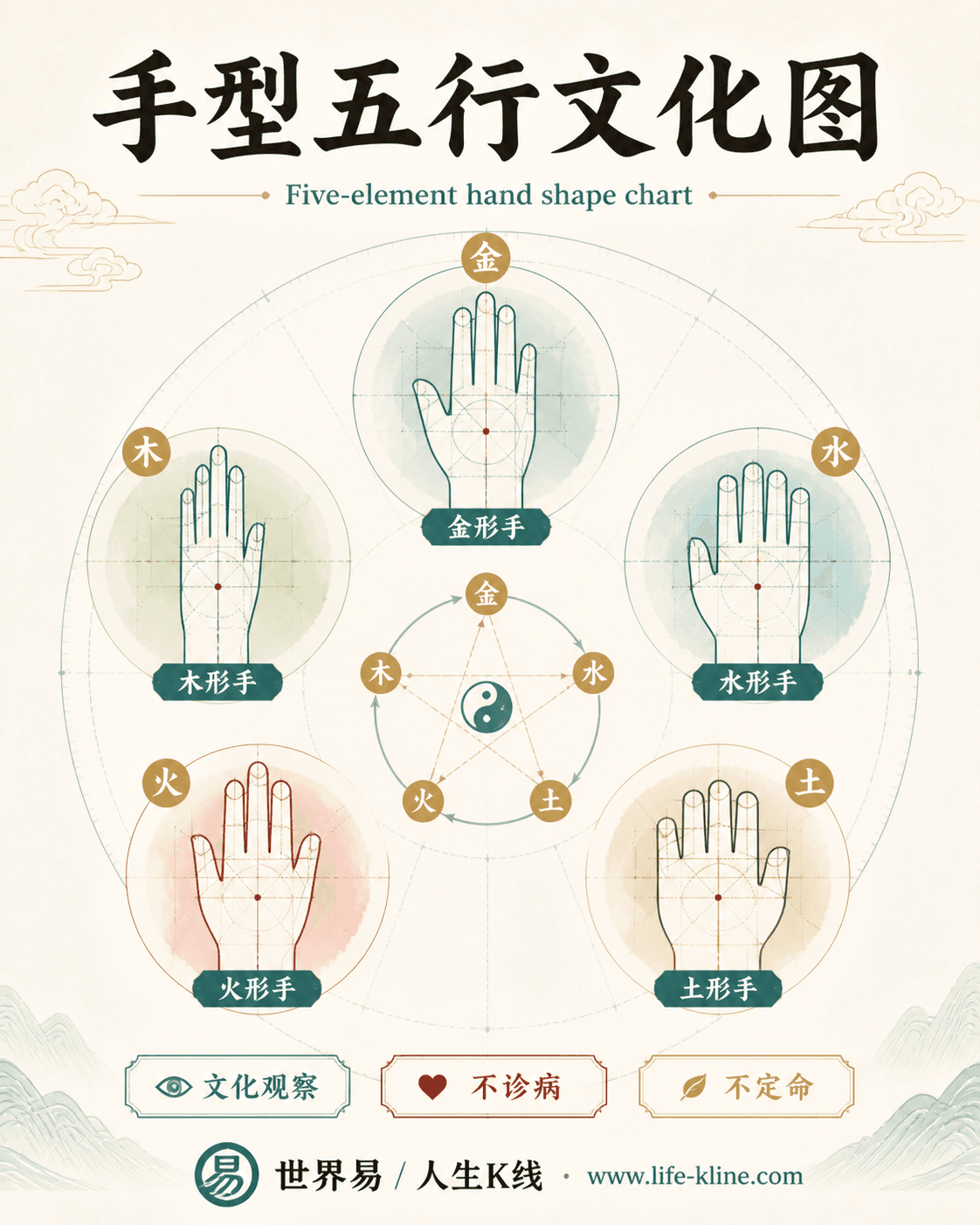
手型五行文化图|北美华人
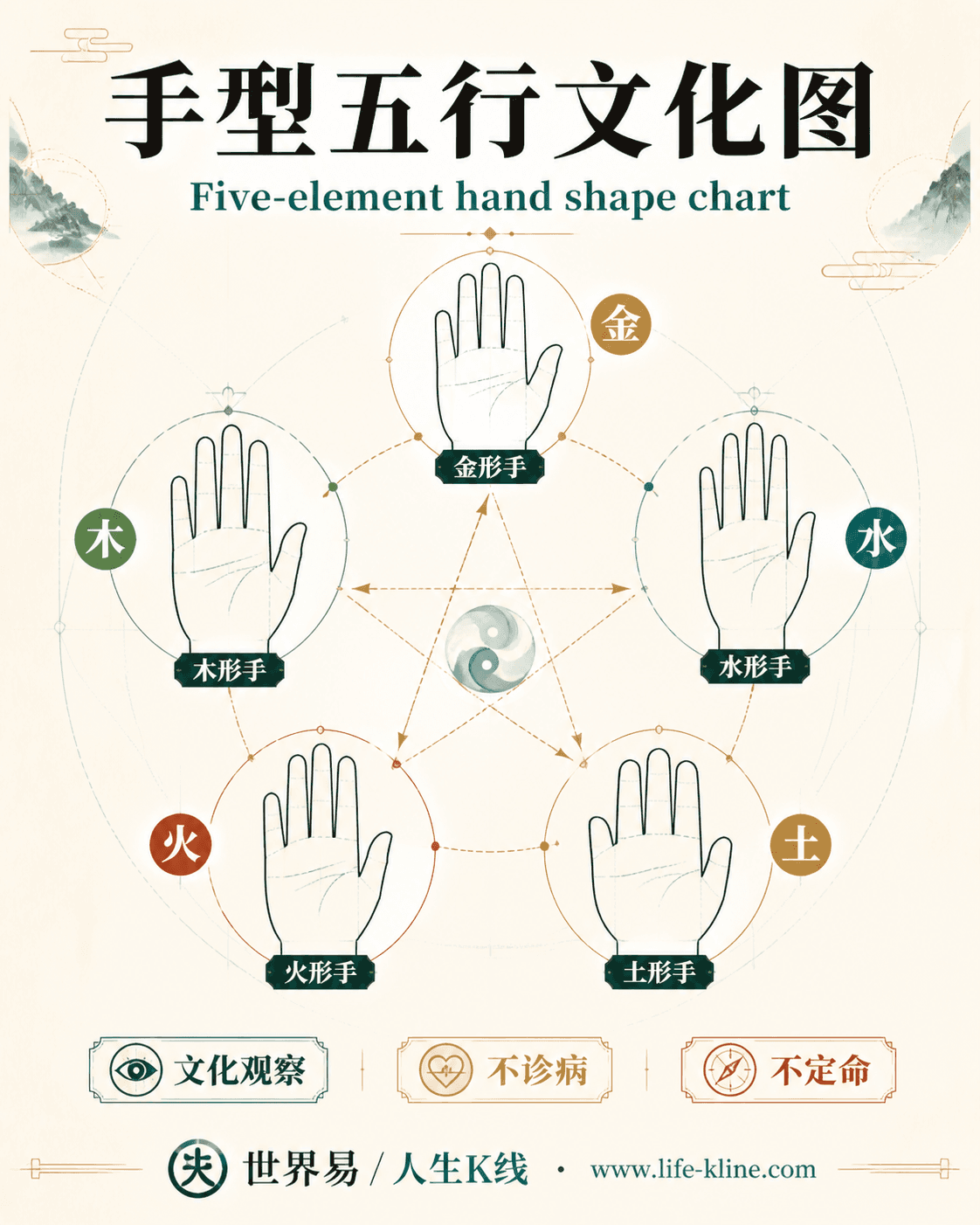
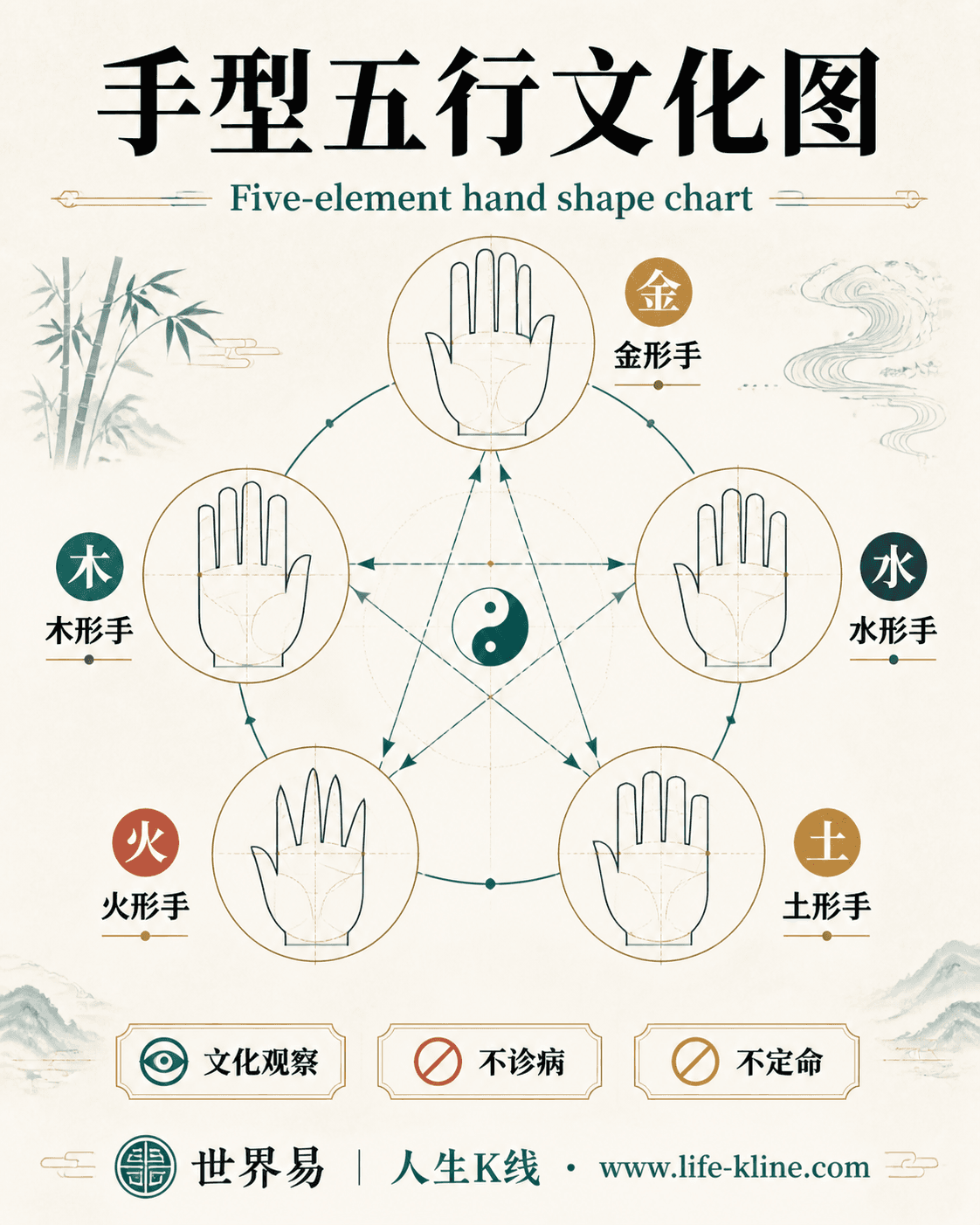
这张图把《Complete Guide to Kitchen Feng Shui: Layout and Adjustments from a Metaphysical Perspective》里的命理概念转成关系、边界和应用场景,适合先看图建立结构,再回到知识文章正文理解细节。
手型五行文化图用于解释Chinese palmistry hand shape相关的手相文化观察方法,适合北美华人用户理解掌纹术语、上传边界和现实复盘方式。
查看图片解读