Complete Guide to Six Yao Prediction: Methods of Casting and Detailed Fate Analysis
把这篇文章落到自己身上验证:先看结构,再进入个人分析,不做泛泛阅读。
What is Six Yao Prediction
Six Yao prediction is an important divination art passed down from ancient China, originating from the foundational theories of the 64 hexagrams in the Zhou Yi (I Ching). By casting hexagrams to obtain six yao lines and interpreting their texts and symbols, it predicts the development trends and outcomes of matters. Six Yao prediction emphasizes not only the changes in hexagrams but also integrates factors such as time and environment for comprehensive judgment.
The core of Six Yao prediction lies in the analysis of “gua yao” (hexagram lines) and “bian yao” (changing lines). By examining the yin-yang transformations of the six yao lines, it reveals the auspiciousness, misfortune, and future trajectory of events. This method is applicable not only to personal destiny but also widely used in career, marriage, health, and other aspects.
By combining metaphysical elements from the Four Pillars BaZi such as the Day Master, pattern (ge ju), and Yong Shen (favorable elements), one can deepen the understanding of Six Yao results. The strength of the Day Master, the choice of Yong Shen, and the conditions of Da Yun and Liu Nian all significantly impact the accuracy and practical value of Six Yao prediction.
How to Interpret Six Yao Prediction: Core Elements
Casting hexagrams is the first step in Six Yao prediction. Common methods include “coin casting,” which uses three copper coins shaken six times in succession, with the combination of heads and tails determining each yao line’s yin or yang. Other methods include “time-based casting,” which uses the numerical values of the current year, month, day, and hour to form the six yao lines, and the “Meihua Xinyi” random casting method, each with its own applicable scenarios and characteristics.
In Six Yao prediction, the Shi Yao (世爻) represents the querent or the main subject of the inquiry, while the Ying Yao (应爻) represents the counterpart or object, such as a partner, opponent, or spouse. The generating and overcoming (sheng-ke) relationships and the dynamic/static status between Shi Yao and Ying Yao are key factors in judging whether the matter will succeed smoothly.
The interpretation of moving yao (dong yao) and changing yao (bian yao) reflects the development and transformation of the situation. Moving yao refers to the yao line currently undergoing change, representing turning points and trends; changing yao is the new yao line formed after the moving yao changes, indicating the final outcome. When the changing yao generates the Shi Yao, it often signals auspiciousness; if it overcomes the Shi Yao, it usually indicates misfortune.
Metaphysical elements such as the strength of the Day Master, pattern, and the relationship between Yong Shen and Ji Shen (unfavorable elements) play an important auxiliary role in Six Yao prediction. Whether the Day Master is strong or weak determines the choice of Yong Shen; the pattern reflects the overall momentum of the chart; and the interaction between Yong Shen and Ji Shen influences how Da Yun and Liu Nian affect the matter. These are indispensable references in Six Yao divination.
Three Real BaZi Case Studies
Case One involves a female aged approximately 40 to 45, with Four Pillars of Yi Chou (乙丑), Geng Chen (庚辰), Gui Wei (癸未), and Yi Mao (乙卯). The Day Master Gui Water (癸水) is relatively weak, the pattern is Zheng Yin (正印), the Yong Shen is Metal, and the Ji Shen are Wood and Fire. She is currently in the Jia Shen (甲申) Da Yun (37-46 years), a stable period suitable for consolidation. The Liu Nian is Bing Wu (丙午), with interactions between Da Yun and Liu Nian showing adaptability. In this chart, Metal as Yong Shen symbolizes harmonizing the weak Gui Water Day Master. When applying Six Yao prediction, focus should be on how Da Yun and Liu Nian influence the Yong Shen to judge whether the trend favors stability and consolidation.
Case Two is a male aged approximately 30 to 35, with Four Pillars Yi Hai (乙亥), Wu Zi (戊子), Jia Xu (甲戌), and Ren Shen (壬申). The Day Master Jia Wood (甲木) is relatively strong, the pattern is Pian Cai (偏财), Yong Shen is Fire, and Ji Shen is Water. He is currently in the Jia Shen (甲申) Da Yun (31-40 years), also a stable period suitable for consolidation. The Liu Nian is Bing Wu (丙午), with Da Yun and Liu Nian interactions showing adaptability. In Six Yao prediction, Fire as Yong Shen supports the strong Jia Wood Day Master. Attention should be paid to the generative effect of Fire in the Liu Nian on promoting the matter, combined with the relationship between Shi Yao and Ying Yao to judge auspicious or inauspicious changes.
Case Three involves a male aged approximately 35 to 40, with Four Pillars Xin Wei (辛未), Wu Xu (戊戌), Xin Wei (辛未), and Bing Shen (丙申). The Day Master Xin Metal (辛金) is relatively strong, the pattern is Zhuan Wang (专旺), Yong Shen is Earth, and Ji Shen is Wood. He is currently in the Yi Wei (乙未) Da Yun (27-36 years), a stable period suitable for consolidation. The Liu Nian is Bing Wu (丙午), with Da Yun and Liu Nian interactions showing adaptability. The Xin Metal Day Master is strong; Earth as Yong Shen plays a role in generating and harmonizing. In Six Yao prediction, one should analyze how the power of Yong Shen Earth affects the generating and overcoming relationships between Earth and Metal in moving and changing yao lines to judge the auspiciousness of the matter’s development.
These three cases demonstrate how charts with different Day Master strengths, patterns, and Yong Shen orientations can be combined with Four Pillars metaphysics in Six Yao prediction to provide a more scientific and accurate judgment of how Da Yun and Liu Nian influence personal fortune and event development.
Common Misconceptions
Many people mistakenly believe that Six Yao prediction relies solely on the results of hexagram casting, neglecting the auxiliary role of the Day Master, pattern, and Yong Shen in the Four Pillars BaZi when interpreting the hexagram. In fact, ignoring the metaphysical background often leads to one-sided judgments that fail to accurately reflect the full picture of the matter.
Another misconception concerns the understanding of moving and changing yao lines. Some simply regard moving yao as representing change and changing yao as representing outcome, overlooking the generating and overcoming relationships between the changing yao and Shi Yao. When the changing yao generates Shi Yao, it often indicates auspiciousness; when it overcomes Shi Yao, it signals danger. Only by considering this relationship can one accurately predict the fortune of the matter.
Additionally, the choice of casting method affects prediction results. Although coin casting is the most classic method, time-based casting or the Meihua Xinyi method also have their advantages in different contexts. Blindly adhering to a single casting method may cause prediction deviations.
Practical Recommendations
When conducting Six Yao prediction, first clarify the casting method. The classic coin casting method is recommended to ensure the randomness and accuracy of the hexagram. Next, combine the querent’s Four Pillars BaZi chart, focusing on the strength of the Day Master, pattern, and the relationships between Yong Shen and Ji Shen to assist in interpreting the hexagram.
During interpretation, special attention should be paid to the generating and overcoming relationships between Shi Yao and Ying Yao, as well as the conditions of moving and changing yao lines. A comprehensive judgment of the trend and final outcome of the matter should be made. Combining the current Da Yun and Liu Nian helps understand the environmental and temporal influences on the matter, improving the relevance and practicality of the prediction.
Finally, it is recommended to repeatedly practice with real case studies to accumulate experience. Six Yao prediction is not only about interpreting hexagrams but also a comprehensive integration of metaphysical knowledge and divination skills. Continuous learning and summarization can steadily improve the accuracy of divination.
FAQ
Question 1: What are the most common methods for casting Six Yao hexagrams? Answer: The classic method is “coin casting,” which uses three copper coins shaken six times consecutively, with the heads and tails combinations determining yin and yang yao lines. Other methods include “time-based casting,” which uses the numerical values of the current year, month, day, and hour, and the “Meihua Xinyi” random casting method. Different methods suit different environments and purposes, but coin casting is the most widely used due to its randomness and tradition.
Question 2: What do Shi Yao and Ying Yao represent respectively? Answer: Shi Yao represents the querent or the main subject of the matter and is the core focus of the divination. Ying Yao represents the counterpart or object, such as a partner, opponent, buyer, or spouse. The generating and overcoming relationships and the dynamic/static status between Shi Yao and Ying Yao determine whether the matter will succeed, making them key factors in Six Yao divination.
Question 3: How should moving yao and changing yao be interpreted? Answer: Moving yao refers to the yao line currently undergoing yin-yang change, representing the trend of change in the matter. Changing yao is the new yao line formed after the moving yao changes, symbolizing the final outcome. When the changing yao generates Shi Yao, it is usually an auspicious sign; when it overcomes Shi Yao, it indicates misfortune. Accurate interpretation of moving and changing yao and their relationship with Shi Yao is essential for judging the future development of the matter.
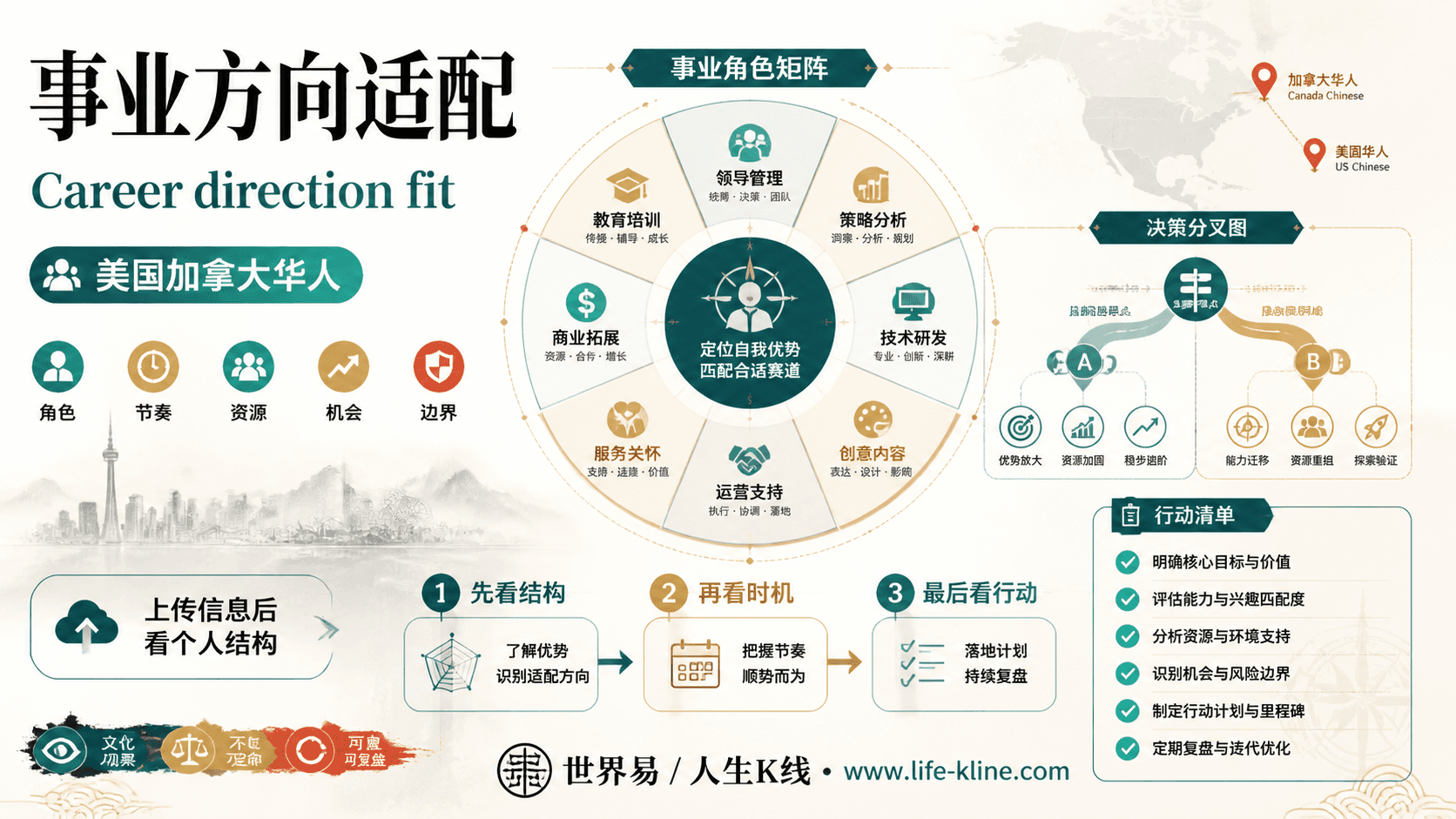
事业方向适配|美国加拿大华人
这张图把《Complete Guide to Six Yao Prediction: Methods of Casting and Detailed Fate Analysis》里的命理概念转成关系、边界和应用场景,适合先看图建立结构,再回到知识文章正文理解细节。
事业方向适配不应被写成固定结论。更适合美国加拿大华人的读法,是把传统术语翻译成结构、时机、环境、行动和复盘。
查看图片解读