Complete Guide to Six Yao Divination: Methods and Integration with Destiny Analysis
把这篇文章落到自己身上验证:先看结构,再进入个人分析,不做泛泛阅读。
What is Six Yao Divination
Six Yao divination is a vital component of traditional Chinese prediction studies, originating from the sixty-four hexagrams theory in the I Ching. Through the arrangement and combination of six yin-yang lines (yao), it reflects the changes of heaven and earth and the development trends of things, assisting people in foreseeing the future and resolving doubts.
The six yao used in Six Yao divination correspond to yin yao (broken line) and yang yao (solid line), each representing a stage of change. The hexagram derived from the divination, combined with the yao texts and changing yao, can be used to infer the progress and outcome of events.
There are various methods to generate hexagrams, with the most classic being the coin tossing method, which uses three coins tossed six times consecutively to form the yin-yang combination of six yao. Additionally, there are time-based hexagram generation methods and the Plum Blossom Heart Yi’s random hexagram method, each with unique characteristics suited to different prediction needs.
Six Yao divination does not rely solely on the hexagram itself but also integrates Four Pillars BaZi destiny analysis, considering the strength of the Day Master, patterns, and the coordination of Yong Shen (favorable elements) to further enhance the accuracy and specificity of predictions. This integration makes Six Yao divination a systematic destiny tool.
How to Interpret Six Yao Divination: Core Elements
The core elements of Six Yao divination include identifying the Shi Yao (世爻, representing the querent or main subject) and Ying Yao (应爻, symbolizing the counterpart or object). The generating and restraining relationships between these two, as well as their dynamic or static states, are key to judging the auspiciousness and success of the situation.
The moving yao refers to the line among the six that changes, manifested as an old yang changing to yin or an old yin changing to yang, representing the current trend of change. The changing yao is the new state after the moving yao changes, reflecting the final result of the matter. If the changing yao generates or assists the Shi Yao, it is usually a good omen; if it restrains the Shi Yao, it indicates potential danger.
Incorporating Four Pillars destiny analysis, the strength of the Day Master reflects the querent’s own energy and risk resistance ability. The pattern type reveals the character traits and fortune direction of the person, while the Yong Shen is the key element that adjusts the yin-yang and Five Elements balance in the chart. These factors assist in interpreting the hexagram, making predictions more targeted.
Da Yun (大运, decade luck cycle) and Liu Nian (流年, annual fortune) represent changes in fortune over time. Da Yun indicates the trend over a longer period, while Liu Nian reflects the fortune of the current year. When predicting with Six Yao, combining Da Yun and Liu Nian interactions helps determine the timing and success probability of the events indicated by the hexagram, providing more precise guidance for action.
Three Real-Life Chart Cases
Case 1: A male aged 30-35, Four Pillars are Jia Xu (甲戌), Bing Yin (丙寅), Yi You (乙酉), Ding Hai (丁亥). The Day Master is Yi Wood (乙木) slightly strong, belonging to the Yang Ren (羊刃) pattern. Yong Shen are Metal and Earth; Ji Shen (unfavorable elements) is Water. Currently in the first year of Geng Wu (庚午) Da Yun, with the Liu Nian being Bing Wu (丙午). The Da Yun is auspicious and the Liu Nian follows the trend. When combining Six Yao divination with this chart, special attention should be paid to the generating and restraining changes of the Metal and Earth Yong Shen and the impact of the Yang Ren pattern. The prediction should emphasize the smoothness of career and wealth luck, leveraging the auspicious energy of the Da Yun to actively respond to the changes of the Liu Nian.
Case 2: A male aged 40-45, Four Pillars are Gui Hai (癸亥), Bing Chen (丙辰), Ji Chou (己丑), Bing Zi (丙子). The Day Master is Ji Earth (己土) slightly strong, belonging to the Zheng Yin (正印) pattern. Yong Shen is Metal; Ji Shen is Fire. Currently in the fifth year of Ren Zi (壬子) Da Yun, with the Liu Nian Bing Wu (丙午). The Da Yun is stable, and the Liu Nian requires flexible adaptation. In Six Yao divination, combined with the steady nature of Ji Earth Day Master and the support of the Zheng Yin pattern, focus should be on the generating effect of Metal and the restraining effect of Fire, to judge whether the career is stable and how to handle unexpected situations during the Liu Nian.
Case 3: A female aged 30-35, Four Pillars are Bing Zi (丙子), Yi Wei (乙未), Jia Xu (甲戌), Yi Hai (乙亥). The Day Master is Jia Wood (甲木) slightly strong, belonging to the Jie Cai (劫财) pattern. Yong Shen is Metal; Ji Shen is Water. Currently in the first year of Ren Chen (壬辰) Da Yun, with the Liu Nian Bing Wu (丙午). The Da Yun is stable, and the Liu Nian requires flexible adaptation. When combining Six Yao divination with this chart, attention should be paid to the competitive nature of the Jie Cai pattern and the regulating effect of the Metal Yong Shen. Particularly during the Liu Nian changes, analyze how the moving and changing yao affect interpersonal relationships and wealth status, to guide current decisions and future directions.
Common Misunderstandings
Many beginners mistakenly believe that Six Yao divination relies only on the coin tossing process, neglecting the subsequent destiny analysis. In fact, generating the hexagram is only the first step; combining the Day Master’s strength, pattern, and Yong Shen is essential to make scientific and accurate judgments.
Another common misunderstanding is confusing the meanings of Shi Yao and Ying Yao. Shi Yao represents oneself or the main subject; judgments should focus on the generating and restraining state of Shi Yao. Mistakenly treating Ying Yao as the main focus can lead to biased conclusions.
The understanding of moving yao and changing yao is also often confused. The moving yao reflects the current trend of change, while the changing yao is the final outcome. Interpretation should distinguish between the two and not equate or ignore the role of the changing yao, as this affects prediction accuracy.
Some also overlook the influence of Da Yun and Liu Nian on Six Yao hexagrams, assuming the hexagram is static. In reality, combining Da Yun and Liu Nian analysis allows one to judge the timing and auspiciousness changes of events, which is an indispensable part of Six Yao prediction.
Practical Suggestions
It is recommended to use the classic coin tossing method when generating hexagrams, as it is simple, traditional, and ensures randomness and accuracy of the hexagram. Alternatively, time-based hexagram generation can be chosen according to the situation, using the year, month, day, and hour numbers to increase the targeting of predictions.
When interpreting hexagrams, it is essential to combine Four Pillars destiny analysis, clearly identifying the strength of the Day Master and the pattern type, and reasonably distinguishing Yong Shen and Ji Shen, avoiding reliance solely on the yao texts while neglecting individual destiny characteristics.
During prediction, focus on the generating and restraining relationships between Shi Yao and Ying Yao, combined with the trends of moving and changing yao, to dynamically judge the progress of events. Always integrate the current Da Yun and Liu Nian to assess timing and environmental changes, enabling scientific decisions and reasonable responses.
FAQ
Question 1: What are the most common methods of Six Yao divination? Answer: The most classic method is coin tossing, using three coins tossed six times consecutively to form the six yao hexagram based on heads and tails combinations. Other methods include time-based hexagram generation, which uses the querent’s year, month, day, and hour numbers, and the Plum Blossom Heart Yi’s random hexagram method. Each method has unique features suitable for different prediction scenarios.
Question 2: What do Shi Yao and Ying Yao represent respectively? Answer: Shi Yao represents the querent or the main subject of the event and is the core focus in prediction. Ying Yao symbolizes the counterpart or object, such as partners, opponents, buyers, or spouses. By analyzing the generating and restraining relationships and the dynamic or static states between Shi Yao and Ying Yao, one can judge whether the event will succeed, which is key in Six Yao prediction.
Question 3: How to interpret moving yao and changing yao? Answer: The moving yao is the line among the six that changes, from old yang to yin or old yin to yang, representing the current trend of change. The changing yao is the new state after this change, reflecting the final outcome. If the changing yao generates or assists Shi Yao, it indicates auspiciousness; if it restrains Shi Yao, it may indicate danger. Therefore, accurate interpretation of moving and changing yao is crucial for prediction results.
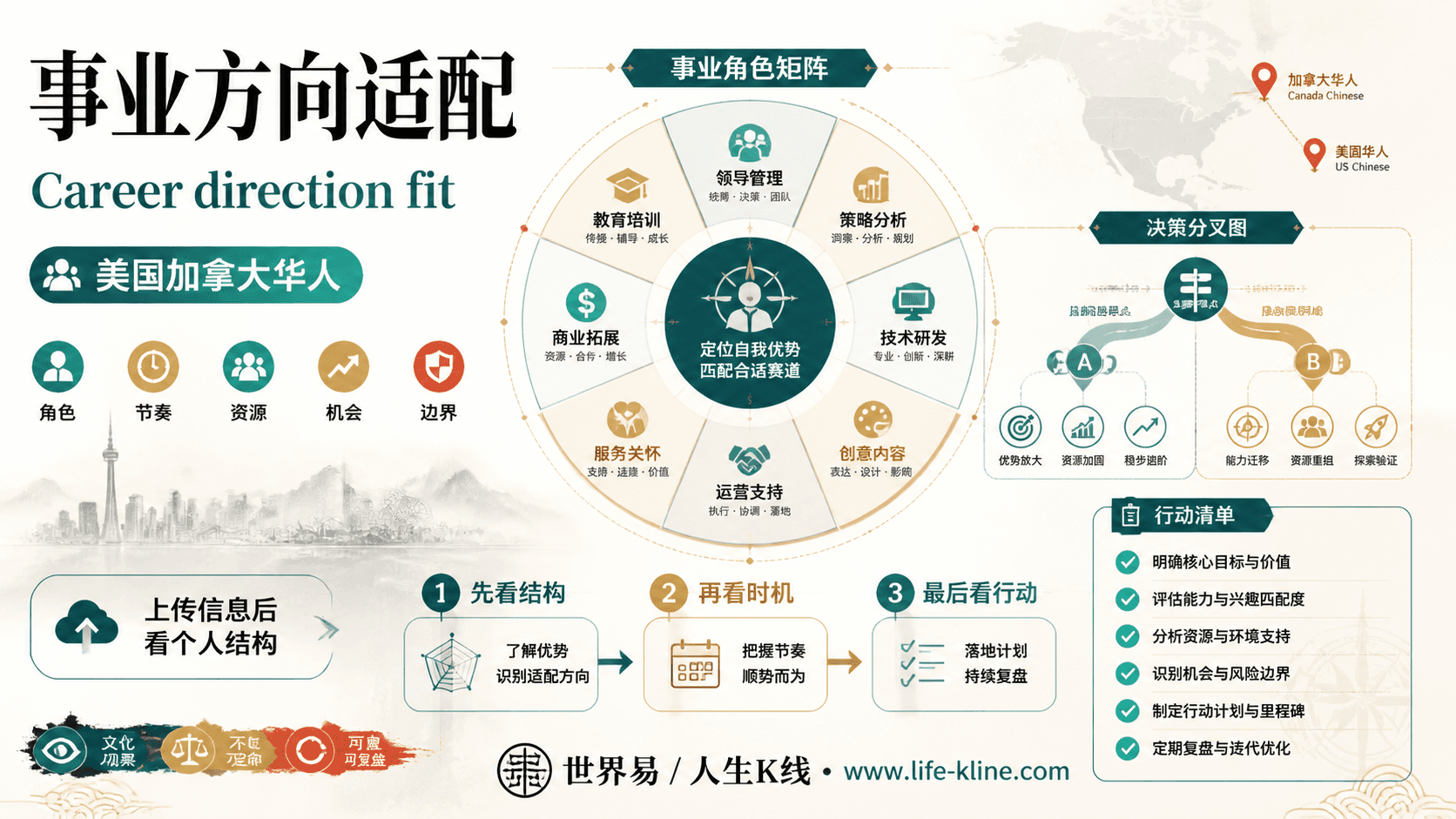
事业方向适配|美国加拿大华人
这张图把《Complete Guide to Six Yao Divination: Methods and Integration with Destiny Analysis》里的命理概念转成关系、边界和应用场景,适合先看图建立结构,再回到知识文章正文理解细节。
事业方向适配不应被写成固定结论。更适合美国加拿大华人的读法,是把传统术语翻译成结构、时机、环境、行动和复盘。
查看图片解读