Complete Guide to BaZi Fortune Telling: Core Theories and Real Case Analyses
把这篇文章落到自己身上验证:先看结构,再进入个人分析,不做泛泛阅读。
What is BaZi Fortune Telling
BaZi fortune telling, also known as the Four Pillars of Destiny, is an important branch of traditional Chinese metaphysics. It analyzes the combination of Heavenly Stems and Earthly Branches corresponding to the year, month, day, and hour of a person's birth, forming eight characters (BaZi), to infer information about personality, fortune, health, marriage, and career.
The Heavenly Stems and Earthly Branches in BaZi represent the Five Elements attributes and Yin-Yang changes. Metaphysicians judge the strength of the Day Master (the Heavenly Stem of the birth day) and the overall balance of the chart through the generating, overcoming, controlling, and transforming relationships among these elements, thereby selecting appropriate Yong Shen (favorable elements) and Ji Shen (unfavorable elements) to guide individuals in seeking auspiciousness and avoiding misfortune.
BaZi fortune telling not only focuses on the Day Master itself but also emphasizes the configuration of the Ten Gods patterns, such as Bi Jian (Peer) and Pian Yin (Indirect Resource), which reflect the personality tendencies and life patterns of the chart owner. Additionally, Da Yun (decade luck cycles) and Liu Nian (annual fortune), as temporal dimensions of fortune changes, play important roles in BaZi fortune telling to help predict future ups and downs.
How to Read BaZi Fortune Telling: Core Elements
The core of BaZi fortune telling lies in accurately judging the strength of the Day Master. If the Day Master is relatively weak, the chart requires Yong Shen to assist in balancing the Five Elements; if relatively strong, it needs to drain or consume excessive energy. The choice of Yong Shen directly relates to the smoothness or adversity of one's destiny, while Ji Shen are the Five Elements that must be carefully guarded against.
Secondly, identifying the Ten Gods patterns is crucial. For example, the Pian Yin (Indirect Resource) pattern usually represents the Wen Chang nobleman star, which can generate and assist the Day Master, reflecting learning ability and nobleman luck; the Bi Jian (Peer) pattern often shows strong self-awareness, suitable for independent struggle. Different patterns determine the personality and coping strategies of the chart owner.
Da Yun are decade-long luck cycles, with each cycle lasting ten years, whose starting point is determined by reverse or forward counting from the birth month pillar. The strength of Da Yun, combined with Liu Nian (the annual changes of Heavenly Stems and Earthly Branches), jointly influence the chart owner's fortune trend in a given year. The interaction between Da Yun and Liu Nian is especially important in determining whether the chart tends toward auspiciousness or misfortune.
Three Real BaZi Case Studies
Case One is a woman aged 55-60, with a Day Master of 甲 (Jia) Wood, relatively weak, belonging to the Pian Yin (Indirect Resource) pattern. Her main Yong Shen is Water, and Ji Shen are Fire and Earth. She is currently in the 8th year of the 丁丑 (Ding Chou) Da Yun, which is an unfavorable luck cycle, and the Liu Nian is 丙午 (Bing Wu). Both Da Yun and Liu Nian are weak, indicating the need to cautiously guard against major misfortunes. This chart illustrates that when the Day Master is weak and Yong Shen is Water, encountering unfavorable Da Yun and Liu Nian leads to volatile fortunes, suggesting the chart owner should strengthen the Yong Shen and avoid harm from Ji Shen.
Case Two is also a woman aged 55-60, with a Day Master of 癸 (Gui) Water, relatively weak, belonging to the Bi Jian (Peer) pattern. Her Yong Shen is Metal, and Ji Shen are Wood and Fire. She is currently in the 2nd year of the 丁丑 (Ding Chou) Da Yun, with weak fortune, and the Liu Nian is 丙午 (Bing Wu). Both Da Yun and Liu Nian are unfavorable, advising cautious conduct. This chart emphasizes that when the Day Master is weak and Yong Shen is Metal, facing a weak Da Yun and challenging Liu Nian, one should act prudently, avoid rashness, and prevent fortune damage.
Case Three is a woman aged 30-35, with a Day Master of 壬 (Ren) Water, relatively strong, belonging to the Bi Jian (Peer) pattern. Her Yong Shen is Metal, and Ji Shen is also Metal. She is currently in the 4th year of the 己巳 (Ji Si) Da Yun, which is a stable luck cycle, and the Liu Nian is 丙午 (Bing Wu). The overall chart is relatively stable. This chart shows that when the Day Master is strong and both Yong Shen and Ji Shen are Metal, one needs to adapt flexibly within a stable Da Yun, make good use of the Yong Shen effects, avoid Ji Shen interference, and maintain steady and improving fortune.
The above three cases demonstrate how BaZi fortune telling interprets complex personal fortune changes through different Day Master strengths, patterns, and Yong Shen combinations, combined with Da Yun and Liu Nian, reflecting the practical application value of BaZi theory.
Common Misconceptions
Many people mistakenly believe BaZi fortune telling is simply a matter of matching Five Elements, neglecting the judgment of Day Master strength and the deeper meanings of the Ten Gods patterns. In fact, only by combining the Day Master's prosperity or decline with the selection of Yong Shen and Ji Shen can one accurately grasp the chart's balance and adjustment.
Another misconception is ignoring the importance of the birth hour. Without an accurate hour pillar, the chart is incomplete, affecting the calculation of Da Yun and Liu Nian, thereby reducing prediction accuracy. Although a three-pillar BaZi (year, month, day) can provide preliminary analysis, it is recommended to confirm the birth hour whenever possible.
Some also have a vague understanding of Da Yun and Liu Nian, thinking they have the same influence. Actually, Da Yun affects a long-term period, setting the overall fortune tone; Liu Nian represents short-term fluctuations. Only by analyzing Da Yun and Liu Nian together can one comprehensively predict fortune ups and downs.
Practical Recommendations
When performing BaZi fortune telling, it is essential first to accurately confirm the birth time, especially the hour pillar, to ensure the completeness and accuracy of the BaZi chart. If the birth hour is unknown, one can use reverse calculation combined with important personal events to infer it.
When interpreting BaZi, first identify the strength of the Day Master, then combine the Ten Gods patterns to reasonably select Yong Shen and Ji Shen, providing a basis for adjusting the chart. Analyze the auspicious and inauspicious trends by combining the current Da Yun and Liu Nian, offering practical and actionable advice.
When facing unfavorable Da Yun and Liu Nian, adopt a cautious attitude, avoid blind actions, strengthen the Yong Shen's influence, and appropriately adjust life and work rhythms to mitigate negative impacts and smoothly pass through adverse periods.
FAQ
Question 1: What does BaZi fortune telling actually examine? Answer: BaZi fortune telling is based on the four pillars of birth year, month, day, and hour converted from the solar calendar to the lunar calendar, combined with the generating and overcoming relationships of Heavenly Stems and Earthly Branches and the prosperity or decline of the Five Elements. It judges the strength of the Day Master (the Heavenly Stem of the birth day) and the Ten Gods patterns. A complete BaZi interpretation includes Day Master strength, selection of Yong Shen and Ji Shen, Ten Gods patterns, Da Yun and Liu Nian trends, as well as the auspicious and inauspicious meanings of spouse and children palaces, comprehensively reflecting the chart owner's personality and fortune.
Question 2: Can BaZi be calculated without knowing the birth hour? Answer: A three-pillar BaZi (year, month, day) can be used for preliminary analysis, but accuracy will decrease by approximately 30% to 50%. It is recommended to confirm the birth hour whenever possible by asking parents or checking household registration records. If the hour cannot be determined, reverse calculation using important life events from the past five years is a common metaphysical method.
Question 3: How often does Da Yun change? Answer: Da Yun usually changes every ten years, starting from the birth month pillar. The direction of counting forward or backward depends on the Yin-Yang attributes of the birth year and gender, with one set of Heavenly Stem and Earthly Branch per ten years. Da Yun greatly influences personal life rhythm and overall circumstances, far exceeding the annual influence of Liu Nian, thus holding a significant position in BaZi prediction.
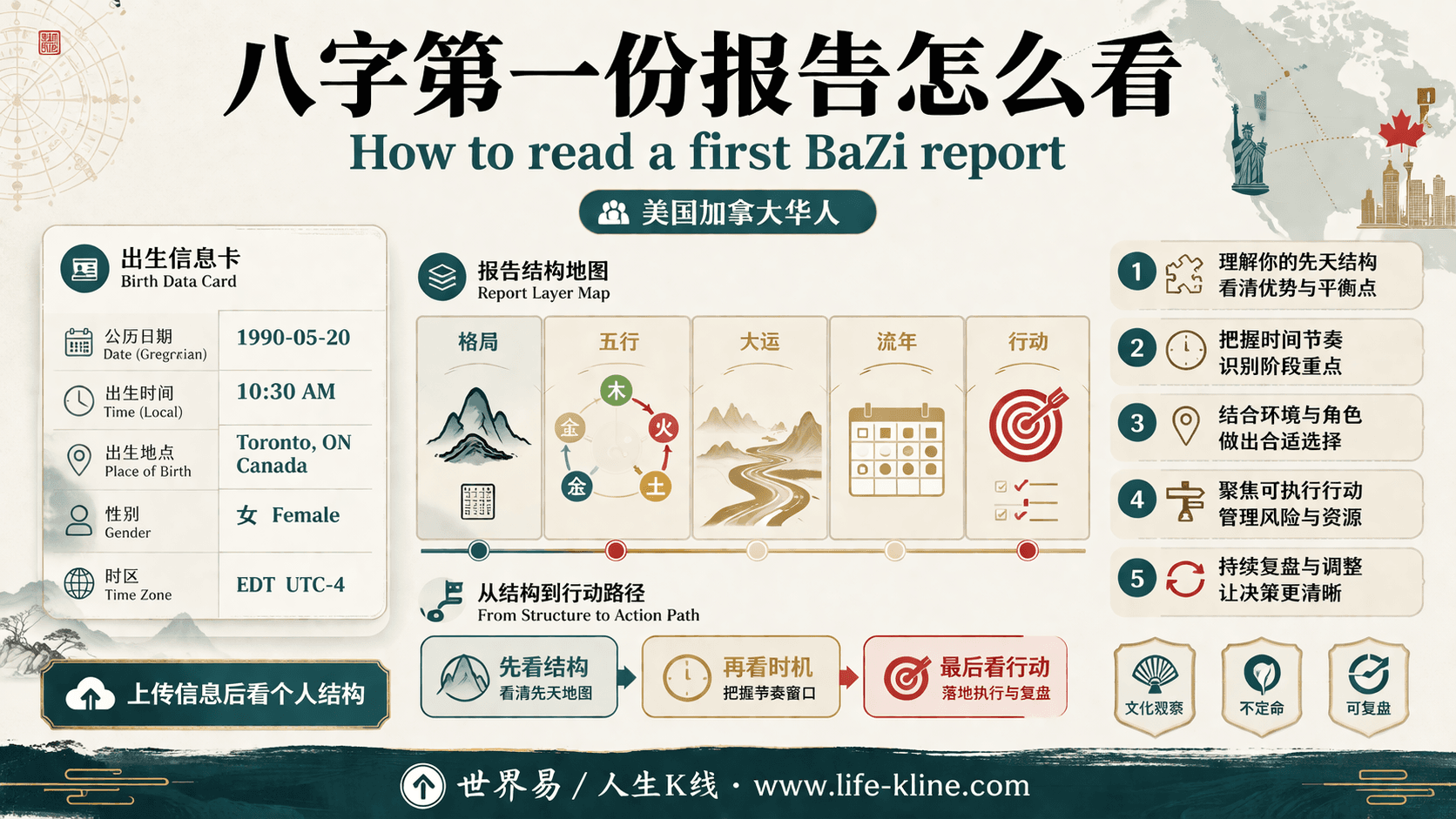
八字第一份报告怎么看|美国加拿大华人
这张图把《Complete Guide to BaZi Fortune Telling: Core Theories and Real Case Analyses》里的命理概念转成关系、边界和应用场景,适合先看图建立结构,再回到知识文章正文理解细节。
八字第一份报告怎么看不应被写成固定结论。更适合美国加拿大华人的读法,是把传统术语翻译成结构、时机、环境、行动和复盘。
查看图片解读