Complete Guide to BaZi Annual Fortune Analysis and Da Yun Interaction
把这篇文章落到自己身上验证:先看结构,再进入个人分析,不做泛泛阅读。
What is BaZi Liu Nian
BaZi Liu Nian refers to calculating an individual's yearly fortune based on their Four Pillars BaZi at birth, combined with the annual changes of Heavenly Stems and Earthly Branches. Liu Nian reveals the possible auspicious and inauspicious events in that year through interactions with the Day Master, Yong Shen (favorable elements), Ji Shen (unfavorable elements), and other factors in the natal chart. In metaphysics, Liu Nian is regarded as a dynamic reference for annual luck and a detailed manifestation within the broader Da Yun cycle.
The theoretical foundation of BaZi Liu Nian originates from the ancient Chinese system of Heavenly Stems and Earthly Branches and the Five Elements’ generating, overcoming, controlling, and transforming relationships. Each year, the Liu Nian Heavenly Stem and Earthly Branch interact with those in the Four Pillars through relationships such as Sheng (generating), Ke (overcoming), He (combining), Chong (clashing), and Xing (punishing), thereby influencing the individual's career, health, relationships, and wealth.
In practice, BaZi Liu Nian is usually analyzed together with Da Yun. Da Yun represents the overall trend of a ten-year luck cycle, while Liu Nian reflects the specific fortune fluctuations within that year. By examining the interaction between Da Yun and Liu Nian, one can more accurately grasp the individual's metaphysical trajectory and life rhythm.
How to Read BaZi Liu Nian: Core Elements
To interpret BaZi Liu Nian, one must first identify the Day Master (the Heavenly Stem of the birth day) and its strength. The Day Master represents the individual and its strength affects the overall balance of the chart, determining the choice of Yong Shen (favorable elements). Yong Shen are the Five Elements that regulate the chart’s balance and support the Day Master. If the Liu Nian contains the Yong Shen, it helps improve fortune; conversely, the presence of Ji Shen (unfavorable elements) may bring obstacles or misfortune.
Secondly, the pattern (ge ju) refers to the combination of the Ten Gods (Shi Shen) and Five Elements in the BaZi, reflecting the fundamental metaphysical structure of the individual. Different patterns respond differently to the Liu Nian Heavenly Stems and Earthly Branches. The generating and overcoming relationships between Liu Nian and the pattern determine the year’s auspiciousness. Favorable combinations indicate good fortune, while clashes or overcomings warn of potential setbacks or accidents.
Furthermore, the interaction between Da Yun and Liu Nian is crucial. Da Yun is the main luck cycle spanning ten years, while Liu Nian represents annual changes within that cycle. The stability of Da Yun and the harmony or clash between the Heavenly Stems and Earthly Branches of Da Yun and Liu Nian affect the strength of the yearly fortune. Generally, when Da Yun is stable, Liu Nian fortunes tend to be more flexible and random, requiring detailed analysis based on the Five Elements relationships of the specific Liu Nian.
Finally, a comprehensive application of the generating, overcoming, controlling, and transforming relationships among Heavenly Stems and Earthly Branches, the configuration of the Ten Gods, and the strength or weakness of the Five Elements—combined with the individual's age and current Da Yun—is necessary to fully grasp the auspicious and inauspicious changes brought by BaZi Liu Nian, enabling one to seek good fortune and avoid misfortune proactively.
Three Real Birth Chart Cases
Case One is a female aged 45 to 50, with a Ren Water (壬, Ren) Day Master that is relatively strong, and a Qi Sha (Seven Killings) pattern. Her Yong Shen are Earth and Fire, while Metal is the Ji Shen. She is currently in the Gui Wei Da Yun (癸未, Gui Wei, ages 46-55), which is stable and suitable for maintaining achievements. The Liu Nian is Bing Wu (丙午, Bing Wu) year; Bing Fire, as one of the Yong Shen elements, helps balance the relatively strong Ren Water Day Master. From the interaction of Da Yun and Liu Nian, the first year of Gui Wei Da Yun combined with Bing Wu Liu Nian shows overall stability. The presence of Fire in Liu Nian enables her to adapt flexibly, maintaining Da Yun stability while stimulating potential, demonstrating the regulating role of Liu Nian within Da Yun.
Case Two is a male aged 20 to 25, with a Ji Earth (己, Ji) Day Master that is relatively strong, and a Jie Cai (Rob Wealth) pattern. His Yong Shen are Wood and Water, with Fire as the Ji Shen. He is currently in the Geng Xu Da Yun (庚戌, Geng Xu, ages 17-26), also a stable cycle suitable for consolidation. The Liu Nian is Bing Wu (丙午, Bing Wu) year; Bing Fire is the Ji Shen, theoretically bringing some pressure or challenges. However, since the Geng Xu Da Yun is stable and the Liu Nian Heavenly Stem and Earthly Branch do not form obvious clashes with Da Yun, the Liu Nian fortune shows flexible adaptation. This individual needs to cautiously handle the adverse effects of the Ji Shen in Liu Nian while relying on the Yong Shen Wood and Water elements to resolve potential conflicts.
Case Three is a female aged 50 to 55, with a Bing Fire (丙, Bing) Day Master of medium strength and a Pian Yin (偏印, Indirect Resource) pattern. Her Yong Shen is Wood, and Ji Shen is Water. She is currently in the Geng Yin Da Yun (庚寅, Geng Yin, ages 51-60), a stable cycle suitable for maintaining achievements. The Liu Nian is Bing Wu (丙午, Bing Wu) year; Bing Fire shares the same element as the Day Master, strengthening its power. The Fire element in Bing Wu Liu Nian also supports the Wood Yong Shen in the chart through generating. Both Da Yun and Liu Nian are stable, resulting in flexible adaptation in the yearly fortune, which benefits the advantages of the Pian Yin pattern and promotes positive developments in career or health.
Common Misconceptions
Many people mistakenly think BaZi Liu Nian only involves looking at the Heavenly Stem and Earthly Branch of the current year, neglecting its integration with Da Yun. In reality, Liu Nian is only an annual detail within the ten-year Da Yun cycle, and its auspiciousness or inauspiciousness must be judged in the context of the overall Da Yun trend. Without considering Da Yun, conclusions tend to be superficial or inaccurate.
Another common misconception is overlooking the crucial role of Day Master strength and Yong Shen. Some only check whether the Liu Nian Heavenly Stem and Earthly Branch are auspicious, ignoring whether Liu Nian effectively regulates the Day Master’s strength. The Day Master’s strength determines the rational selection of Yong Shen and Ji Shen, and only the presence of Yong Shen in Liu Nian can truly bring positive effects.
Some believe Liu Nian’s influence is extremely significant, neglecting that Liu Nian fortune inherently has a flexible and adaptive nature. Especially when Da Yun is stable, Liu Nian often presents a mix of opportunities and challenges with many changes, requiring flexible responses based on the specific Liu Nian Heavenly Stem and Earthly Branch and the individual’s pattern.
Lastly, many individuals lack clarity about their birth hour, which weakens the foundation for Liu Nian analysis. Although a Three-Pillar BaZi (year, month, day) can provide a general framework, the absence of the hour pillar reduces the accuracy of Liu Nian auspiciousness judgments, affecting the depth and precision of overall metaphysical analysis.
Practical Advice
In practical BaZi Liu Nian analysis, it is essential first to clarify the complete Four Pillars BaZi, especially the accurate birth hour. Only by accurately grasping the Day Master, pattern, and Yong Shen of the natal chart can one reasonably interpret the changes brought by the Liu Nian Heavenly Stem and Earthly Branch, avoiding blind or one-sided judgments.
Analyzing Liu Nian fortune in conjunction with the current Da Yun phase is key. When Da Yun is stable, Liu Nian fortunes are more flexible, and a strategy of adaptive response is advisable—seizing opportunities while guarding against potential risks brought by Ji Shen. When Da Yun is unfavorable, greater caution is required in Liu Nian to prevent shocks.
It is recommended to focus on changes in the Yong Shen Five Elements during Liu Nian, moderately adjusting lifestyle and work rhythms to align with the generating and overcoming cycles of the Five Elements. This strengthens personal advantages and weakens Ji Shen influences. For example, if Fire is the Yong Shen in Liu Nian, one may increase activities or environments related to Fire; when Ji Shen appears, caution is needed to avoid impulsiveness and overexertion.
FAQ
Question 1: What does BaZi fortune-telling mainly examine? Answer: BaZi fortune-telling analyzes the Heavenly Stems and Earthly Branches of the year, month, day, and hour of birth, combined with the generating and overcoming relationships of the Five Elements and the configuration of the Ten Gods. It assesses the strength of the Day Master, the choice of Yong Shen, and the overall pattern of the chart. Additionally, it analyzes Da Yun and Liu Nian to predict the individual’s fortune fluctuations and life changes at different stages, guiding one to seek good fortune and avoid misfortune.
Question 2: Can BaZi be calculated without knowing the birth hour? Answer: A Three-Pillar BaZi (year, month, day) can still provide a general metaphysical framework, but the accuracy decreases by approximately 30% to 50%. It is recommended to verify the birth hour if possible. If the hour is unknown, one can use key events from the past five years to backtrack and estimate the hour pillar, a method commonly used and effective in practical metaphysics.
Question 3: How often does Da Yun change? Answer: Da Yun generally changes every ten years. The starting point depends on the birth month pillar and the Yin-Yang attribute of the individual’s gender, progressing forward or backward in ten-year cycles of Heavenly Stems and Earthly Branches. Da Yun significantly influences the overall fortune during life stages and usually has a more decisive effect than a single Liu Nian.
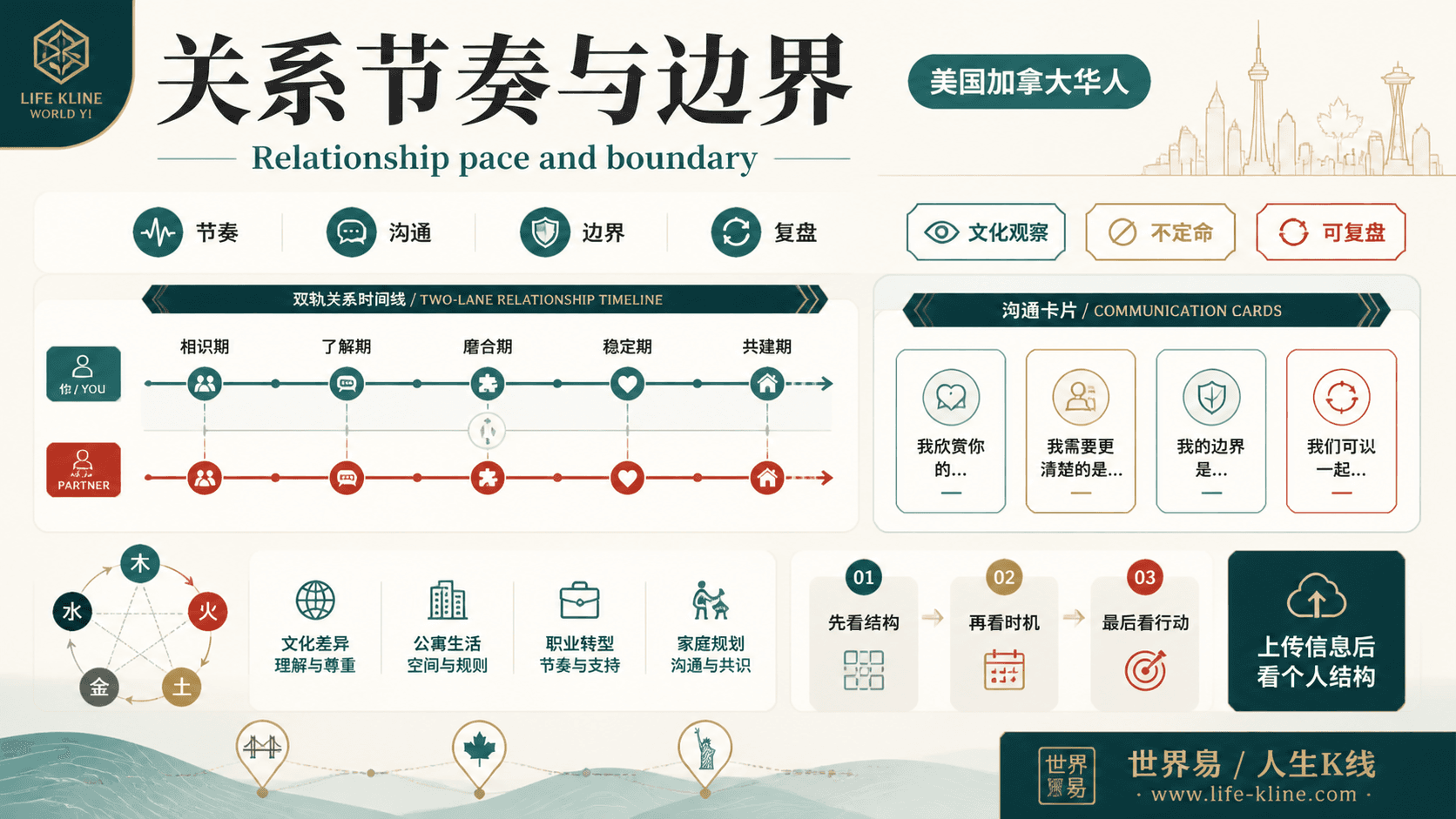
关系节奏与边界|美国加拿大华人
这张图把《Complete Guide to BaZi Annual Fortune Analysis and Da Yun Interaction》里的命理概念转成关系、边界和应用场景,适合先看图建立结构,再回到知识文章正文理解细节。
关系节奏与边界不应被写成固定结论。更适合美国加拿大华人的读法,是把传统术语翻译成结构、时机、环境、行动和复盘。
查看图片解读