BaZi Marriage Analysis: Complete Guide to Day Master Patterns and Da Yun & Liu Nian Influences
把这篇文章落到自己身上验证:先看结构,再进入个人分析,不做泛泛阅读。
What is BaZi Marriage
BaZi marriage analysis studies the influence and trends of marital life by analyzing the combinations of Heavenly Stems (天干) and Earthly Branches (地支) in an individual’s birth BaZi chart. BaZi consists of four pillars—year, month, day, and hour—each containing a Heavenly Stem and Earthly Branch, encompassing the relationships of the Five Elements (Wood, Fire, Earth, Metal, Water) through mutual generation and restriction. It is a fundamental tool in traditional Chinese metaphysics for predicting personal destiny.
In BaZi marriage analysis, the Day Master (日主), which is the Heavenly Stem of the birth day, is central as it determines the individual's basic nature and the dominant energy influencing marriage. By assessing the strength of the Day Master, the Ten Gods (十神) patterns, and the roles of Yong Shen (用神, favorable elements) and Ji Shen (忌神, unfavorable elements), one can understand the harmony of the marriage, spouse characteristics, and emotional development trends.
Additionally, although not detailed in this entry, the spouse palace and children palace within the BaZi chart are also important dimensions in marriage analysis. Integrating Da Yun (大运, decade luck cycles) and Liu Nian (流年, annual fortune) further reflects the auspicious and inauspicious changes at different stages of marriage, aiding in forecasting smoothness and challenges in marital relationships.
BaZi marriage analysis not only focuses on the internal Five Elements balance but also emphasizes the interaction between the natal chart and timing luck, reflecting the dynamic changes in marital life and providing theoretical support for marital decisions and adjustments.
How to Read BaZi Marriage: Core Elements
First, identify the strength of the Day Master. A strong Day Master often indicates an independent personality who requires appropriate space and support in marriage; a weak Day Master tends to need support and balance from the partner and external environment. The choice of Yong Shen is especially crucial as it determines the stable foundation of the marriage.
Second, pattern types such as Pian Yin (偏印, Partial Resource), Zheng Cai (正财, Direct Wealth), and Pian Cai (偏财, Indirect Wealth) influence the dominant wealth and emotional modes in marriage. Zheng Cai patterns often reflect stable marital relationships, Pian Cai patterns relate more to emotional opportunities and external resources, while Pian Yin patterns lean towards wisdom and support.
The analysis of Yong Shen and Ji Shen is key to harmonizing the chart. Yong Shen brings smoothness and assistance to marriage, whereas Ji Shen may cause conflicts and setbacks. By adjusting lifestyle or behavioral habits, one can enhance auspicious influences and avoid misfortunes, thereby improving marital quality.
Da Yun and Liu Nian reflect the stage-wise changes in marriage. During auspicious luck cycles, relationships and marriage often receive positive momentum; during adverse cycles, challenges or tests may arise. Especially the interaction between Da Yun and Liu Nian can reveal critical turning points in marriage.
In summary, BaZi marriage analysis emphasizes the overall balance of the Five Elements and alignment with timing luck, helping individuals grasp the rhythm of marital development and make rational and appropriate choices.
Three Real BaZi Chart Cases
Case 1: This chart’s Day Master is 戊 (Wu) Earth, relatively strong, with a Pian Yin (Partial Resource) pattern. The Yong Shen are Wood and Water, while the Ji Shen is Fire. The gentleman is currently in the Xin Mao (辛卯) Da Yun, an auspicious luck cycle with progress in career and wealth. The current Liu Nian is Bing Wu (丙午), which harmonizes well with the Da Yun. The Pian Yin pattern symbolizes wisdom and supportive strength, which is particularly important for understanding and supporting the spouse in the marriage. With a relatively strong Day Master and Yong Shen Wood and Water, the marriage requires attention to emotional nourishment and communication. The Ji Shen Fire warns to avoid intense emotional conflicts. Overall, the favorable luck cycle benefits marital stability and harmony, with a relatively smooth spouse relationship but a need to manage emotions carefully.
Case 2: This chart’s Day Master is 辛 (Xin) Metal, relatively weak, with a Zheng Cai (Direct Wealth) pattern. The Yong Shen is Earth, while the Ji Shen are Water and Wood. The gentleman is in the second year of the Xin Mao (辛卯) Da Yun, with stable luck and a tendency to maintain the status quo. The current Liu Nian is Bing Wu (丙午), requiring adaptability. The Zheng Cai pattern represents a stable economic foundation and marital relationship. The weak Day Master indicates a dependence on external support, and the Yong Shen Earth helps enhance chart stability. The Ji Shen Water and Wood may bring emotional fluctuations or external disturbances. In marriage, emphasis should be placed on cultivating a sense of family responsibility and stability, avoiding the influence of external temptations or emotional volatility.
Case 3: This chart’s Day Master is 戊 (Wu) Earth, relatively weak, with a Pian Cai (Indirect Wealth) pattern. The Yong Shen is Fire, and the Ji Shen are Metal and Water. The gentleman is in the eighth year of the Wu Xu (戊戌) Da Yun, with stable luck and a tendency to maintain the status quo. The current Liu Nian is Bing Wu (丙午), requiring flexibility. The Pian Cai pattern is often associated with emotional opportunities and wealth. The weak Day Master indicates a significant need for partner and emotional support. Yong Shen Fire helps stimulate emotional vitality, while Ji Shen Metal and Water warn against conflicts and external pressures in the relationship. Marriage should focus on emotional expression and communication, avoiding disruptions caused by external factors. The stable luck cycle lays a foundation for marital stability.
Common Misconceptions
Many people mistakenly believe that BaZi marriage analysis only requires looking at the spouse palace or the auspiciousness of a single Ten God. This narrow view overlooks the comprehensive effects of Day Master strength, pattern, and Yong Shen and Ji Shen. The chart is an integrated whole, and a single factor cannot accurately reflect the full picture of marriage.
Some also think that Da Yun and Liu Nian are merely references for luck changes, ignoring their profound impact on the stage-wise dynamics of marital relationships. In fact, Da Yun and Liu Nian represent key timing nodes for marital ups and downs, and neglecting them can cause missed opportunities for adjustment.
Some beginners in metaphysics overlook the importance of the birth hour, believing that only the year, month, and day pillars suffice for detailed marriage analysis. While the three-pillar BaZi can provide rough judgments, the absence of the hour pillar results in incomplete chart information, significantly reducing accuracy and affecting the precision of marriage interpretation.
Another misconception is equating Day Master strength simply with good or bad. Both strong and weak Day Masters have pros and cons. The key lies in finding the appropriate Yong Shen to balance the chart, enabling harmonious and stable marital relationships.
Practical Recommendations
In practical marriage analysis, accurately confirming the birth hour is essential to ensure the BaZi chart is complete. This allows a comprehensive grasp of chart information and improves judgment accuracy. When necessary, the hour can be retroactively deduced by correlating with significant personal events.
After understanding the Day Master strength and Yong Shen and Ji Shen, one can integrate lifestyle habits, emotional management, and environmental adjustments to assist marriage. For those with weak Day Masters, it is advisable to enhance personal energy and partner support; for strong Day Masters, attention should be paid to emotional balance and communication.
Pay attention to changes in Da Yun and Liu Nian, and plan important marital decisions and life arrangements accordingly. During auspicious luck periods, actively promote emotional development; during adverse periods, focus on stability and adjustment, avoiding impulsiveness and major changes.
FAQ
What does BaZi fortune-telling mainly look at? Answer: BaZi fortune-telling analyzes the four pillars of year, month, day, and hour, based on the interactions of Heavenly Stems and Earthly Branches and the strength of the Five Elements. It assesses the strength of the Day Master and the Ten Gods patterns, combined with Yong Shen and Ji Shen, and analyzes the trends of Da Yun and Liu Nian as well as key palaces, thereby comprehensively revealing personal destiny and marriage conditions.
Can BaZi be calculated without knowing the birth hour? Answer: Knowing only the year, month, and day pillars (three pillars) allows for rough judgments but with lower accuracy. It is recommended to verify the birth hour with parents or household registration records. If unavailable, the hour pillar can be retroactively deduced using major life events to improve the accuracy of BaZi analysis.
How often does the BaZi Da Yun change? Answer: BaZi Da Yun generally changes every ten years. Da Yun starts from the birth month pillar and is determined by the gender and yin-yang attributes of the birth year, moving forward or backward through the Heavenly Stems and Earthly Branches combinations. Da Yun has a significant impact on destiny and marriage, far beyond that of a single Liu Nian, reflecting major life phase changes.
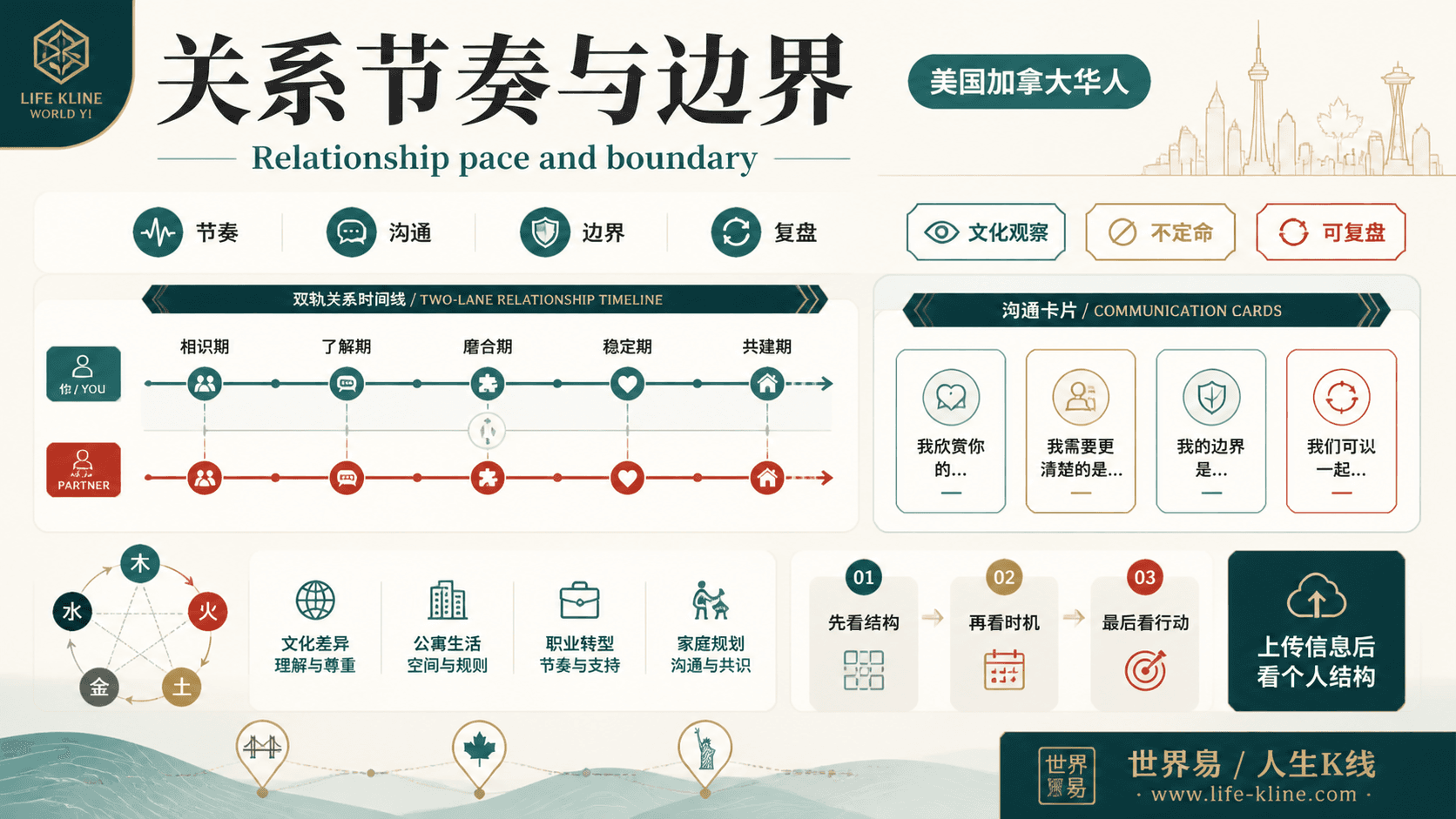
关系节奏与边界|美国加拿大华人
这张图把《BaZi Marriage Analysis: Complete Guide to Day Master Patterns and Da Yun & Liu Nian Influences》里的命理概念转成关系、边界和应用场景,适合先看图建立结构,再回到知识文章正文理解细节。
关系节奏与边界不应被写成固定结论。更适合美国加拿大华人的读法,是把传统术语翻译成结构、时机、环境、行动和复盘。
查看图片解读