Detailed Explanation of BaZi Da Yun: The Cycle of Fortune and Practical Guide in Destiny Analysis
把这篇文章落到自己身上验证:先看结构,再进入个人分析,不做泛泛阅读。
What is BaZi Da Yun
BaZi Da Yun is a life fortune stage divided into ten-year cycles based on the Four Pillars BaZi of birth time, integrating the Heavenly Stems (Tiangan), Earthly Branches (Dizhi), and Five Elements theory. It reflects the strength and trend of fortune changes during different periods of life and is a crucial component in destiny studies.
The starting point of Da Yun usually begins from the birth month pillar, calculated by pushing forward or backward the stem-branch combinations according to gender and the yin-yang attribute of the birth year, changing every ten years. Da Yun not only influences overall auspiciousness and misfortune but also interacts with Liu Nian (annual fortune) to jointly determine the specific fortune performance of the year.
Historically, BaZi Da Yun originated from the combination of ancient astronomy, calendar systems, and yin-yang Five Elements theory. By observing the correspondence between celestial changes and life fluctuations, it gradually formed a systematic destiny judgment tool. Modern destiny scholars still use this theory combined with individual BaZi charts to deduce life trajectories.
The core significance of Da Yun lies in revealing the fortune trends and Five Elements balance during different life stages, providing individuals with guidance for adjustment and risk prevention. Through Da Yun analysis, one can more accurately predict fluctuations in career, wealth, health, and interpersonal relationships.
How to Read BaZi Da Yun: Core Elements
To interpret BaZi Da Yun, one must first clarify the Day Master’s strength and pattern. The Day Master is the Heavenly Stem of the birth day and is the core of the chart. The strength of the Day Master determines the choice of Yong Shen (favorable element) and the auspiciousness or inauspiciousness of Da Yun; a strong Day Master benefits from elements that drain it, while a weak Day Master benefits from elements that support it. Balancing the Five Elements can help avoid misfortune and promote good fortune.
Secondly, the pattern refers to the combination form of the Ten Gods (Shi Shen) in the BaZi, such as Zheng Guan (Proper Officer) pattern, Pian Yin (Partial Seal) pattern, or Cong Cai (Following Wealth) pattern. These represent the personality traits and destiny trends of the individual. Different patterns respond differently to Da Yun, determining the opportunities and challenges brought by the luck cycle.
Yong Shen is the key Five Element that regulates the balance of the chart. After correctly identifying the Yong Shen, one can judge the favorable or unfavorable relationships of the Five Elements in Da Yun to accurately assess its auspiciousness. For example, if the Yong Shen is Metal and Earth, then encountering a Da Yun with Metal and Earth elements usually indicates smoother fortune.
The interaction between Da Yun and Liu Nian (annual fortune) is also an important factor. Even if Da Yun is generally auspicious, if the Liu Nian conflicts with the Yong Shen or Day Master, unfavorable events may occur. Therefore, a comprehensive judgment considering the specific year is necessary.
Finally, when observing the auspicious and inauspicious characteristics of Da Yun, it is important not only to consider the Five Elements generating and overcoming relationships but also to combine the Day Master’s strength, Yong Shen and Ji Shen (unfavorable element), pattern features, and the individual’s actual situation for a thorough and detailed analysis.
Three Real BaZi Chart Cases
Case One involves a 45-50-year-old female with a Day Master of Ding Fire (丁, Ding), moderate strength, a Cong Cai (Following Wealth) pattern, Yong Shen being Metal and Earth, and Ji Shen being Wood and Fire. She is currently in the Yi Hai (乙亥) Da Yun, where the fortune is relatively weak and requires cautious action. Considering her Yong Shen, Metal and Earth are not entirely favorable in the Yi Hai Da Yun, indicating challenges during this luck cycle but still room for adjustment. The addition of Bing Wu (丙午) Liu Nian further weakens the Da Yun, reminding her to remain low-profile and avoid excessive risk-taking during this phase. This case illustrates that BaZi Da Yun not only affects the strength of fortune but also requires attention to the interaction with Liu Nian to adjust behavior strategies appropriately.
Case Two is a 45-50-year-old male with a relatively strong Bing Fire (丙, Bing) Day Master, a Zheng Guan (Proper Officer) pattern, Yong Shen of Water and Metal, and Ji Shen being Wood. His current Da Yun is Wu Shen (戊申), which is an auspicious luck cycle with progress in both career and wealth. The Five Elements of Wu Shen Da Yun correspond well with his Yong Shen Water and Metal, supporting the improvement of his fortune. The Bing Wu (丙午) Liu Nian complements the Da Yun, making the annual fortune smooth and favorable for proactive actions and seizing opportunities. This case demonstrates that good alignment between Da Yun and Yong Shen can bring dual development in career and wealth, emphasizing the importance of Da Yun selection.
Case Three features a 50-55-year-old female with a relatively weak Bing Fire (丙, Bing) Day Master, a Pian Yin (Partial Seal) pattern, Yong Shen being Water, and Ji Shen being Earth and Metal. She is currently in the Ji Chou (己丑) Da Yun, where the fortune is weak and there is a risk of significant adverse events. The Earth and Metal elements of Ji Chou Da Yun suppress her Yong Shen Water, leading to poor overall fortune that requires special caution. The Bing Wu (丙午) Liu Nian intensifies the weakness of the Da Yun, indicating potential challenges and risks. This case shows that conflicts between the Five Elements of Da Yun and Yong Shen/Ji Shen can severely affect fortune, reminding the individual to strengthen prevention and adjustment during this phase.
These three cases fully demonstrate the core role of BaZi Da Yun: through in-depth analysis of the Day Master, pattern, and Yong Shen, combined with the Five Elements attributes of Da Yun, they reveal the rules of fortune changes and destiny trends, providing a scientific basis for life decision-making.
Common Misconceptions
Many people mistakenly think Da Yun is simply a division of years, but its essence is the dynamic changes based on the generating and overcoming relationships of the Five Elements and the balance of the chart. Ignoring the Day Master’s strength and Yong Shen coordination can easily lead to incorrect judgments.
Some misunderstand that Da Yun and Liu Nian are unrelated. In fact, Da Yun is a large cycle while Liu Nian is a small cycle; the two complement each other, and only comprehensive analysis can yield accurate conclusions. Focusing solely on Liu Nian often overlooks the profound influence of Da Yun.
Some destiny enthusiasts absolutize the auspiciousness or inauspiciousness of Da Yun, thinking a good Da Yun means smooth sailing and a bad one means total obstruction. In reality, Da Yun only indicates trends; specific destiny outcomes require considering personal effort, environment, Liu Nian, and other factors.
Additionally, inaccurate birth time affects the calculation and interpretation of Da Yun, causing deviations in the overall BaZi chart. Therefore, confirming the accurate birth time is the foundation of destiny analysis; missing the time pillar can only provide rough estimations.
Practical Suggestions
In practice, it is recommended to first accurately determine the birth time to ensure the completeness of the Four Pillars BaZi, thereby obtaining precise Da Yun starting time and stem-branch combinations. If the birth time is unknown, one can use reverse deduction based on key life events to assist in determination.
Secondly, focus on analyzing the Day Master’s strength and the Yong Shen and Ji Shen, combined with the Five Elements attributes of the current Da Yun to judge the auspiciousness trend of the luck cycle, and plan life and career accordingly. When fortune is weak, act cautiously; when fortune is favorable, actively expand opportunities.
Finally, flexibly adjust strategies according to Liu Nian changes, avoiding blind optimism or excessive pessimism. The interaction between Da Yun and Liu Nian determines the specific fortune of the year; reasonable planning can help avoid misfortune and improve life quality.
FAQ
Question 1: What exactly does BaZi fortune telling look at? Answer: BaZi fortune telling mainly examines the Four Pillars BaZi composed of birth year, month, day, and hour, combined with the generating, overcoming, controlling, and transforming relationships of the Heavenly Stems and Earthly Branches, as well as the strength and weakness of the Five Elements. It determines the Day Master’s strength and the Ten Gods pattern. A complete BaZi analysis includes Day Master strength, Yong Shen selection, pattern identification, Da Yun and Liu Nian trends, and auspicious or inauspicious meanings of key palaces, helping reveal the full picture of an individual’s destiny.
Question 2: Can BaZi be calculated without knowing the birth hour? Answer: Knowing only the three pillars of year, month, and day can provide a basic BaZi framework, but the accuracy decreases by about 30%-50%. It is recommended to confirm the birth hour with parents or household registration systems if possible. If necessary, reverse deduction methods based on recent key life events can be used to infer the hour pillar and improve analysis accuracy.
Question 3: How often does BaZi Da Yun change? Answer: BaZi Da Yun generally changes every 10 years. The starting time of Da Yun is pushed forward or backward from the birth month pillar, with the specific direction determined by gender and the yin-yang attribute of the birth year. Da Yun represents different life stages’ fortune and has a far greater impact than Liu Nian, serving as a key basis for judging destiny trends.
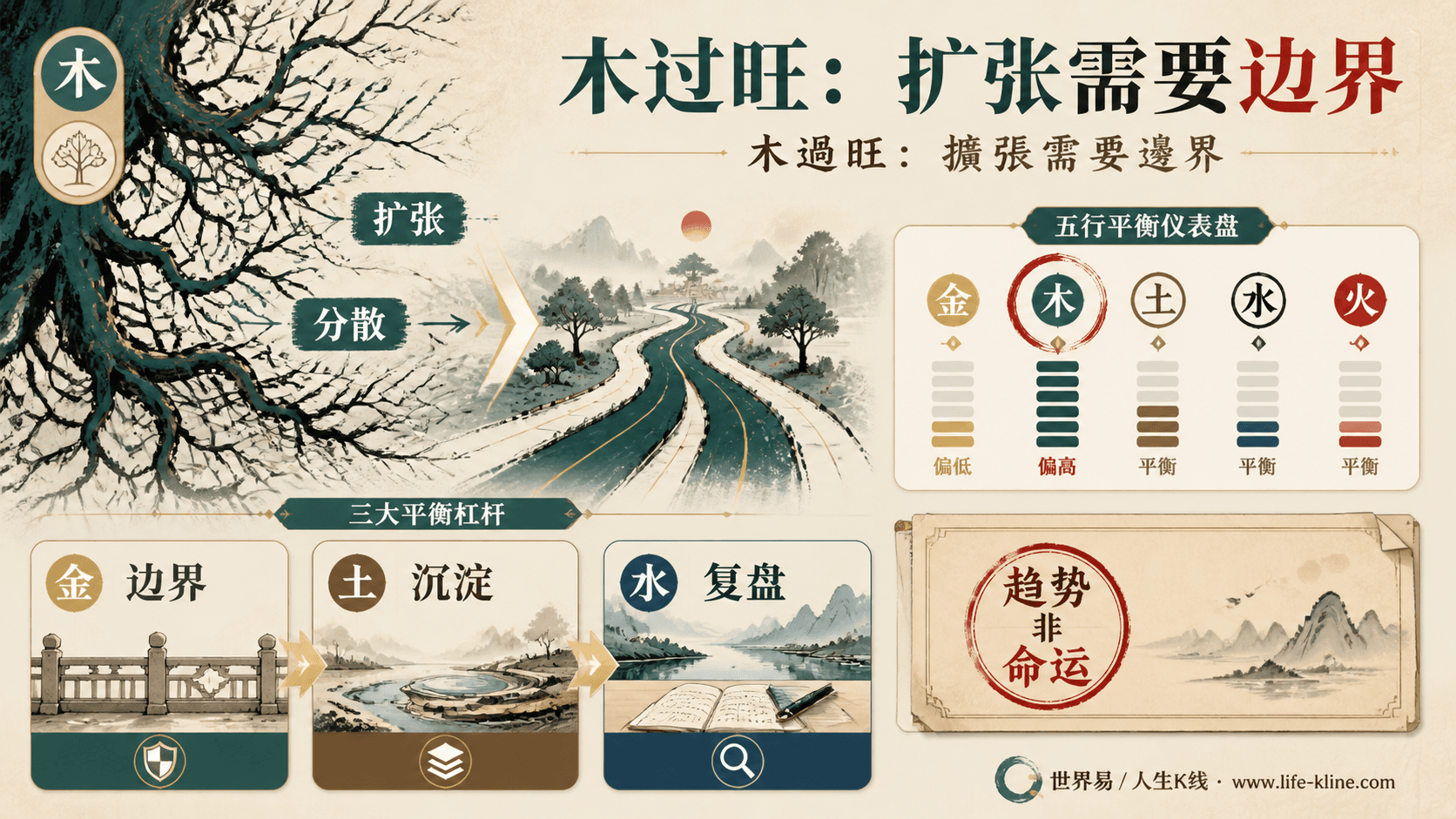
木过旺与再平衡
这张图把《Detailed Explanation of BaZi Da Yun: The Cycle of Fortune and Practical Guide in Destiny Analysis》里的命理概念转成关系、边界和应用场景,适合先看图建立结构,再回到知识文章正文理解细节。
木过旺常表现为扩张过快、计划繁多、方向分散。在人生K线系统中,这是一种时位特征,而非固定标签。通过引入边界、沉淀与复盘,可实现自然再平衡,导向更可持续的结构。
查看图片解读