Analysis of Ti-Yong Relationship: The Core Metaphysical Wisdom and Complete Application Guide in Plum Blossom Yi Numerology
把这篇文章落到自己身上验证:先看结构,再进入个人分析,不做泛泛阅读。
你现在搜索的,
其实是一个要落到自己身上的判断。
当前页面主要回答「Ti-Yong Relationship」这类搜索问题;真正有价值的下一步是把这套结构带进自己的报告、工具与案例验证。
What is the Ti-Yong Relationship
The Ti-Yong relationship is one of the fundamental theories in traditional Chinese metaphysics, emphasizing the interdependence and dynamic balance between the 'Ti' (Body) and 'Yong' (Use) within a natal chart. The 'Ti' represents the fundamental essence of the destiny chart, usually referring to the Day Master (Ri Zhu) and its Five Elements attribute, while the 'Yong' refers to the Five Elements forces in the chart that regulate, assist, or restrain the Day Master. The Ti-Yong relationship reveals the interaction mechanism between the inner energy of the person and the external environmental influences.
In Plum Blossom Yi Numerology and other metaphysical systems, the Ti-Yong relationship is not only the basis for judging the strength or weakness of the chart but also the key to determining the Yong Shen (favorable element). By accurately grasping the Ti-Yong relationship, one can analyze the strengths and weaknesses of the chart more scientifically, thereby reasonably predicting the auspicious and inauspicious changes in Da Yun (decade luck cycles) and Liu Nian (annual fortune) as well as life trends.
The Ti-Yong theory originates from the ancient Yin-Yang and Five Elements philosophy, combined with the characteristics of the Four Pillars (BaZi) combinations, gradually forming a complete methodological system. It is not only applicable to BaZi metaphysics but also plays an important role in the hexagram analysis of Plum Blossom Yi Numerology, serving as a core perspective for understanding the structure of destiny.
How to Observe the Ti-Yong Relationship: Core Elements
To observe the Ti-Yong relationship, one must first clarify the position of the 'Ti,' that is, the Five Elements attribute and strength of the Day Master (Ri Zhu). The strength or weakness of the Day Master determines the fundamental pattern and energy state of the entire chart and is the basis for judging the chart’s prosperity or decline. Secondly, one needs to identify the 'Yong,' which refers to the Five Elements elements in the chart that can balance or enhance the Day Master; these are usually the Yong Shen (favorable elements).
Determining the pattern (Ge Ju) is an important step in understanding the Ti-Yong relationship. Different patterns show the interaction between the Day Master and other Five Elements, such as Shang Guan (Hurting Officer) pattern, Zheng Cai (Direct Wealth) pattern, Yang Ren (Goat’s Blade) pattern, etc. These reflect the Day Master’s expression form and its cooperation with the Yong Shen, thereby affecting the choice of Yong Shen and the exclusion of Ji Shen (unfavorable elements).
Da Yun (decade luck cycles) and Liu Nian (annual fortune) are key factors reflecting the dynamic changes of the Ti-Yong relationship. Da Yun represents the overall fortune of the person for a ten-year phase, while Liu Nian refers to the specific environmental influence of the year. By observing the interaction between Da Yun, Liu Nian, and the Ti-Yong relationship, one can judge the person’s favorable or adverse conditions at different stages, guiding life decisions and strategy adjustments.
Three Real Natal Chart Cases
Case One involves a female aged 45-50, with a Day Master of Geng Metal (庚 Geng) slightly strong, pattern is Shang Guan (Hurting Officer) pattern, Yong Shen is Fire, and Ji Shen is Earth. She is currently in the 7th year of the Wu Wu (戊午 Wu Wu) Da Yun, with the Liu Nian being Bing Wu (丙午 Bing Wu). The overall Da Yun is stable, but the Liu Nian requires flexible responses. In this chart, the Geng Metal Day Master is somewhat strong; the Shang Guan pattern shows strong self-expression. Fire as the Yong Shen both drains the Metal energy and supports the Day Master, reflecting a good balance between Ti (Geng Metal) and Yong (Fire). Both Da Yun and Liu Nian contain Wu Fire, further strengthening the Yong Shen’s power, supporting the person to maintain achievements and adapt flexibly during this phase.
Case Two is a female aged 50-55, with a Day Master of Ren Water (壬 Ren) slightly weak, pattern is Zheng Cai (Direct Wealth) pattern, Yong Shen is Earth, and Ji Shen are Wood and Fire. She is currently in the 3rd year of the Gui Hai (癸亥 Gui Hai) Da Yun, with the Liu Nian being Bing Wu (丙午 Bing Wu). The overall Da Yun is stable, but the Liu Nian changes require flexible adjustments. The Ren Water Day Master is somewhat weak; the Zheng Cai pattern indicates that the wealth star Earth is the Yong Shen. The Yong Shen Earth is used in the chart to restrain the Ji Shen Wood and Fire, balancing the Day Master’s energy. The Gui Hai Da Yun’s Water supports the Day Master, while the Bing Wu Liu Nian Fire is a Ji Shen; however, due to the stable Da Yun, a defensive approach is advised with flexible adaptation to mitigate adverse effects, reflecting the dynamic regulation of the Ti-Yong relationship.
Case Three is a male aged 45-50, with a Day Master of Xin Metal (辛 Xin) slightly strong, pattern is Yang Ren (Goat’s Blade) pattern, Yong Shen are Fire and Wood, and Ji Shen is Earth. He is currently in the 5th year of the Ren Chen (壬辰 Ren Chen) Da Yun, with the Liu Nian being Bing Wu (丙午 Bing Wu). The Da Yun is stable, and the Liu Nian requires flexible adaptation. The Xin Metal Day Master is somewhat strong; the Yang Ren pattern signifies prominent and sharp power. Fire and Wood as Yong Shen respectively drain Metal and generate Metal, harmonizing the chart’s energy. Although the Ren Water Da Yun is not directly a Yong Shen, it is overall stable. The Bing Wu Liu Nian Fire is strong, and the Yong Shen is effective, helping the Day Master to exert advantages, demonstrating the balance and reinforcement mechanism within the Ti-Yong relationship.
Common Misunderstandings
A common misunderstanding is equating the Ti-Yong relationship simply with the strength or weakness of the Day Master, neglecting the complex regulatory role of Yong Shen and Ji Shen in the chart. In fact, the Ti-Yong relationship is a dynamic holistic system; the Day Master’s strength is only the foundation. Only by combining the cooperation of Yong Shen and the changes in Da Yun and Liu Nian can accurate judgments be made.
Another misunderstanding is ignoring the influence of Da Yun and Liu Nian on the Ti-Yong relationship. Many people focus only on the inherent pattern of the chart but overlook the energy changes brought by Da Yun and Liu Nian. This can lead to metaphysical predictions that deviate from reality and fail to reflect the ups and downs of the person’s fortune at different times.
Additionally, there is a blind-following phenomenon in the selection of Yong Shen, without considering the specific chart pattern and Day Master’s condition. Some charts may have different Yong Shen depending on the pattern. Blindly applying fixed Yong Shen can easily cause deviations and affect the accuracy of metaphysical analysis.
Practical Suggestions
In specific metaphysical analysis, one should first accurately determine the strength or weakness of the Day Master, combine the pattern to identify the Yong Shen and Ji Shen, and fully understand the internal logic of the Ti-Yong relationship. Only by mastering the dynamic balance between the Day Master and Yong Shen can one accurately grasp the auspicious and inauspicious trends of the chart.
The analysis of Da Yun and Liu Nian should not be neglected. It is recommended to combine the person’s current age stage, focus on observing the Sheng-Ke-Zhi-Hua (generating, overcoming, restraining, transforming) relationships of the Five Elements in Da Yun and Liu Nian, judge their specific impact on the Ti-Yong relationship, reasonably predict fortune changes, and achieve a combination of maintaining achievements and adapting to changes.
For different Ti-Yong combinations, the person should adjust life strategies and mindset according to metaphysical advice. For example, when the Yong Shen is strong, it is appropriate to actively expand career opportunities; when the Yong Shen is restrained, one should act cautiously. Flexibly applying the Ti-Yong relationship theory helps improve the practical value and guiding significance of metaphysical analysis.
FAQ
Question 1: What is the difference between Plum Blossom Yi Numerology and Liu Yao (Six Lines Divination)? Answer: Plum Blossom Yi Numerology, founded by Shao Yong, emphasizes 'Xin Yi' (Heart Yi), that is, generating hexagrams through randomly appearing numbers, sounds, and objects, valuing the combination of intuition and symbolic meaning. It is suitable for immediate and minor matter predictions. Liu Yao is a more systematic divination method with a complete system of Shi Ying (World and Response), dynamic changes, and Sheng-Ke (generating and overcoming) relationships, suitable for predicting complex structural events. Both have their advantages, and users can choose according to their needs.
Question 2: How to determine the Yong Shen in a natal chart? Answer: The determination of Yong Shen is based on judging the strength or weakness of the Day Master and the overall pattern analysis. Yong Shen is the Five Elements element in the chart that can harmonize, assist, or restrain the Day Master, helping to balance the Five Elements energy and achieve the best state of the chart. The specific Yong Shen needs to be comprehensively judged based on the Day Master’s prosperity, pattern characteristics, and actual Da Yun and Liu Nian conditions.
Question 3: How do Da Yun and Liu Nian affect the Ti-Yong relationship? Answer: Da Yun represents the overall fortune of the person for a ten-year phase, while Liu Nian refers to the specific Five Elements environment of the year. Both dynamically influence the Ti-Yong relationship through the generating, overcoming, restraining, and transforming of the Five Elements, potentially strengthening or weakening the effect of Yong Shen and changing the energy balance of the chart. Accurately grasping the interaction between Da Yun, Liu Nian, and the Ti-Yong relationship helps improve the accuracy and practicality of metaphysical predictions.
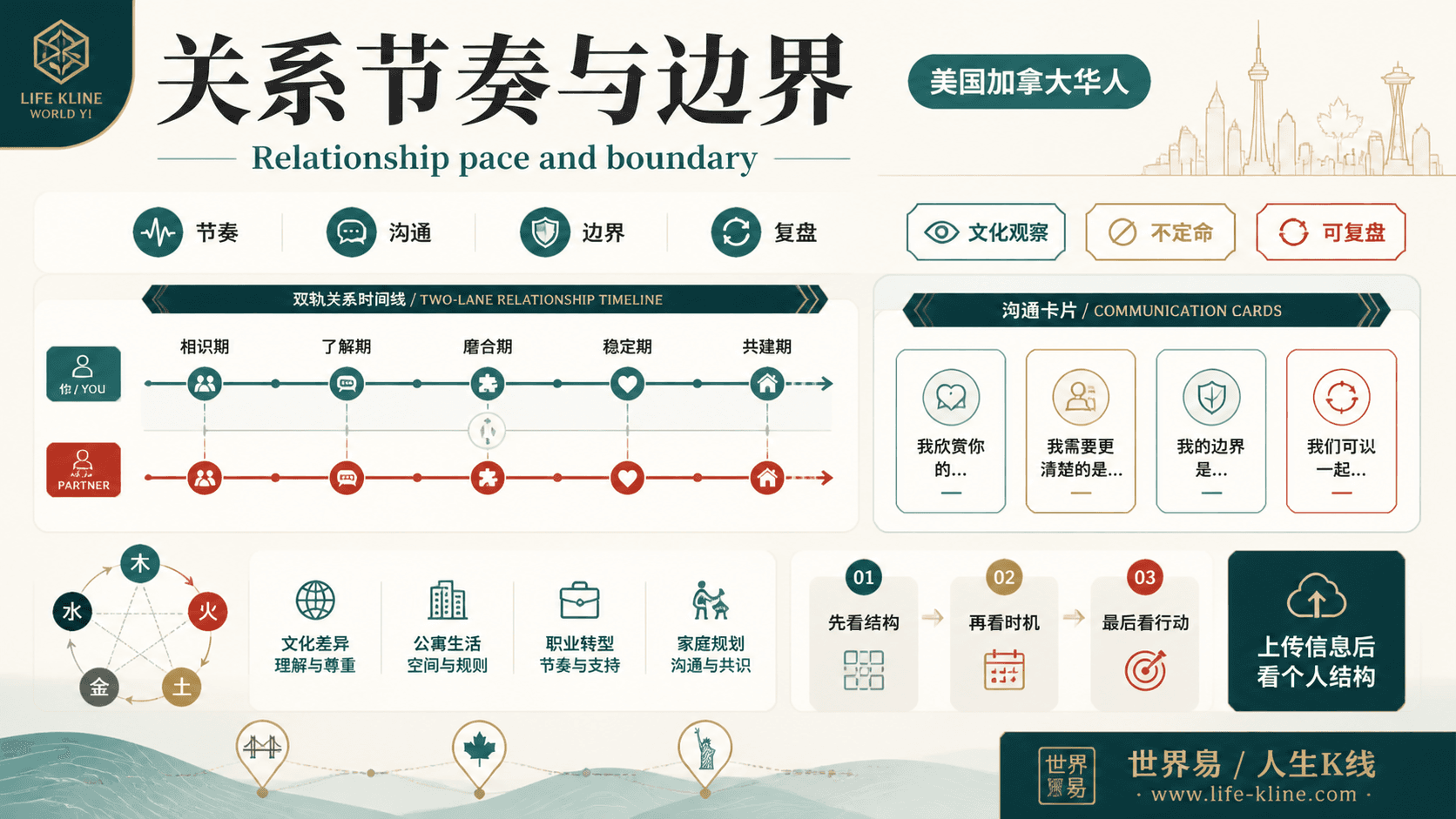
关系节奏与边界|美国加拿大华人
这张图把《Analysis of Ti-Yong Relationship: The Core Metaphysical Wisdom and Complete Application Guide in Plum Blossom Yi Numerology》里的命理概念转成关系、边界和应用场景,适合先看图建立结构,再回到知识文章正文理解细节。
关系节奏与边界不应被写成固定结论。更适合美国加拿大华人的读法,是把传统术语翻译成结构、时机、环境、行动和复盘。
查看图片解读