Complete Guide to Career Line Palmistry and Its Integration with Destiny Analysis
把这篇文章落到自己身上验证:先看结构,再进入个人分析,不做泛泛阅读。
What is the Career Line
The career line, also known as the fate line, is an important line on the palm that usually extends upward from the base of the palm. It represents a person's career development and professional trajectory. The length, depth, clarity, and directional changes of the career line are all considered significant indicators reflecting an individual's career fortune.
In physiognomy and palmistry, the career line not only indicates achievements and challenges in one's profession but also reflects career fluctuations at different life stages. It is closely related to a person's character, abilities, and interaction with external environments, making it an important basis for career planning and fortune analysis.
The origin of the career line can be traced back to ancient systems of physiognomy, where people observed palm lines to infer personal destiny and career development. With the continuous evolution of destiny studies, the interpretation of the career line has gradually integrated elements from the Four Pillars BaZi, making its judgment more scientific and systematic.
How to Read the Career Line: Core Elements
When observing the career line, the first aspect to note is the starting and ending points of the line. The career line typically starts near the wrist at the base of the palm. A clear and straight starting point indicates a stable career foundation. If the line is broken or blurred, it may suggest obstacles and uncertainties in one's career.
Secondly, the depth of the career line reflects the intensity of the professional life. A deep and distinct career line represents strong ambition and high execution ability, enabling stable development; whereas a faint or broken line indicates instability or turning points in the career.
Additionally, the direction and branches of the career line are very important. A line that runs straight upwards signifies smooth career progress; branches may indicate career changes or multiple options. By combining the BaZi elements such as the Day Master, patterns, and Yong Shen (favorable elements), one can more accurately understand the fortune changes hidden behind the career line.
Three Real BaZi Cases
Case One is a female aged between 50 and 55, with the Four Pillars as 癸丑 (Gui Chou) year, 丙辰 (Bing Chen) month, 甲申 (Jia Shen) day, and 壬申 (Ren Shen) hour. The Day Master is 甲木 (Jia Wood), which is relatively weak, belonging to the Shi Shen (Eating God) pattern. The Yong Shen (favorable element) is Water, and the Ji Shen (unfavorable elements) are Fire and Earth. She is currently in the 辛酉 (Xin You) Da Yun (45-54 years), which is stable and suitable for consolidation. Her career line likely appears relatively stable but requires flexibility to adapt to changes. This reflects the Liu Nian (annual fortune) 丙午 (Bing Wu) which brings adaptability, showing that although her career foundation is not strong, she can maintain steady development through adjustment and environmental adaptation.
Case Two is a male aged between 55 and 60, with the Four Pillars as 庚戌 (Geng Xu) year, 乙酉 (Yi You) month, 壬寅 (Ren Yin) day, and 辛丑 (Xin Chou) hour. The Day Master is 壬水 (Ren Water), which is relatively strong, belonging to the Shang Guan (Hurting Officer) pattern. The Yong Shen are Earth and Fire, and the Ji Shen is Metal. The current Da Yun is 庚寅 (Geng Yin) (47-56 years), also a stable luck cycle suitable for consolidation. This chart’s career line should be solid and strong, indicating relatively smooth career development with some breakthroughs. However, attention should be paid to the influence of the Ji Shen Metal to avoid external obstacles. Combined with the Liu Nian 丙午 (Bing Wu), the career line may show some changes, suggesting the need for flexibility in handling sudden career situations.
Case Three is a male aged between 35 and 40, with the Four Pillars as 庚午 (Geng Wu) year, 戊寅 (Wu Yin) month, 戊申 (Wu Shen) day, and 甲寅 (Jia Yin) hour. The Day Master is 戊土 (Wu Earth), relatively strong, belonging to the Bi Jian (Peer) pattern. The Yong Shen are Wood and Water, and the Ji Shen is Fire. The current Da Yun is 辛巳 (Xin Si) (27-36 years), also a stable cycle suitable for consolidation. His career line should exhibit strong competitiveness and autonomy, likely deep and clear, reflecting active progress and sustained stable development in his career. Although the Liu Nian 丙午 (Bing Wu) is Fire and an unfavorable element, the stable Da Yun suggests that despite pressure, the overall career trend is positive.
Common Misconceptions
Many people believe the career line is unchanging, but in fact, it changes noticeably with age, mood, and health conditions. For example, the career line may be faint in youth and become clearer and stronger in middle age due to accumulated experience and career achievements.
Some mistakenly think the meanings of the left and right hand career lines are exactly the same. Traditionally, there is a saying “men left, women right,” but modern palmistry generally holds that the left hand represents innate potential (inborn talents and abilities), while the right hand reflects acquired conditions and changing trends, showing current life status and upcoming changes. Ignoring the comparison between both hands can lead to biased interpretations of the career line.
Furthermore, relying solely on the career line to judge destiny while neglecting BaZi patterns and Da Yun/Liu Nian is a common error. The career line must be analyzed together with the Day Master’s strength, patterns, Yong Shen and Ji Shen, and current Da Yun and Liu Nian to provide a comprehensive and accurate analysis of career fortune.
Practical Advice
When observing the career line, it is important to consider the individual’s age stage and BaZi Da Yun and Liu Nian, to understand the deeper meanings behind line changes. Especially during stable Da Yun periods, the career line often appears steady and is suitable for consolidation; during years with significant changes, the career line may fluctuate noticeably, requiring flexible responses.
It is recommended to observe the differences between the left and right hand career lines to distinguish innate potential from acquired changes. Large differences between the two hands indicate a life with many changes and possible multiple career adjustments.
Finally, adjust career strategies according to one’s own BaZi Yong Shen and Ji Shen. For example, a person whose Yong Shen is Water should utilize water-related environments and resources more, while avoiding obstacles related to Ji Shen elements. This approach can better realize the potential indicated by the career line.
FAQ
Question 1: Does physiognomy change with age? Answer: Yes, and the changes can be significant. Different age stages focus on different facial areas: youth mainly observes the Tian Ting (forehead), middle age focuses on cheekbones and nose, and old age emphasizes the chin and nasolabial folds. A person’s physiognomy at 30 and 50 years old can be very different, as mood, lifestyle habits, and health conditions are all reflected on the face. Therefore, both the career line and overall physiognomy change over time.
Question 2: Which hand’s palmistry is more accurate, left or right? Answer: Traditionally, there is a saying “men left, women right,” but modern palmistry generally believes the left hand represents innate potential, i.e., the talents and abilities one is born with; the right hand reflects acquired conditions and trends, showing current life status and upcoming changes. Comparing both hands, the greater the difference, the more life changes one has experienced, which helps better understand the dynamic changes of the career line.
Question 3: What does a broken or blurred career line indicate? Answer: A broken or blurred career line generally indicates obstacles and challenges in career development, possibly unstable work situations or the need for career transitions. By combining BaZi elements such as the Day Master’s strength, patterns, and Da Yun/Liu Nian, one can judge whether these obstacles are temporary or long-term and whether adjustments to Yong Shen and Ji Shen can resolve them, thus achieving career stability and improvement.
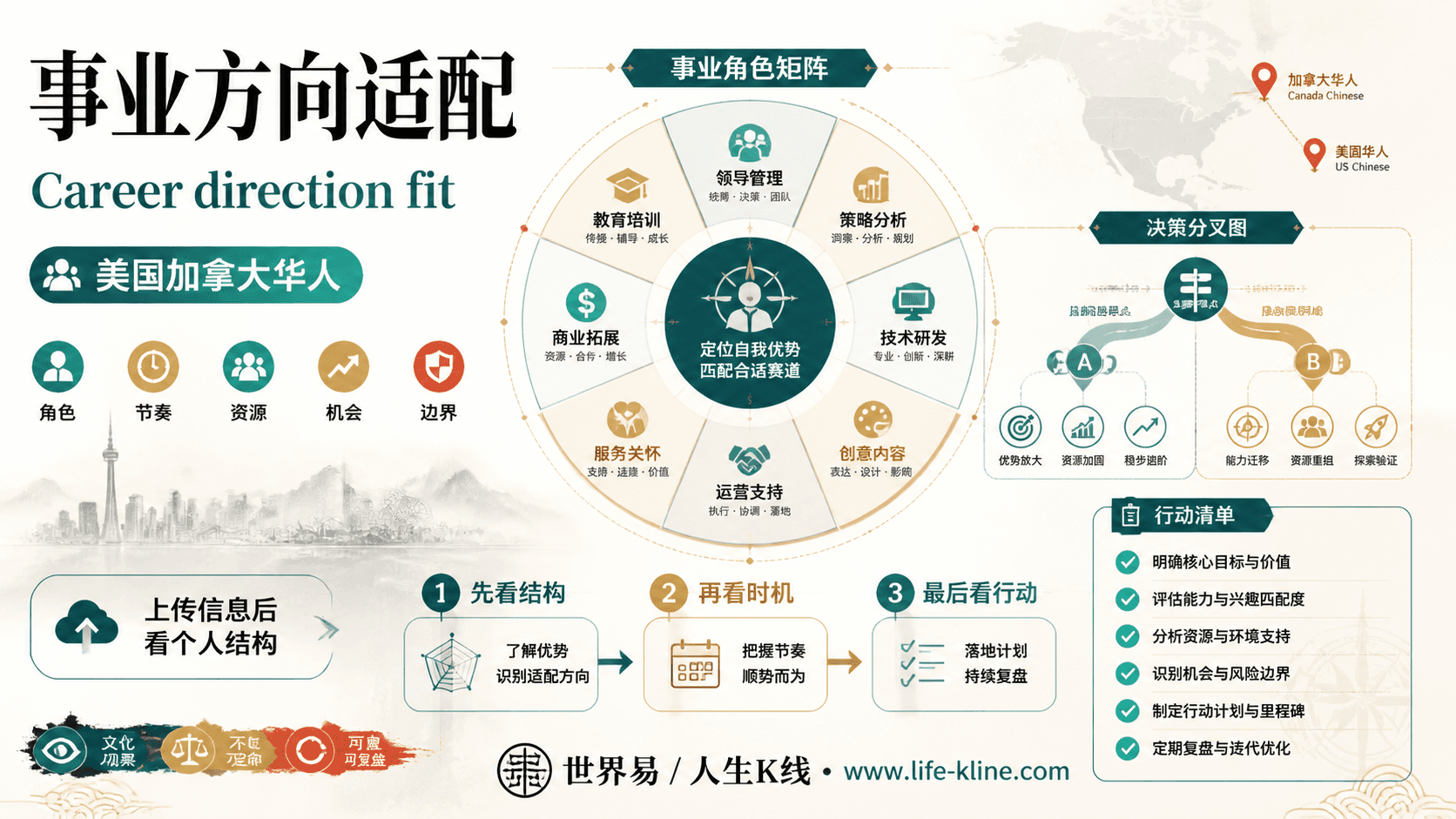
事业方向适配|美国加拿大华人
这张图把《Complete Guide to Career Line Palmistry and Its Integration with Destiny Analysis》里的命理概念转成关系、边界和应用场景,适合先看图建立结构,再回到知识文章正文理解细节。
事业方向适配不应被写成固定结论。更适合美国加拿大华人的读法,是把传统术语翻译成结构、时机、环境、行动和复盘。
查看图片解读