Complete Guide to Choosing Auspicious Dates for Beam Raising: Precise Timing with BaZi Analysis
把这篇文章落到自己身上验证:先看结构,再进入个人分析,不做泛泛阅读。
What is Beam Raising Date Selection
Beam raising date selection is an important step in traditional construction rituals, referring to choosing an auspicious date for the beam raising ceremony, aiming to bring good fortune and smoothness to a new residence or building. This ritual not only symbolizes the completion of the main structural framework but also carries the wish for prosperous family fortune and career success.
The origin of date selection can be traced back to ancient Chinese lunar calendar culture, integrating the timing of heaven and earth with an individual’s BaZi (Four Pillars) chart. It is believed that when the qi of heaven and earth aligns with personal fortune, major activities such as groundbreaking and beam raising are more likely to succeed and reduce calamities.
Modern date selection theory emphasizes combining the personal Four Pillars BaZi to assess the strength of the Day Master, the structure (geju), Yong Shen (favorable elements) and Ji Shen (unfavorable elements), as well as the current Da Yun (decade luck) and Liu Nian (annual fortune). The goal is to select the most suitable auspicious date according to the individual’s metaphysical needs. At the same time, it avoids clash days, breaking months, and other unfavorable times to ensure the best timing for the ceremony.
How to View Beam Raising Date Selection: Core Elements
Beam raising date selection requires attention to the strength of the Day Master and the structure (geju) in the personal BaZi chart, because the Day Master represents the individual’s foundation. Its strength determines the required Yong Shen (favorable elements) and Ji Shen (unfavorable elements). Through harmonizing the Yong Shen, the chosen date can enhance the owner’s fortune and avoid triggering the Ji Shen which causes adverse effects.
The choice of Yong Shen is especially critical. The date for beam raising should prioritize times that can generate, assist, or regulate the Yong Shen, while avoiding days when the Yong Shen is overcome or when the Ji Shen appears, ensuring the ceremony proceeds smoothly and benefits the family’s fortune development.
The interaction of Da Yun (decade luck) and Liu Nian (annual fortune) should not be ignored. The strength of the current Da Yun determines the overall trend of fortune, while the Liu Nian reflects the specific luck of the year. When selecting a date, one should consider the status of Da Yun and Liu Nian, avoiding periods when the Da Yun is weak or the Liu Nian is unfavorable, to ensure the beam raising ceremony is auspicious.
Additionally, it is necessary to avoid generally unfavorable days in the traditional Huang Li (Chinese almanac), such as clash days, punishment days, and breaking months. One should also consider the clash relationships of the involved zodiac signs and important matters, comprehensively evaluating the suitability of the date to prevent negative impacts on the ceremony.
Three Real BaZi Cases
Case 1 involves a female aged 35-40, with Four Pillars 丁卯 (Ding Mao), 己酉 (Ji You), 乙亥 (Yi Hai), 丁亥 (Ding Hai). The Day Master is Yi Wood, which is relatively strong. The structure (geju) is Pian Cai (Indirect Wealth). The Yong Shen are Metal and Earth, and the Ji Shen is Water. She is currently in the 5th year of the 癸丑 (Gui Chou) Da Yun, with the Liu Nian being 丙午 (Bing Wu). Given her Day Master is relatively strong and the Yong Shen are Metal and Earth, the beam raising date should be chosen on days that generate or assist Metal and Earth, avoiding Water days to prevent Ji Shen influence. The current Da Yun is stable, and the Liu Nian requires flexible adjustment. The date selection should emphasize the Liu Nian’s qi, choosing auspicious days favorable to Metal and Earth to promote household stability and wealth growth.
Case 2 is a female aged 35-40, with Four Pillars 辛未 (Xin Wei), 庚子 (Geng Zi), 丙辰 (Bing Chen), 癸巳 (Gui Si). The Day Master is Bing Fire, which is relatively weak. The structure is Pian Cai (Indirect Wealth). The Yong Shen is Metal, and the Ji Shen is Earth. She is currently in the 8th year of the 癸卯 (Gui Mao) Da Yun, with the Liu Nian being 丙午 (Bing Wu). Because the Day Master is weak and the Yong Shen is Metal, the date selection should prioritize days that support Metal and avoid days with strong Earth to prevent intensifying the Ji Shen. The Da Yun is stable, and the Liu Nian requires flexible adjustment. Date picking should incorporate Metal-strong days to strengthen the Day Master, ensuring the beam raising timing benefits family fortune and career development.
Case 3 is a male aged 25-30, with Four Pillars 己卯 (Ji Mao), 庚午 (Geng Wu), 戊申 (Wu Shen), 庚申 (Geng Shen). The Day Master is Wu Earth, which is relatively strong. The structure is Zhuan Wang Ge (Specially Strong Structure). The Yong Shen is Metal, and the Ji Shen is Fire. He is currently in the 1st year of the 丁卯 (Ding Mao) Da Yun, with the Liu Nian being 丙午 (Bing Wu). Given the Day Master is strong and the Yong Shen is Metal, the beam raising date should be chosen on days that assist Metal and avoid days with strong Fire, especially avoiding the intense Fire influence in the Liu Nian. The Da Yun is relatively weak, and the Liu Nian requires caution. Date selection should carefully avoid the Ji Shen Fire’s impact to ensure a smooth ceremony and stable family fortune.
Common Misconceptions
Many people believe that the general 'Yi Ji' (suitable and unsuitable) listed in the common Huang Li (Chinese almanac) can be directly applied for beam raising date selection, neglecting the differences in personal BaZi and the current Da Yun and Liu Nian. This leads to date choices that do not align with the individual’s metaphysics, affecting the ceremony’s effectiveness.
Another misconception is focusing only on a single factor such as zodiac clashes, while ignoring core BaZi elements like the strength of the Day Master, Yong Shen, and Ji Shen. This results in a one-sided date selection that fails to maximize the introduction of auspicious qi.
Some also overlook the dynamic interaction between Da Yun and Liu Nian, failing to adjust the date selection strategy according to the current fortune trends. As a result, the chosen date may comply with traditional rules but does not suit the individual’s actual metaphysical condition.
Practical Suggestions
Beam raising date selection should comprehensively analyze the personal BaZi, focusing on the strength of the Day Master, the structure (geju), and the Yong Shen and Ji Shen. Choose auspicious dates that can generate or assist the Yong Shen and avoid the influence of the Ji Shen, ensuring the ceremony proceeds smoothly and benefits future fortune.
Simultaneously consider the current Da Yun and Liu Nian, evaluating the strength of the fortune and the qi of the Liu Nian. Avoid conducting the beam raising during periods when the Da Yun is weak or the Liu Nian has severe clashes to reduce adverse effects.
It is recommended to integrate the metaphysics of both parties involved, avoiding zodiac clashes, punishments, breaking months, and other unfavorable factors. Prioritize days blessed by auspicious stars such as Tian De and Yue De to enhance the auspicious qi of the beam raising ceremony.
FAQ
Question 1: Are the auspicious dates in the zodiac calendar accurate? Answer: The 'Yi Ji' (suitable and unsuitable) in the general Huang Li (Chinese almanac) are based on common rules such as the Twelve Gods of Construction and Deconstruction and the Twenty-Eight Mansions, without considering personal BaZi or zodiac signs. Therefore, their accuracy is limited. True date selection must combine the individual’s BaZi, the current Liu Nian, and the BaZi of related persons (such as both parties in a wedding) for a scientific and precise calculation.
Question 2: What elements should be considered when choosing a wedding date? Answer: Besides avoiding zodiac clashes, punishment days, breaking months, extinction days, and wedding taboos, one should prioritize days blessed by auspicious stars like Tian De, Yue De, Tian De He, and Yue De He, as well as days favorable to both parties’ Yong Shen. If major events like moving or groundbreaking conflict with the wedding date, priority should be given to ensuring the wedding proceeds smoothly, adjusting the date selection accordingly.
Question 3: Why should beam raising date selection consider Da Yun and Liu Nian? Answer: Da Yun represents the overall strength of fortune over a certain period, while Liu Nian reflects the specific luck changes of the year. Combining Da Yun and Liu Nian in date selection helps avoid performing important ceremonies during periods of weak personal fortune or unfavorable Liu Nian, ensuring the beam raising proceeds smoothly and enhances auspicious effects.
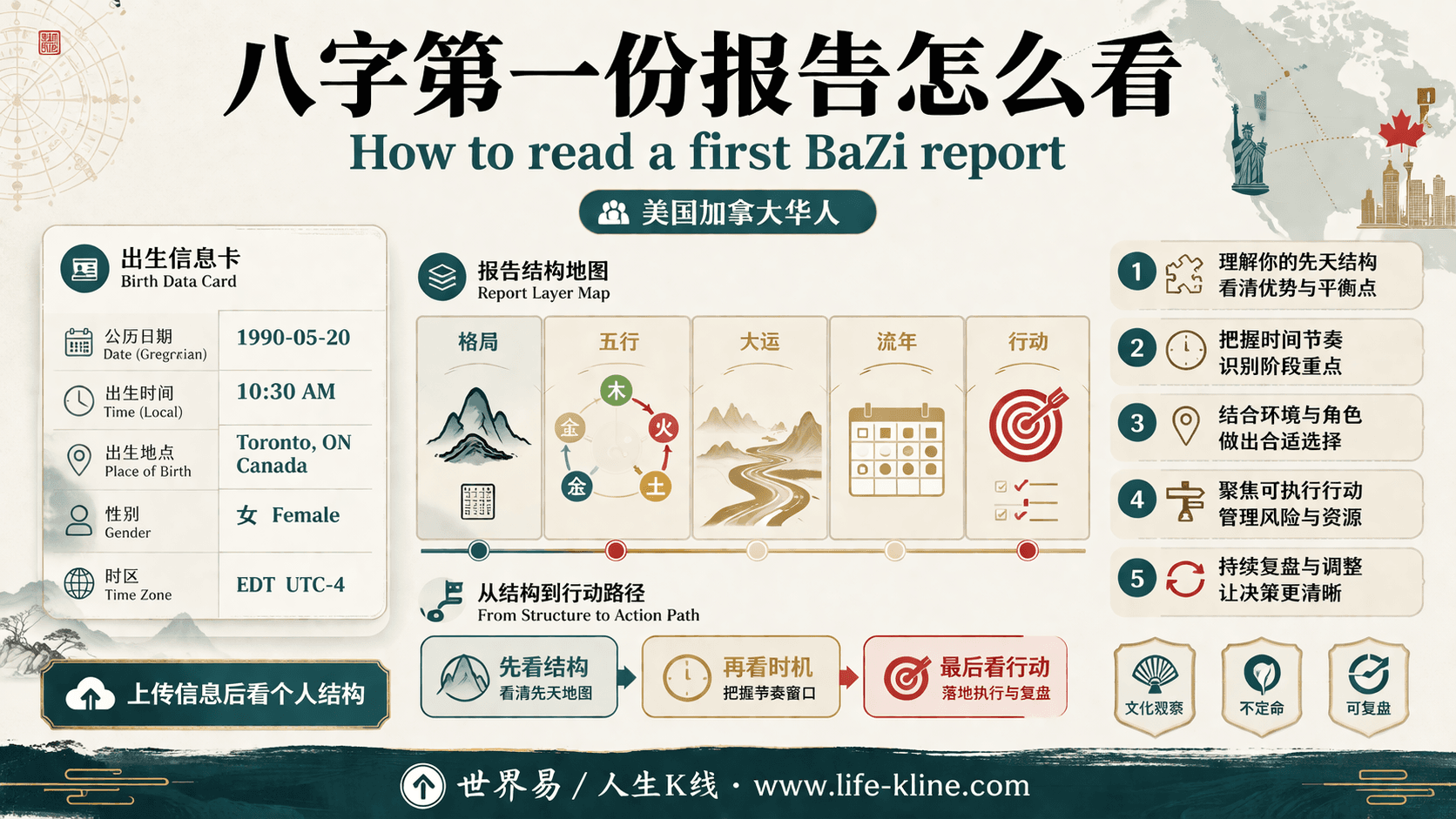
八字第一份报告怎么看|美国加拿大华人
这张图把《Complete Guide to Choosing Auspicious Dates for Beam Raising: Precise Timing with BaZi Analysis》里的命理概念转成关系、边界和应用场景,适合先看图建立结构,再回到知识文章正文理解细节。
八字第一份报告怎么看不应被写成固定结论。更适合美国加拿大华人的读法,是把传统术语翻译成结构、时机、环境、行动和复盘。
查看图片解读