Relocation Choices under Spousal Five Elements Complementarity and Analysis of the Jia Chen Da Yun Transition
先看完案例关键信息,再进入分析页验证自己的结构与阶段。
Client Background
The client is a middle-aged male between 45 and 50 years old, with a stable occupation and married. There is a significant difference in the Five Elements attributes between him and his spouse. Recently, due to work and life needs, the couple is discussing whether to relocate to a more suitable city in hopes of achieving complementary and balanced Five Elements, thereby improving their living and career environment. The couple currently enjoys a good relationship and family atmosphere, but the relocation decision is filled with uncertainty, especially concerning its impact on the client's destiny.
The client values the integration of metaphysics and daily life and is concerned whether the move will align with his personal fortune, aiming to avoid any metaphysical disruptions caused by environmental changes. Particularly during the current Jia Chen Da Yun period, he wishes to confirm if the relocation conforms to the Da Yun trend, helping to stabilize career development rather than causing obstacles. Both spouses hope to use metaphysical guidance to find an ideal city that promotes Five Elements balance and enhances overall life happiness.
Birth Chart Structure Interpretation
In the client's Four Pillars, the Day Master is Jia Wood (甲, Jia), which is relatively weak, indicating insufficient self-strength and a need to rely on external support to enhance vitality and fortune. The pattern belongs to the Zheng Cai (正财) structure, meaning wealth luck is closely related to the Zheng Cai star, whose strength directly affects career and wealth accumulation. The Yong Shen (favorable element) is Water, which nourishes Jia Wood, facilitating growth and benefiting the overall chart balance and enhancement.
However, the Ji Shen (unfavorable elements) are Fire and Earth. Excessive Fire and Earth consume Jia Wood's vitality, bringing resistance and pressure that affect the client's health and career development. The current Da Yun is Jia Chen (甲辰), where Jia Wood meets Chen Earth. Since Chen contains hidden Water, it provides some nourishment to Jia Wood. Overall, the Da Yun remains stable, suitable for maintaining achievements and steady progress. The Liu Nian (annual fortune) is Bing Wu (丙午), with strong Bing Fire and Wu Fire, requiring caution in handling Fire's influence to avoid excessive Fire and Earth restraint.
In summary, the client's current chart structure requires Water as the Yong Shen to regulate the season and avoid excessive disturbance from Fire and Earth. The Da Yun is generally stable, suitable for maintaining the current foundation while using reasonable relocation choices to strengthen the Yong Shen and alleviate the adverse effects of the Ji Shen.
Focused Issue Judgment
Regarding whether the current Jia Chen Da Yun can accommodate the changes brought by relocation, it is essential to consider if the relocation site’s Five Elements can supplement Water, benefit Jia Wood, and counteract the excessive Fire and Earth influence. Although the Jia Chen Da Yun is stable, if the Chen Earth is not accompanied by sufficient Water nourishment, it may exacerbate Earth’s restraining effect, causing instability in career or family.
With the couple’s differing Five Elements, the relocation city’s Five Elements layout must balance both parties. However, since the client’s chart is weak, prioritizing the Yong Shen Water is the main criterion, favoring locations abundant in Water. Water nourishes Jia Wood, easing the Ji Shen pressure from Fire and Earth, helping the client smoothly transition and gradually enhance fortune during the Da Yun period.
The Liu Nian Bing Wu year features strong Fire, so choosing a city rich in Water or symbolically associated with Water (such as riverside, lakeside, or areas with developed water systems) can effectively neutralize the adverse effects of the Fire-heavy year, reducing the impact of Fire and Earth on the Zheng Cai pattern. At the same time, areas with strong Fire and Earth should be avoided to prevent fortune fluctuations after moving, which could negatively affect career and family.
Therefore, although the current Da Yun suggests maintaining achievements, relocating in accordance with the Yong Shen Water and selecting a suitable city can achieve a gentle fortune transition, avoiding metaphysical shocks caused by sudden environmental changes and promoting a stable transition in career and life.
Recommended Actions and Timing
It is recommended that the client prioritize cities characterized by abundant Water, such as riverside, lakeside, or coastal cities with rich water resources. These cities belong to the Water element, which can effectively nourish Jia Wood and strengthen the Yong Shen, thereby counteracting the negative influence of the Ji Shen Fire and Earth. When selecting specific cities, considering the couple’s Five Elements differences, preference should be given to locations with relatively balanced Five Elements but with a pronounced Water element.
Regarding timing, avoid months with strong Fire in the Liu Nian, such as the summer Wu month, and try to choose months with abundant Water, such as winter or periods near Water-rich solar terms, to minimize Fire and Earth impact. Currently, in the Bing Wu Liu Nian, it is advisable to move in the mid to late part of the year when Fire’s strength diminishes somewhat, reducing the shock from environmental changes.
After relocation, the client should focus on Feng Shui adjustments in the home, especially enhancing Water elements, such as placing fish tanks or water features and adding water-colored decorations. This further supports the Yong Shen and strengthens the Da Yun’s transition capability. Maintaining stable lifestyle routines and environment, avoiding excessive changes, aligns with the Jia Chen Da Yun’s tendency toward maintaining achievements, facilitating steady progress in career and family.
Review and Reminders
A common pitfall in this case is neglecting the importance of the Yong Shen Water and blindly choosing cities with strong Fire and Earth. Although seemingly convenient in the short term, this contradicts the chart’s Yong Shen needs, resulting in poor Da Yun transition and negatively affecting career development and family harmony. Relocation decisions must consider the Five Elements balance in the chart to avoid adverse consequences caused by environmental Five Elements clashes.
Moreover, although the Jia Chen Da Yun is stable, it is not suitable for drastic changes. Relocation should be approached cautiously, avoiding rash attempts to change. It is essential to consider Liu Nian changes and select appropriate time windows for gradual adjustments to ensure a smooth fortune transition. Continuously monitor the interaction between the new environment and the chart after moving, and adjust lifestyle and Feng Shui arrangements in a timely manner to achieve a good Da Yun transition and sustained development.
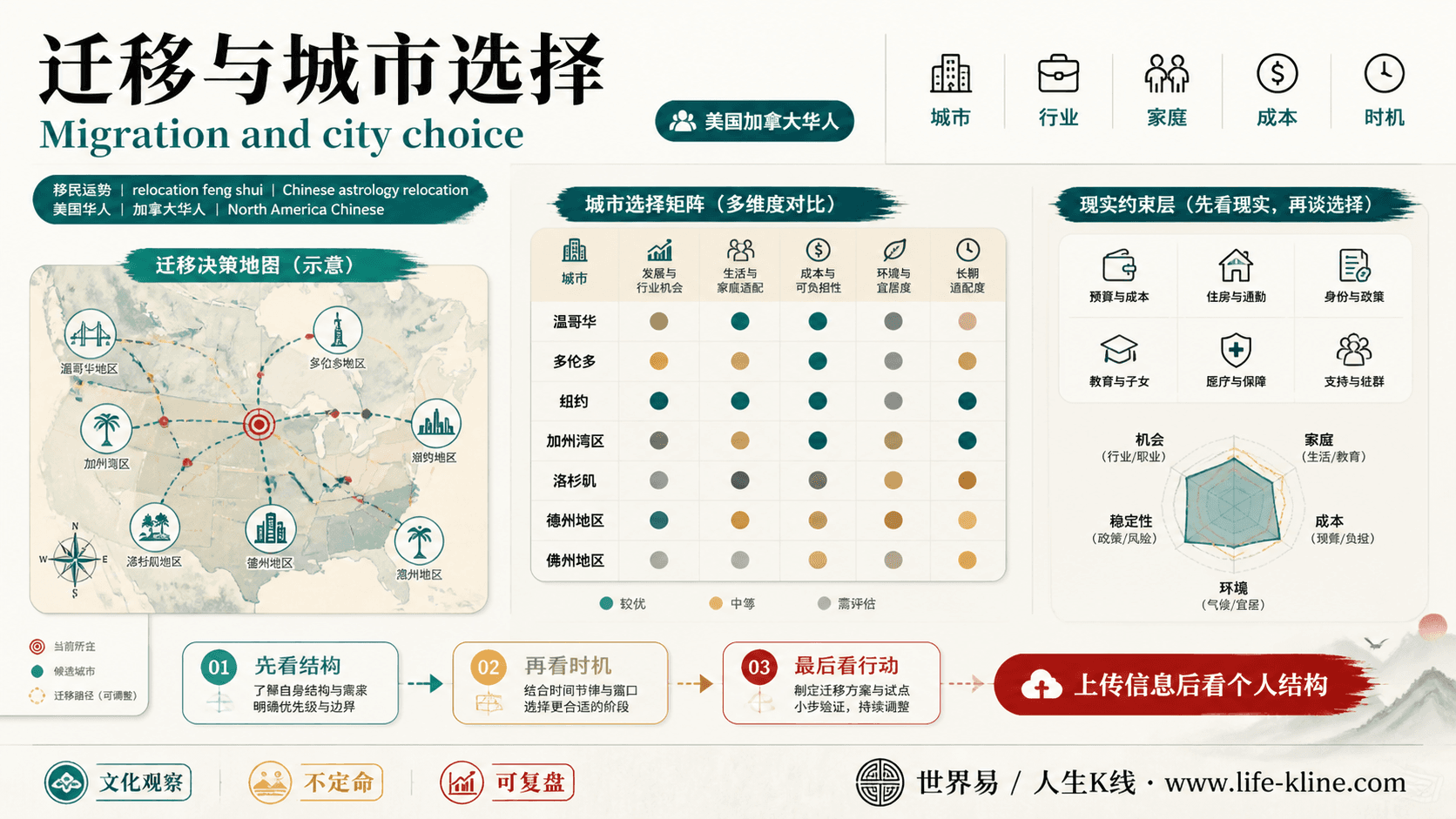
迁移与城市选择|美国加拿大华人
这张图把《Relocation Choices under Spousal Five Elements Complementarity and Analysis of the Jia Chen Da Yun Transition》里的命理概念转成关系、边界和应用场景,适合先看图建立结构,再回到案例正文理解细节。
迁移与城市选择不应被写成固定结论。更适合美国加拿大华人的读法,是把传统术语翻译成结构、时机、环境、行动和复盘。
查看图片解读