Analysis of the He-Chong Relationship in Cultural Integration during Joint Acquisition of Small Teams
先看完案例关键信息,再进入分析页验证自己的结构与阶段。
Client Background
The client is a young male entrepreneur aged between 20 and 25, currently at a critical early stage of his startup. As the leading party, he plans to acquire a small team to expand his business scale and market influence. His main challenge is how to smoothly integrate the corporate cultures of the two teams and avoid conflicts of ideology that may hinder cooperation progress.
He has some management experience professionally, but cultural integration involved in acquisitions is a new challenge. The client clearly understands that relying solely on business advantages cannot guarantee cooperation success; cultural coordination and harmonious relationships between both parties are paramount, especially the stability during the initial cooperation phase.
BaZi Structure Interpretation
The client’s BaZi chart features Xin Metal (辛, Xin) as the Day Master in a balanced state. The Zheng Guan (正官) pattern symbolizes a strong sense of responsibility and rule awareness, making him inclined toward order and norms in management and cooperation. The Xin Metal Day Master requires Earth as the Yong Shen (用神, favorable element), indicating that a stable and solid environment helps him realize his potential, while Fire is the Ji Shen (忌神, unfavorable element), implying that overly intense or conflicting atmospheres adversely affect him.
Currently, the client is in the Gui Chou (癸丑) Da Yun (decade luck cycle), which is a stable phase, favoring consolidation rather than aggressive advancement, emphasizing steady progress and foundation building. The Liu Nian (annual fortune) is Bing Wu (丙午), a year of strong Fire, bringing certain volatility, but the stable Da Yun allows his adaptability to be exercised. Overall, the BaZi suggests the client should maintain steadiness in cooperation, avoid excessive Fire impact, and especially guard against conflicts caused by ideological or personality clashes that could break the partnership.
Focused Issue Assessment
Regarding the "He-Chong relationship" between the other party and himself, the Xin Metal Day Master indicates that the client is essentially firm and rational, tending to drive cooperation through rules and order. If the other team’s culture contains strong Fire elements—such as being passionate but impatient, or exhibiting intense behaviors—it easily triggers the client’s Ji Shen (Fire), potentially causing conflicts and friction that hinder cultural integration.
The Yong Shen Earth requirement in the chart suggests that if the other team demonstrates stability, reliability, and tolerance, it will be easier to gain the client’s recognition and trust. Conversely, if the other party’s culture leans toward recklessness and impulsiveness, effective interaction during cooperation will be difficult, and the He-Chong relationship will manifest as disharmony or even opposition.
Moreover, the interaction between the Gui Chou Da Yun and Bing Wu Liu Nian shows that the client is currently at a stage requiring cautious adaptability. Although the Fire element brings challenges, the stable Da Yun provides opportunities to mitigate He-Chong pressures through rational adjustments. Early cooperation should emphasize communication and gradual adaptation to avoid breakdowns caused by impatience.
Therefore, the key to the He-Chong relationship lies in observing and adjusting the intensity of the other party’s Fire element, adopting strategies to avoid triggering the client’s Ji Shen, and guiding the cooperative atmosphere with the Earth element’s steadiness to create a mutually comfortable cultural symbiosis.
Recommended Actions and Timing
For cultural integration in cooperation, the client should first establish a stable communication mechanism, emphasizing the formulation of rules and processes in line with the Zheng Guan pattern’s demand for order. Especially in the current Bing Wu Liu Nian with strong Fire, emotional control is crucial to prevent escalation of conflicts due to intensified Fire elements. It is recommended to organize regular team-building activities over the next six months to strengthen the Earth element’s stability and gradually blend the cultures.
From the perspective of Da Yun and Liu Nian, the Gui Chou Da Yun emphasizes consolidation, so the client should advance the acquisition steadily and avoid rapid changes. It is advisable to select a relatively stable time node, such as the end of this year or early next year, to conduct important cultural integration evaluations and adjustments, aiming to reach long-term cooperation consensus supported by the stable Da Yun.
At the same time, the client may introduce third-party mediation or corporate culture experts to clarify the core conflicts between parties, promote balance between Fire and Earth elements, and enhance team cohesion. Over the next two years, continuous attention should be paid to subtle changes in the relationship to prevent friction caused by excessive Fire while leveraging its vitality to drive cooperative innovation.
Review and Reminders
In joint cooperation, the cultural He-Chong relationship often critically affects stability. The client must beware of emotional loss of control and decision-making errors caused by excessive Ji Shen Fire manifestations, especially in Fire-strong Liu Nian, requiring calmness. Additionally, over-reliance on rules may neglect human warmth, causing team members to feel alienated.
It is recommended that the client maintain a flexible mindset during cooperation, timely adjusting strategies to avoid rigid thinking. Meanwhile, cultural integration should not be rushed; respecting differences and seeking balance gradually are essential to achieving long-term stable development.
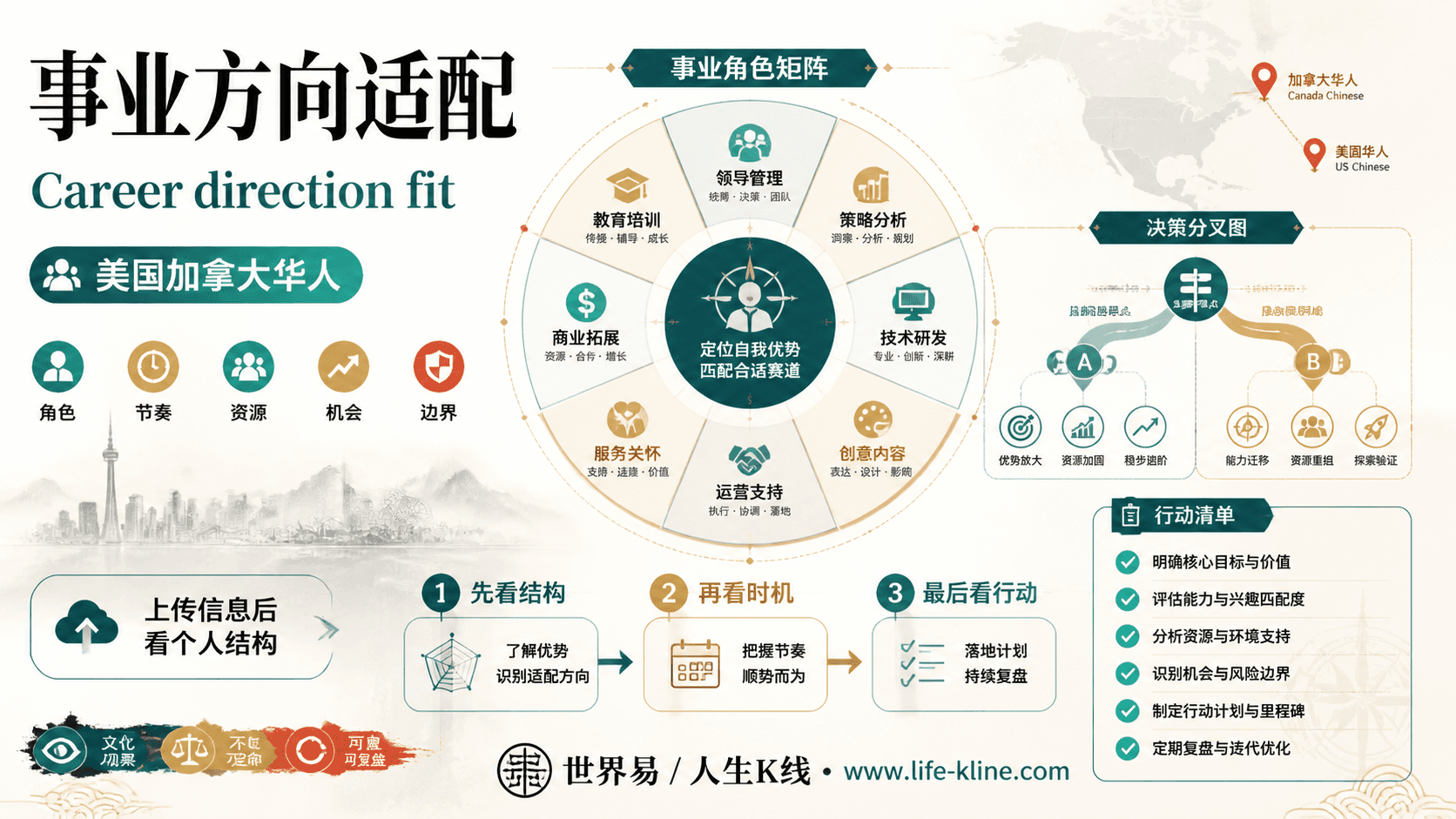
事业方向适配|美国加拿大华人
这张图把《Analysis of the He-Chong Relationship in Cultural Integration during Joint Acquisition of Small Teams》里的命理概念转成关系、边界和应用场景,适合先看图建立结构,再回到案例正文理解细节。
事业方向适配不应被写成固定结论。更适合美国加拿大华人的读法,是把传统术语翻译成结构、时机、环境、行动和复盘。
查看图片解读