Risks of He-Chong Conflicts in Partnerships and Analysis of Exclusive Agreements
先看完案例关键信息,再进入分析页验证自己的结构与阶段。
Client Background
The client is a man over fifty years old, long engaged in enterprise management, currently in a stable phase of his career. As the head of a medium-sized company, he is preparing to sign exclusive agreements with upstream and downstream partners to ensure supply chain stability and priority access to resources. However, during the cooperation process, he is concerned about the He-Chong (combination-conflict) relationship between himself and the partner from a metaphysical perspective, fearing that such conflicts may cause frictions and risks in future cooperation.
On the family front, the client is well-established and values the balance between career and family. Having experienced multiple cooperative ventures, he is well aware of the complexities hidden within partnerships, especially in binding forms like exclusive agreements where any potential clash can significantly impact business operations. Therefore, he hopes to gain in-depth judgment and coping strategies regarding the cooperation relationship through a metaphysical lens.
Chart Structure Interpretation
The client's BaZi chart centers on a Gui (癸, Gui) Water Day Master, with a relatively strong Water element. The Gui Water Day Master, supported by the Ren Zi (壬子, Ren Zi) year pillar and Ren Yin (壬寅, Ren Yin) month pillar, exhibits a strong self-awareness and vigorous vitality, belonging to the Jie Cai (劫财) pattern. This indicates a strong competitive spirit and a tendency toward resource sharing. People with the Jie Cai pattern often show contradictions between resource competition and sharing in cooperation.
The Yong Shen (favorable elements) Earth and Fire play a harmonizing role in his chart; Earth generates Metal, and Fire controls Metal, thus mitigating the excessive impact caused by the strong Water. The Ji Shen (unfavorable element) Metal represents adverse factors, especially manifesting as potential conflicts and obstacles in cooperation. Currently, the client is in the Wu Shen (戊申, Wu Shen) Da Yun, where the stable Wu Earth and the revealing Shen Metal create an overall steady fortune, suitable for maintaining achievements rather than aggressive expansion.
The Liu Nian is Bing Wu (丙午, Bing Wu), which strengthens the Fire element, aiding the Yong Shen Fire’s function and enhancing the client’s adaptability and initiative to some extent. The interaction between the Da Yun and Liu Nian is stable, indicating that the current phase favors prudent management and flexible responses but discourages rash moves. Overall, the chart shows the client has a solid cooperative foundation but must be cautious of the Metal’s clash in the He-Chong relationship, especially in deeply binding exclusive agreements.
Focused Issue Judgment
Regarding the client’s concern about whether a He-Chong relationship exists between himself and the partner, combining the Jie Cai pattern and the analysis of Yong Shen and Ji Shen, if the partner’s Five Elements prominently feature Metal, it will directly hit the client’s Ji Shen, forming a significant He-Chong conflict. This conflict may cause contradictions and disputes in the cooperation, particularly evident in resource allocation and power balance.
The client’s Day Master is relatively strong, and the Jie Cai pattern emphasizes competition among similar elements. If the partner’s metaphysical structure is too similar or has an obvious Metal attribute clash, it will exacerbate conflicts, making cooperation difficult to proceed smoothly. The binding nature of the exclusive agreement amplifies this risk, and once conflicts erupt, the cost of resolution is high, potentially leading to cooperation breakdown.
However, the current Wu Shen Da Yun’s stable Earth and the auxiliary Fire of the Bing Wu Liu Nian equip the client with better regulation and coping abilities. Through effective communication and reasonable cooperation clause design, the negative impact of the He-Chong conflict can be alleviated to some extent. Especially by clarifying responsibilities and establishing reasonable risk control mechanisms, the cooperation relationship can become more stable.
Therefore, judging whether the partner forms a substantial He-Chong conflict with the client hinges on identifying the partner’s Five Element attributes, particularly the Metal component, and pinpointing conflict points in mutual interests. The metaphysical He-Chong warning signals cooperation risks but is not an absolute barrier; reasonable strategic adjustments are key to resolution.
Recommended Actions and Timing
Given the current Da Yun is Wu Shen, with an overall stable environment, it is recommended that before signing the exclusive agreement, the client should focus on verifying the partner’s Five Element attributes, especially the strength of Metal. If the partner’s Metal attribute is strong, sufficient risk prevention clauses should be set in the contract, such as phased assessments, benefit adjustment mechanisms, and exit plans, to reduce risks caused by He-Chong conflicts.
Under the influence of the Bing Wu Liu Nian, the client’s adaptability is strong, suitable for maintaining flexibility in negotiation and timely adjusting cooperation details. It is advised to seize the opportunity in the first half of the Liu Nian when Fire energy is stronger to promote the signing and implementation of the agreement while reserving flexibility for subsequent adjustments to avoid a one-off decision.
Additionally, since the Jie Cai pattern emphasizes competition among similar elements, the client should enhance the benefit-sharing mechanism with the partner to reduce friction caused by resource competition. This can be achieved through clear division of labor, reasonable profit distribution, and establishing regular communication channels to resolve potential conflicts and strengthen cooperation stability.
Overall, steady progress, flexible responses, and risk contingency plans are the three key points at this stage. It is essential to avoid blindly increasing cooperation in an environment where the Ji Shen Metal is overly strong to prevent falling into unfavorable situations.
Review and Reminders
From a metaphysical perspective, He-Chong relationships indicate potential conflicts and risks, but whether cooperation proceeds smoothly depends on both parties’ business attitudes and cooperation details. The client should avoid treating metaphysics as an absolute basis while neglecting real-world communication and cooperation details; only then can the challenges posed by He-Chong conflicts be truly resolved.
Moreover, the Jie Cai pattern’s competitive nature may cause the client to exhibit a strong desire to win in cooperation, which risks amplifying conflicts due to personal willfulness. Properly controlling one’s emotions and expectations, maintaining an open and inclusive attitude, is crucial to minimizing the negative impact of He-Chong conflicts and achieving a win-win cooperation.
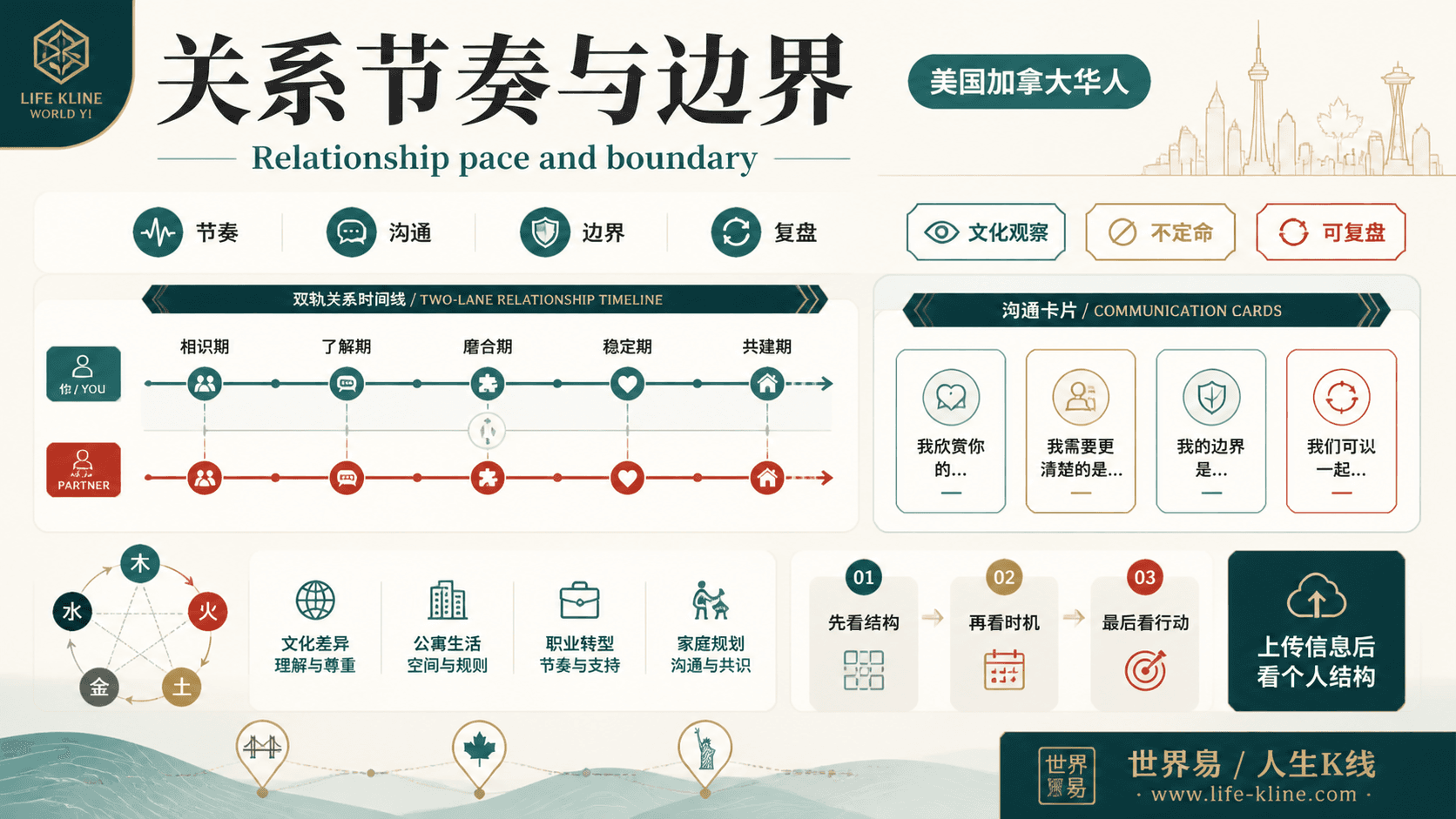
关系节奏与边界|美国加拿大华人
这张图把《Risks of He-Chong Conflicts in Partnerships and Analysis of Exclusive Agreements》里的命理概念转成关系、边界和应用场景,适合先看图建立结构,再回到案例正文理解细节。
关系节奏与边界不应被写成固定结论。更适合美国加拿大华人的读法,是把传统术语翻译成结构、时机、环境、行动和复盘。
查看图片解读