Risk Analysis and Response Strategies for He-Chong Conflicts in Partnerships and Collaborations
先看完案例关键信息,再进入分析页验证自己的结构与阶段。
Client Background
The client is a male entrepreneur between 35 and 40 years old, currently at a critical stage of career development. As a mid-level manager in the manufacturing industry, he faces a major decision to sign exclusive supply agreements with upstream and downstream partners, aiming to enhance market competitiveness through binding cooperation. However, he is quite concerned about the risks of collaboration, especially worrying whether there are irreconcilable conflicts in essence between the parties that could affect future business stability.
On the family front, the client is under dual pressure from career and family responsibilities, needing to consolidate the existing economic foundation while also striving to create a better living environment for his family. He currently hopes to gain deeper insight into the He-Chong relationship between himself and the counterpart from a BaZi perspective, so as to make scientifically reasonable cooperation judgments and avoid adverse impacts on career development due to unsuccessful collaboration.
BaZi Chart Structure Interpretation
The client’s Day Master is 癸水 (Gui Water), positioned in a Shang Guan (Hurting Officer) pattern, with an overall relatively weak Day Master. 癸水 (Gui Water) itself is gentle and clear, but is heavily influenced by the甲寅 (Jia Yin) in the Month Pillar and甲子 (Jia Zi) in the Hour Pillar, where甲木 (Jia Wood) is strong. The Wood and Fire elements are relatively abundant, exerting strong control over Water, especially with a strong aversion to excessive Wood and Fire energy. Currently, the client is in the 戊午 (Wu-Wu) Da Yun (decade luck cycle), where 戊土 (Wu Earth) acts as a neutralizing Earth element that can stabilize the chart to some extent, representing a relatively stable phase focused on maintaining achievements.
However, the Liu Nian (annual fortune) is 丙午 (Bing-Wu), where the 午 (Wu Fire) is strong. The fire energy intensifies the pressure on the 癸水 (Gui Water) Day Master, creating an environment dominated by Wood-Fire mutual generation, posing challenges to the Day Master. The Shang Guan pattern often indicates talent and versatility but also susceptibility to disputes. The weak Day Master and aversion to Wood and Fire suggest the client is prone to passive situations due to intensified external conflicts during cooperation. Special attention must be paid to the counterpart’s zodiac and Five Elements attributes to prevent He-Chong (combination-clash) from causing loss of resources and trust.
Overall, the client’s Da Yun environment is relatively stable, suitable for cautious maintenance of achievements. However, the fire-strong Liu Nian warning indicates that cooperation risks should not be ignored, especially if the counterpart belongs to Wood or Fire elements, which is highly likely to form a significant He-Chong pattern and affect the cooperation foundation.
Focused Problem Assessment
Regarding the client’s concern about He-Chong relationships, analyzing the counterpart’s Heavenly Stems and Earthly Branches attributes is crucial. Assuming the counterpart belongs to Wood or Fire elements, this creates a clear controlling relationship with the client’s 癸水 (Gui Water) Day Master. The strong Wood and Fire elements restrict the Day Master Water, symbolizing disagreements, conflicts of interest, and potential struggles for benefits during cooperation. This relationship easily leads to friction and trust crises in the collaboration process.
Such He-Chong relationships manifest not only as business conflicts but may extend to decision-making levels, causing inconsistent strategic goals and weakening the driving force of cooperation. The client must be vigilant about emotional fluctuations and unpredictable behaviors caused by Five Elements clashes from the counterpart, especially in exclusive upstream and downstream agreements where one party’s dominance may unbalance the cooperation and impose resource pressure on the client.
Additionally, the client’s current Shang Guan pattern represents talent and expression, but the weak Day Master means the client needs to strengthen self-protection and communication skills. Facing a He-Chong counterpart, the client should avoid excessive compromise, maintain principles to prevent passive squeezing, and safeguard personal interests. The stable Da Yun supports maintenance, but the fire-strong Liu Nian calls for flexible strategy adjustment and timely conflict response during cooperation.
The assessment shows that if the counterpart belongs to Wood or Fire elements, this is a cooperation risk point. If the counterpart’s Five Elements lean toward Metal or Water, the He-Chong risk decreases and cooperation is smoother. Therefore, priority should be given to confirming the counterpart’s Five Elements attributes and evaluating the degree of cooperation conflict, which is key to resolving He-Chong issues.
Recommended Actions and Timing
First, before signing exclusive upstream and downstream agreements, the client should thoroughly understand the counterpart’s Five Elements attributes and use BaZi analysis to determine whether a significant He-Chong relationship exists. If the counterpart belongs to Wood or Fire, it is recommended to introduce a third-party neutralizing force, such as incorporating Metal element resources or adjusting contract terms, to reduce the impact of Wood and Fire on Water and enhance overall cooperation harmony.
Second, given the current 戊午 (Wu-Wu) Da Yun belongs to Earth, which favors stability and consolidation, the client should focus on risk control and avoid blind expansion. The agreement should include reasonable risk-sharing mechanisms and conflict resolution procedures to ensure clear response processes when disputes arise, thereby reducing uncertainties caused by He-Chong.
Third, under the fire-strong 丙午 (Bing-Wu) Liu Nian impact, the client needs to maintain high sensitivity and adjust cooperation strategies at any time. It is suggested to closely monitor the cooperation status over the next one to two years, conduct periodic reviews and adjustments as needed, and avoid rash decisions caused by fire-induced impatience, maintaining calmness and rationality.
Finally, the client may appropriately introduce Metal elements, such as financial or legal advisors, to leverage Metal’s supportive role, strengthen the rigidity and rules of the cooperation framework, thereby mitigating the clash of Wood and Fire against Water and ensuring long-term cooperation stability.
Review and Reminders
In practice, although BaZi He-Chong analysis can reveal potential conflicts, it should not be the sole basis for decision-making. Successful cooperation also depends on communication, contractual spirit, and balanced interests between both parties. The client should avoid excessive pessimism or radicalism due to He-Chong and reasonably combine actual circumstances to formulate cooperation strategies.
A special reminder: those with a weak Day Master in a Shang Guan pattern tend to have greater emotional fluctuations and are prone to misjudgments under pressure during cooperation. Maintaining inner stability is essential to prevent cooperation conflicts from affecting overall career development. Moreover, He-Chong relationships are not necessarily irreconcilable; by reasonably applying Five Elements balance and designing cooperation clauses, mutually beneficial outcomes can still be achieved.
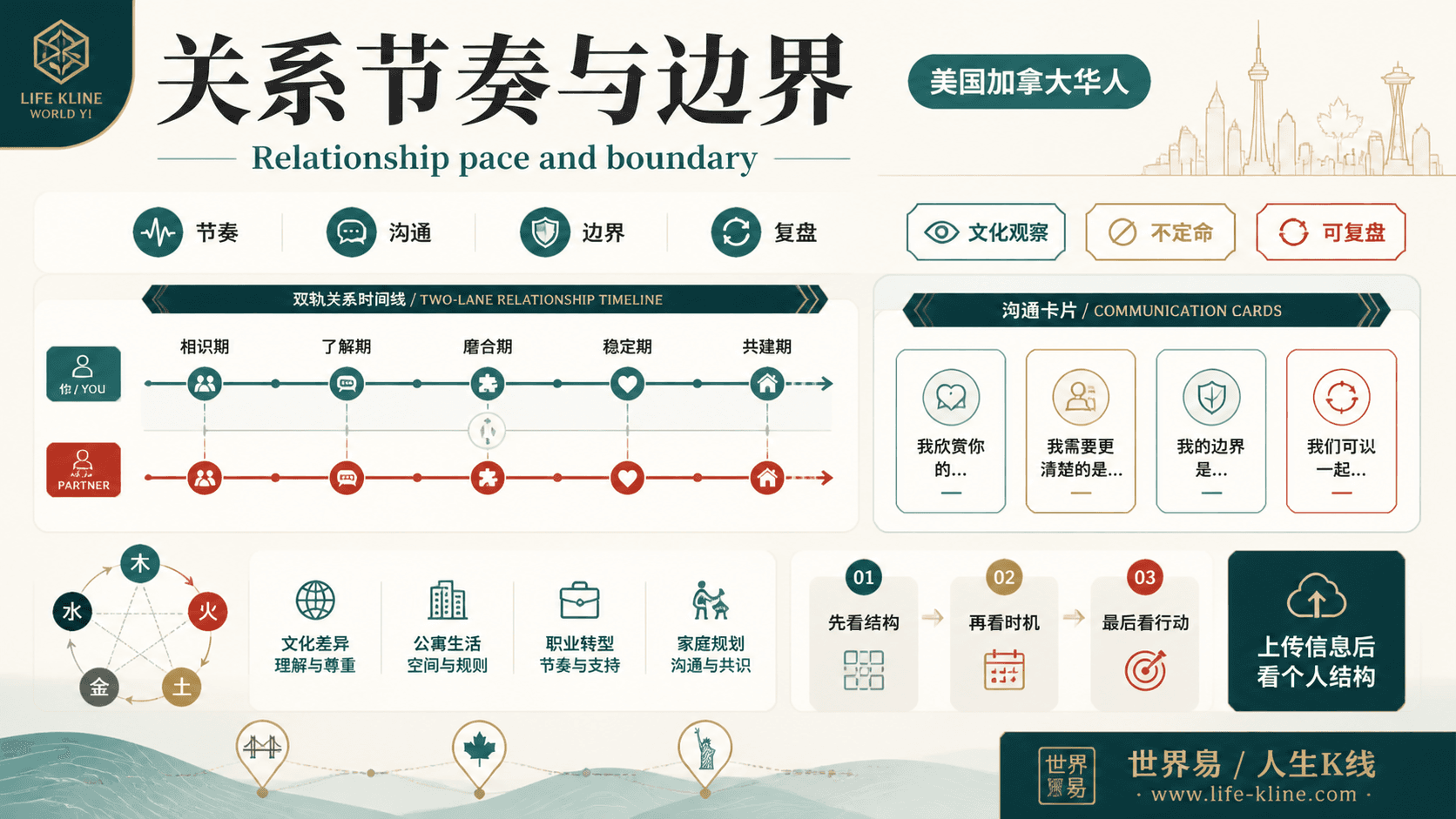
关系节奏与边界|美国加拿大华人
这张图把《Risk Analysis and Response Strategies for He-Chong Conflicts in Partnerships and Collaborations》里的命理概念转成关系、边界和应用场景,适合先看图建立结构,再回到案例正文理解细节。
关系节奏与边界不应被写成固定结论。更适合美国加拿大华人的读法,是把传统术语翻译成结构、时机、环境、行动和复盘。
查看图片解读