Analysis of Combination and Clash Relationships in Shareholder Partnership Conflicts and Exit Decision-Making
先看完案例关键信息,再进入分析页验证自己的结构与阶段。
Client Background
The client is a man in his early fifties who operates a medium-sized enterprise and is currently involved in a shareholder partnership structure. Over the years, he and his partners have worked hard together to steadily develop the business. However, recently, differences in management philosophies have gradually surfaced, intensifying conflicts among shareholders and creating a tense internal atmosphere. The cooperative relationship is under significant strain. The client is contemplating whether to consider exiting the partnership to avoid causing greater harm to himself and the company.
At this critical juncture, the client hopes to clarify the fundamental relationship between himself and his partners from the perspective of Chinese metaphysics, especially whether there exist any combination (He 合) or clash (Chong 冲) relationships between them. This is not only crucial to the smoothness of their cooperation but also directly influences future decisions on whether to persist in collaboration or decisively withdraw.
Interpretation of the Natal Chart Structure
From the client’s Four Pillars (Si Zhu 四柱), the Day Master (Ri Zhu 日主) is Gui Water (癸水, Gui Shui), presenting a偏旺 (excessively strong) condition, indicating he possesses strong self-awareness and an independent spirit. The Bi Jian (比肩, Equal Competitor) pattern highlights his tendency toward equal competition and resonance in cooperation, but his strong personality may also lead to friction.
Both the Yong Shen (用神, favorable element) and Ji Shen (忌神, unfavorable element) are Metal (金, Jin), showing that in decision-making and power struggles, he relies on rationality and rules but is also prone to self-imposed limitations or conflicts with external authority.
Currently, the client is in the Ji Wei (己未, Ji Wei) Da Yun (大运, decade luck cycle), a phase characterized by overall stability, suitable for maintaining achievements and steadily advancing the business. The Bing Wu (丙午, Bing Wu) Liu Nian (流年, annual fortune) brings some vitality and change, reminding him to flexibly adjust strategies according to the current situation. The interaction between the Da Yun and Liu Nian suggests that although challenges exist, the overall environment remains relatively stable, favoring cautious action rather than rash moves.
Focused Problem Assessment
Regarding the combination and clash relationships among partners, if the client’s偏旺 Water Day Master clashes with the partner’s Heavenly Stems and Earthly Branches (Gan Zhi 干支), it is likely to trigger conflicts and disputes. The Bi Jian pattern implies strong competition over resources and power between the client and partners. Although there is a foundation for cooperation, frequent conflicts arise due to similar ideas and interests, making this relationship inherently frictional.
With both Yong Shen and Ji Shen being Metal, it indicates that the client may need to rely on rationality and rules (Yong Shen) in cooperation but may also encounter obstacles caused by the partner’s or his own rigid attitudes (Ji Shen). This reflects the complexity of their interactions, with opportunities for cooperation accompanied by accumulating potential conflicts. The stability of the Ji Wei Da Yun and the adaptability of the Bing Wu Liu Nian suggest that the client should closely observe situational changes and reasonably adjust his stance.
Specifically, if the partner’s Gan Zhi clearly forms a combination or clash with the client’s, tensions in the cooperative relationship are inevitable and difficult to completely resolve in the short term. At this time, the client needs to evaluate the actual impact of the conflicts on business operations and whether he can mitigate disputes through strategy adjustment or communication. If the combination and clash relationship causes frequent decision-making obstacles, reduces cooperation efficiency, and consumes excessive personal energy, exiting the partnership becomes a rational option.
Conversely, if conflicts exist but the cooperative foundation remains and both the current Da Yun and Liu Nian support steady development, it is recommended that the client attempt internal negotiation, clarify division of responsibilities, or introduce third-party mediation to ease tensions and avoid the uncertainties caused by a hasty exit.
Recommended Actions and Timing
Based on the current situation, the client should first conduct comprehensive internal communication to clarify each partner’s demands and bottom lines, attempting to establish a new cooperation framework that reduces direct power struggles. During the stable Ji Wei Da Yun period, maintaining the current situation is most critical to avoid impulsive decisions that could cause missed development opportunities.
At the same time, the client should leverage the changes brought by the Bing Wu Liu Nian to flexibly adjust cooperation strategies, such as appropriately introducing external resources or adjusting equity structure to alleviate pressures caused by combination and clash relationships. This phase is suitable for tentative changes rather than drastic withdrawals or major moves.
If after a period of adjustment, conflicts remain intense and affect normal business operations, the client should choose to gradually exit at a suitable time in the later stage of the Ji Wei Da Yun (after age 56), ensuring maximum personal benefit without damaging overall corporate stability. Preparations for legal and financial matters should be made to ensure a smooth transition upon exit.
Review and Reminders
Although metaphysical analysis can reveal potential combination and clash relationships among partners, real-world decisions must also consider actual business operations and personal endurance. A common pitfall is over-reliance on metaphysics while neglecting communication and negotiation, which may exacerbate conflicts or miss opportunities for adjustment.
Moreover, fate changes occur in phases, and the current situation is not immutable. The client should maintain an open mindset, respond flexibly to changes, and avoid absolutizing the relationships between Yong Shen and Ji Shen, practicing rational judgment and steady action.
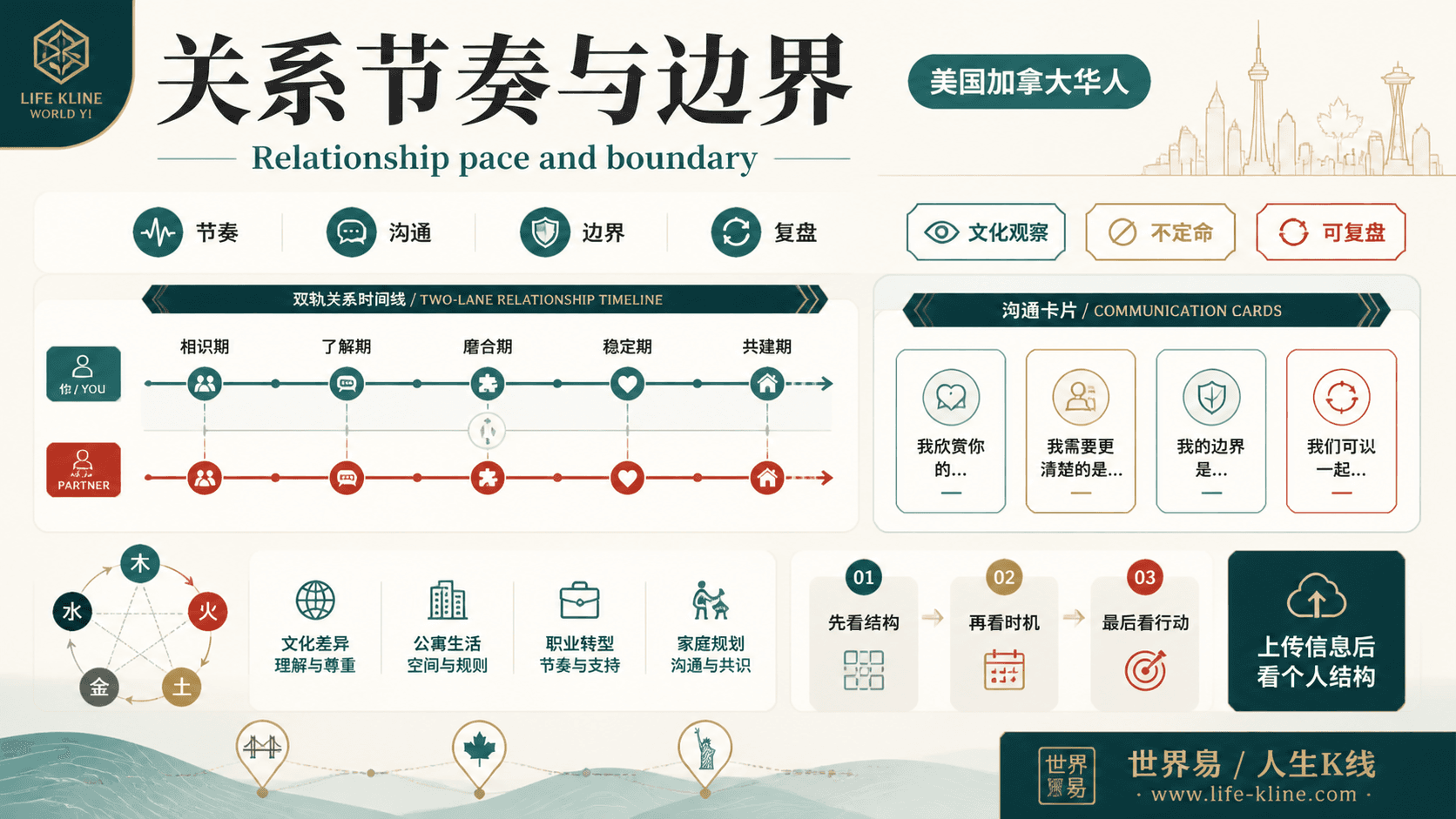
关系节奏与边界|美国加拿大华人
这张图把《Analysis of Combination and Clash Relationships in Shareholder Partnership Conflicts and Exit Decision-Making》里的命理概念转成关系、边界和应用场景,适合先看图建立结构,再回到案例正文理解细节。
关系节奏与边界不应被写成固定结论。更适合美国加拿大华人的读法,是把传统术语翻译成结构、时机、环境、行动和复盘。
查看图片解读