Judging the Timing for Partnership Exit and Action Recommendations
先看完案例关键信息,再进入分析页验证自己的结构与阶段。
Client Background
The client is a man approaching 45 years old who decided to partner with a childhood friend to open a physical store, hoping to leverage their long-standing emotional foundation and resource advantages to achieve a breakthrough in his career. However, as the cooperation progressed, differences arose regarding business philosophy and profit distribution. The client began to consider whether to sign a formal agreement to protect his own rights and at what timing to adjust or exit the partnership.
The client is currently at an important stage of career development, wishing for stable cooperation but also concerned about unnecessary risks caused by strained relationships or market fluctuations. How to clarify cooperation boundaries while maintaining friendship and avoid potential future disputes has become the client's core concern.
BaZi Chart Structure Interpretation
The client's Day Master is Jia Wood (甲 Jia), which is relatively strong, indicating he possesses strong leadership and decision-making abilities. His chart leans toward a Pian Cai (偏财) pattern, representing a tendency to rely on partnerships and external resources for wealth acquisition. Partnership entrepreneurship aligns with his metaphysical trend but also implies the need to be cautious about financial management and profit distribution complexities.
The Yong Shen (favorable element) is Fire, meaning the client needs to utilize the energy of Fire to balance the operation of his Pian Cai pattern. Fire symbolizes action, enthusiasm, and transformation, suitable for proactively adjusting partnership relations at appropriate times to avoid emotional fluctuations and unfavorable situations caused by the Ji Shen (unfavorable element) Water. The current Da Yun is Jia Xu (甲戌), representing a stable and conservative phase, recommending steady operation and avoiding reckless advancement.
The Liu Nian is Bing Wu (丙午), with strong Fire energy, offering the client opportunities for flexible adaptation. This period favors proactive adjustments in cooperation methods but requires controlling the pace to prevent impulsive actions that might break the relationship. Overall, the chart advises the client to remain vigilant during stable development and make timely adjustments based on external environment and internal cooperation status.
Focused Issue Judgments
Regarding whether to sign a formal partnership agreement, the metaphysics indicates the client is currently in the conservative Jia Xu Da Yun, favoring stability. Signing an agreement helps clarify responsibilities and rights, reducing potential future disputes, and is an important means to ensure cooperation stability. Considering the sensitivity of financial and profit relationships in the Pian Cai pattern, signing an agreement is a rational choice.
As for the timing of exit, the Liu Nian Bing Wu with strong Fire energy is a favorable time for proactive adjustment. The client should pay attention to key signals in the cooperation, such as changes in the partner’s attitude, increased business risks, or uneven profit distribution, which serve as criteria for judging the exit timing. The flexibility of Fire suggests that when obvious disadvantages appear, the client should decisively take action to avoid prolonged entanglement causing greater losses.
Combining the Da Yun and Liu Nian, the best timing for exit mainly concentrates in the Fire-strong years, specifically during the Bing Wu Liu Nian or adjacent Fire-strong years. During these times, the client will have abundant energy and the ability to handle complex situations with rationality and decisiveness. Exiting is not about rushing to quit but about proactive adjustment based on risk assessment to safeguard long-term interests.
Recommended Actions and Timing Nodes
First, the client should promptly promote the signing of a partnership agreement to clarify both parties’ rights and obligations, especially regarding financial management, profit distribution, and exit mechanisms. This is not only risk prevention but also the foundation of stable cooperation. The agreement should include flexible adjustment clauses to accommodate reasonable changes as cooperation evolves.
Second, the client should closely monitor key points during the cooperation process, especially in the Bing Wu Liu Nian and upcoming Fire-strong years, carefully observing changes in the partnership status. If obvious trust crises, performance declines, or intensified disagreements occur, the client should leverage his strong Fire decisiveness to promptly initiate exit procedures, avoiding losses caused by delays.
Finally, during the Jia Xu Da Yun, the client should focus on maintaining and steady operation, avoiding overly aggressive actions that might cause cooperation breakdown. By utilizing the energy of Fire, he can adjust partnership strategies timely and maintain flexibility. In future Fire-strong Da Yun such as Ding Wei (丁未) or Wu Shen (戊申), the client should further use his vigorous action power to actively optimize the partnership structure or exit at the right time, ensuring the dual stability of career and personal interests.
Review and Reminders
Emotional factors in partnerships should not be overlooked, but over-reliance on emotional foundations without legal agreement safeguards easily leads to entanglement in profit disputes. The client needs to be wary of blind tolerance and unreasonable compromises caused by emotional fluctuations, especially since the Ji Shen Water element represents emotional instability that can affect judgment. Maintaining rationality and calmness is essential.
Although exiting a partnership is sometimes necessary to protect one’s interests, premature or frequent exits may damage long-term cooperation relationships and personal reputation. It is recommended that the client conduct thorough risk assessments and financial planning before taking action, flexibly adjusting according to timing, ensuring exit decisions are both decisive and prudent.
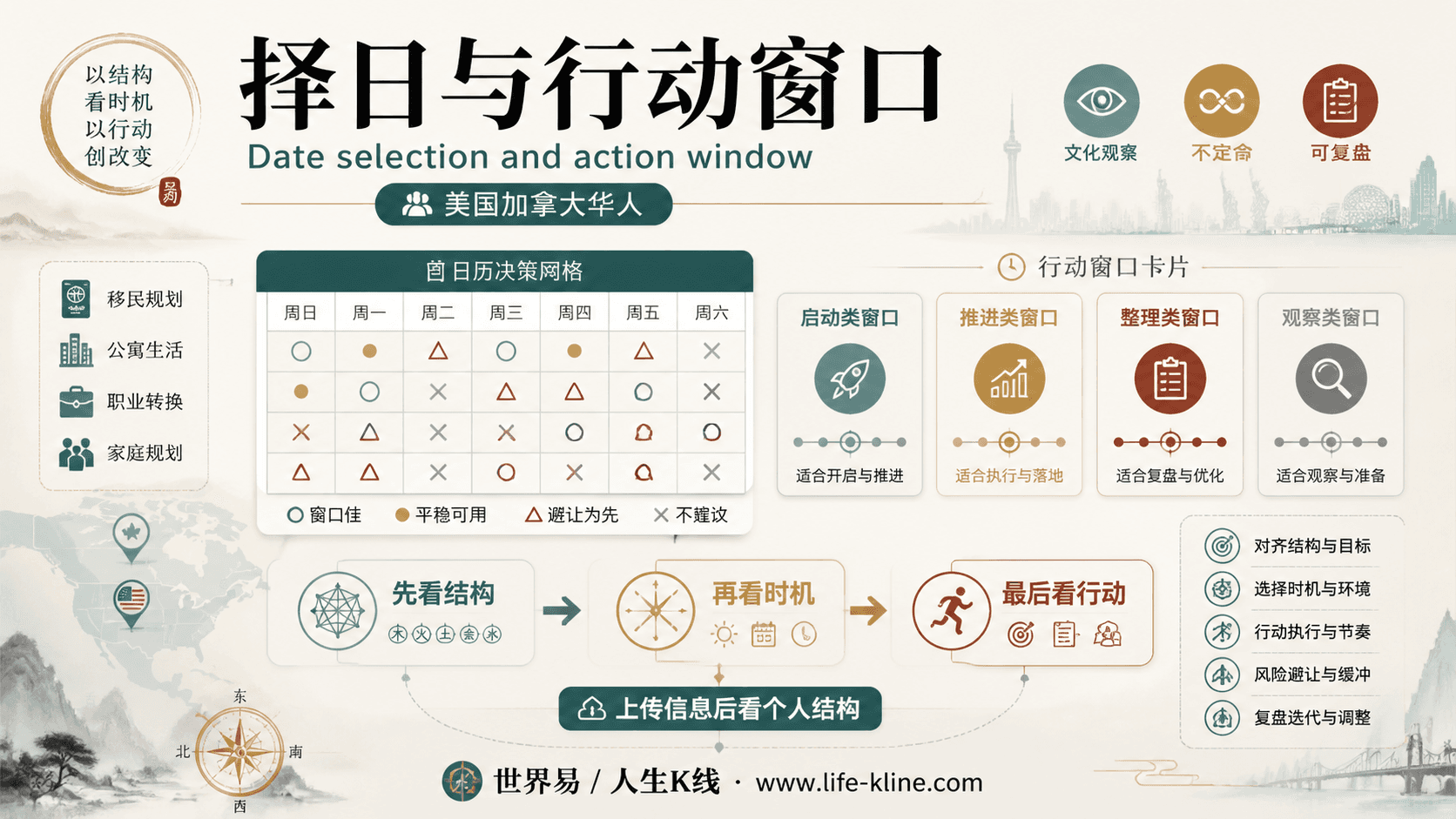
择日与行动窗口|美国加拿大华人
这张图把《Judging the Timing for Partnership Exit and Action Recommendations》里的命理概念转成关系、边界和应用场景,适合先看图建立结构,再回到案例正文理解细节。
择日与行动窗口不应被写成固定结论。更适合美国加拿大华人的读法,是把传统术语翻译成结构、时机、环境、行动和复盘。
查看图片解读