Risk Analysis and Prevention Strategies of He-Chong Conflicts in Partnerships and Cooperations
先看完案例关键信息,再进入分析页验证自己的结构与阶段。
Client Background
The client is a business owner in his fifties, running a medium-sized manufacturing company, currently in a stable phase of his career. With business expansion, he faces a critical decision to sign exclusive cooperation agreements with upstream and downstream enterprises. The industry is highly competitive, requiring cautious handling of partnerships to ensure long-term development and maximize benefits.
Recently, the client has been concerned about potential He-Chong risks with the partner. Especially after binding exclusive agreements, if the parties' BaZi charts are incompatible, the partnership may lead to intensified conflicts, causing operational instability. Therefore, he hopes to analyze the He-Chong relationship between both parties from a metaphysical perspective to assist decision-making and reduce cooperation risks.
BaZi Chart Structure Interpretation
The client’s BaZi chart shows a Wu Earth (戊, Wu) Day Master in a balanced state, neither overly strong nor weak, capable of bearing external changes well. The chart belongs to the Qi Sha (Seven Killings) pattern, indicating strong initiative and decisiveness in personality, but also accompanied by external pressures and challenges. Fire is the Yong Shen (favorable element), indicating that Fire energy stimulates and supports him, while Wood is the Ji Shen (unfavorable element), meaning Wood elements may bring adverse effects and obstacles.
Currently, the client is in the Geng Xu (庚戌) Da Yun, with an overall stable fortune suitable for maintaining achievements and steady development, not for aggressive moves. The Liu Nian is Bing Wu (丙午), with strong Fire energy, representing many changes and opportunities this year that require flexible responses. The interaction between the Da Yun and Liu Nian shows that although the overall situation is stable, vigilance in cooperation is necessary to avoid impulsiveness or external interference.
In summary, the client’s BaZi structure supports maintaining initiative in cooperation, but the influence of the Ji Shen Wood warns that if the potential partner has Wood characteristics or behaviors, conflicts or disharmony may arise, and the cooperation risk should not be underestimated.
Focused Issue Assessment
Regarding the client’s concern about the He-Chong relationship in the partnership, special attention should be paid to whether the partner has Wood attributes or behavioral patterns. Since Wood is the client’s Ji Shen, if the partner’s BaZi or business style leans toward Wood, conflicts are likely, intensifying frictions and contradictions during cooperation, especially under the constraints of exclusive agreements, increasing risks.
Additionally, the client’s Qi Sha pattern inherently represents competition and challenges. If the partner is overly strong-willed or independent, power and interest conflicts may easily arise. The strong Fire energy in this Liu Nian suggests that the client should use Fire energy to harmonize and promote cooperation this year. If the partner shows a positive, cooperative, and supportive attitude, conflicts can be alleviated.
However, as the current fortune favors maintaining achievements, excessive aggressiveness or blindly signing exclusive agreements carries hidden dangers. The client should carefully evaluate the partner’s actual capabilities and attitudes, avoiding being deceived by superficial cooperation intentions. Especially if Wood traits are detected in the partner, greater caution is advised to prevent the partnership from becoming a source of depletion and conflict.
Recommended Actions and Timing
Based on BaZi analysis, the client should strengthen his Yong Shen Fire energy during the current Bing Wu Liu Nian by enhancing communication and coordination to improve cooperation transparency and trust, avoiding misunderstandings caused by information asymmetry. It is recommended to clarify mutual rights and responsibilities in the agreement and set reasonable exit mechanisms to prevent cooperation failure due to He-Chong conflicts.
Practically, inviting a third-party professional institution to conduct a cooperation risk assessment is advisable, especially to investigate the partner’s business style and background thoroughly, eliminating or adjusting cooperation details that may trigger He-Chong conflicts. The stable Geng Xu Da Yun is suitable for steady progress, and it is not advisable to rush into long-term exclusive agreements. Phase-based agreements or pilot cooperation models are recommended to gradually deepen the partnership.
Regarding timing, the next two years are critical for adjustment and observation. The client should focus on detecting friction and conflict signals in cooperation and make timely adjustments. When the fortune enters the next Da Yun more favorable to the Yong Shen, then consider expanding the scale and depth of cooperation, keeping risks within a controllable range.
Review and Reminders
This case reminds business owners that He-Chong in BaZi is an important but not the sole risk factor in partnerships. It is essential to combine actual business conditions and contract terms to form a multidimensional risk prevention system. The Ji Shen Wood risk should not be simply attributed to a single trait of the partner but should focus on the interaction patterns and benefit distribution throughout the cooperation process.
Moreover, although the current Da Yun and Liu Nian support steady development, overreliance on metaphysical judgment while neglecting market and legal risks may also lead to cooperation failure. It is recommended to integrate professional legal and business consulting based on BaZi analysis to form a scientifically sound cooperation plan, ensuring a stable and long-lasting partnership.
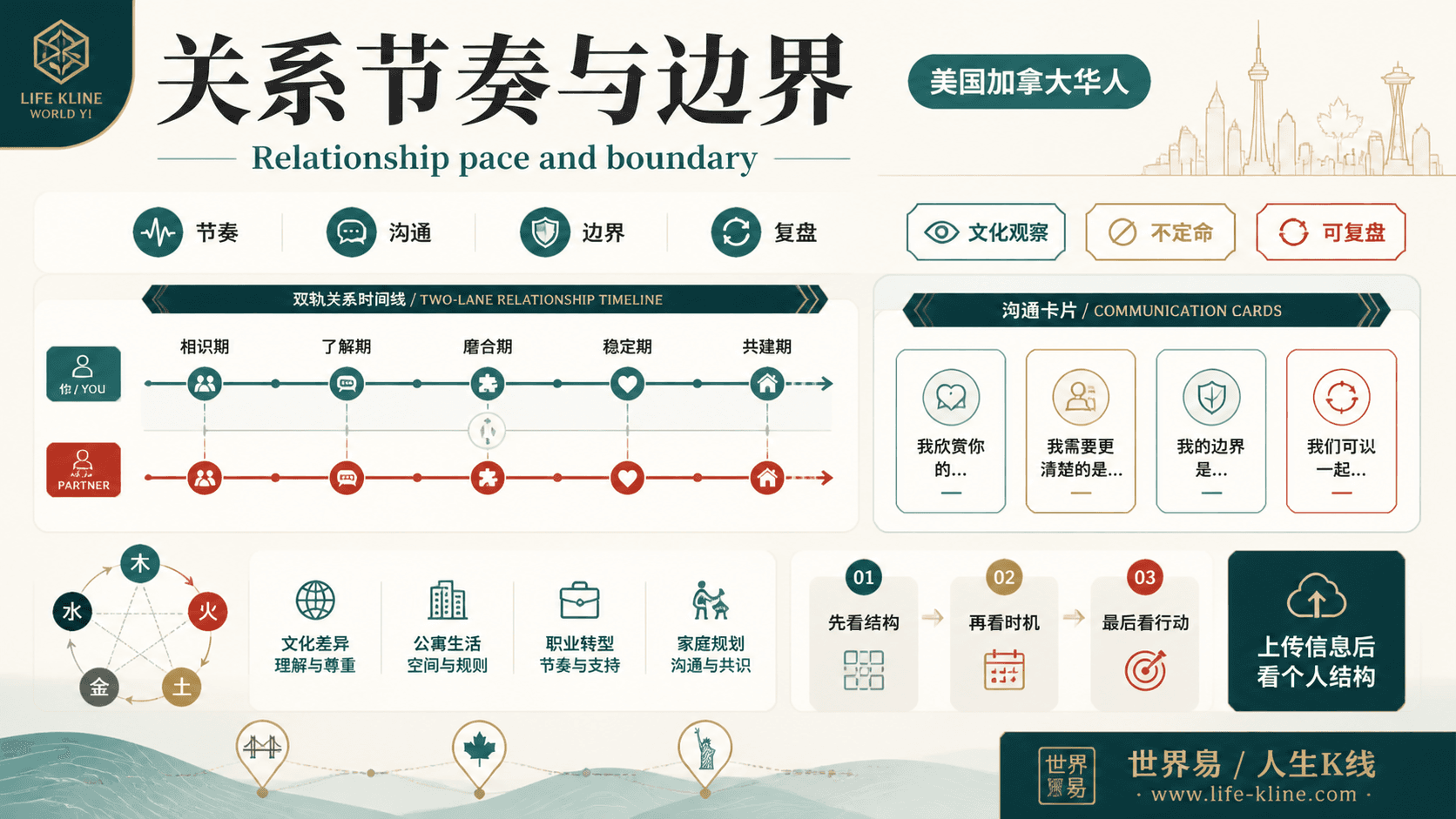
关系节奏与边界|美国加拿大华人
这张图把《Risk Analysis and Prevention Strategies of He-Chong Conflicts in Partnerships and Cooperations》里的命理概念转成关系、边界和应用场景,适合先看图建立结构,再回到案例正文理解细节。
关系节奏与边界不应被写成固定结论。更适合美国加拿大华人的读法,是把传统术语翻译成结构、时机、环境、行动和复盘。
查看图片解读