Analysis of He-Chong (Combination-Clash) Relationships in Shareholder Conflicts and Exit Decision-Making
先看完案例关键信息,再进入分析页验证自己的结构与阶段。
Client Background
The client is a female entrepreneur aged between 35 and 40, currently at a critical stage of career development. She is experiencing severe internal conflicts with partner shareholders, resulting in a tense cooperative atmosphere and obstructed business progress. She hopes to analyze the relationship between both parties from a BaZi perspective to determine whether to choose to exit the partnership, thereby avoiding greater losses in career and finances.
As a shareholder partner, the client holds significant influence and responsibility within the company. The internal strife not only affects company operations but also impacts her personal emotions and family life. She wishes to clarify the He-Chong relationship between both parties, understand the risks and feasible future paths of cooperation, and find the best course of action.
BaZi Chart Structure Interpretation
The client's BaZi chart centers on a Geng Metal (庚, Geng) Day Master, which is relatively strong, belonging to a specialized strong pattern. This reflects her strong and decisive personality, with robust leadership and execution abilities. Her Yong Shen (favorable element) is Earth, which generates Metal and plays a harmonizing and supportive role, helping her maintain balance and enhance stability amid complex interpersonal and career relationships.
The Ji Shen (unfavorable element) is Wood, which overcomes Earth, indicating that if the opposing party's element carries Wood characteristics, it will exert pressure and obstacles on the client. The current Da Yun (decade luck cycle) is Wu Wu (戊午), an auspicious luck phase, with progress in career and wealth. The Liu Nian (annual fortune) Bing Wu (丙午) aligns with this trend, overall supporting the client to actively face challenges and discouraging premature withdrawal.
The harmonizing role of Earth in BaZi suggests the client should seek 'Earth' factors in cooperation—elements of balance and stability—to resolve conflicts between both parties. The strong Geng Metal Day Master also indicates the client has the ability to protect herself and assert her rights in conflicts but must be cautious of the Ji Shen Wood's influence to avoid escalating disputes.
Focused Issue Judgment
Regarding the He-Chong relationship between the client and her partners, BaZi indicates a certain mutual overcoming relationship, especially as the opposing party may possess Wood attributes. This directly affects the client's Yong Shen Earth, causing ongoing conflicts and friction in cooperation. The Wood overcoming Earth pattern emphasizes conflicts over interests and power; without effective harmonization, cooperation is difficult to sustain.
Considering the client's specialized strong Geng Metal Day Master, she possesses strong internal energy and stress resilience. However, the Ji Shen Wood influence advises caution in handling conflicts to avoid impulsiveness and excessive confrontation. The He-Chong relationship in cooperation not only manifests as conflict but may also bring opportunities, provided the key to harmonization is found.
Currently, the Da Yun is Wu Wu (戊午), an auspicious cycle favorable for career and wealth development. This suggests the client still has opportunities during conflicts to adjust cooperation models or incorporate stabilizing factors (the power of Earth) to ease relations. The Liu Nian Bing Wu (丙午) follows the Da Yun trend, supporting the client to act in accordance with circumstances, making it suitable to actively seek balance in cooperation rather than hastily exit.
Therefore, BaZi analysis confirms the existence of the He-Chong relationship between the client and the other party, but it is not irreconcilable. The key lies in utilizing the harmonizing effect of Yong Shen Earth, finding stable factors in cooperation, and paying attention to timing, avoiding major decisions during the peak of conflict.
Recommended Actions and Timing
Based on BaZi analysis, the client should prioritize efforts to increase the 'Earth' element within the cooperation to ease tensions, such as introducing a neutral third-party shareholder as a stabilizing force or adjusting internal responsibility divisions to strengthen the stability of the cooperative structure, thereby reducing the negative impact of Wood overcoming Earth.
In the first year of the current Wu Wu (戊午) Da Yun, combined with the Liu Nian Bing Wu (丙午) that aligns with the trend, the client can seize this period to actively communicate and reshape the partnership. It is recommended to focus on resolving internal conflicts within the next one to two years, especially while the Liu Nian remains favorable, avoiding impulsive decisions to exit.
If despite these efforts the cooperative atmosphere fails to improve and conflicts escalate, the client may consider, after the mid-term of the Da Yun, when the Wu Wu phase gradually transitions to the next stage, to carefully evaluate the timing of exit. At that time, the client will have accumulated more strength and resources, making exit less risky and conducive to subsequent career transformation or independent development.
Review and Reminders
This case serves as a reminder that He-Chong relationships in cooperation should not be ignored but also not blindly avoided. The role of BaZi is to help the client identify favorable and unfavorable factors in relationships and guide reasonable choices at appropriate times. A common mistake is to hastily exit due to intense conflict, overlooking possibilities for harmonization and improvement.
Moreover, BaZi analysis focuses on trends and potential; practical execution must also consider the real business environment and legal protections. The client should maintain rationality, avoiding emotional loss of control caused by the Ji Shen Wood influence, to ensure decision quality and maximize personal interests and enterprise stability.
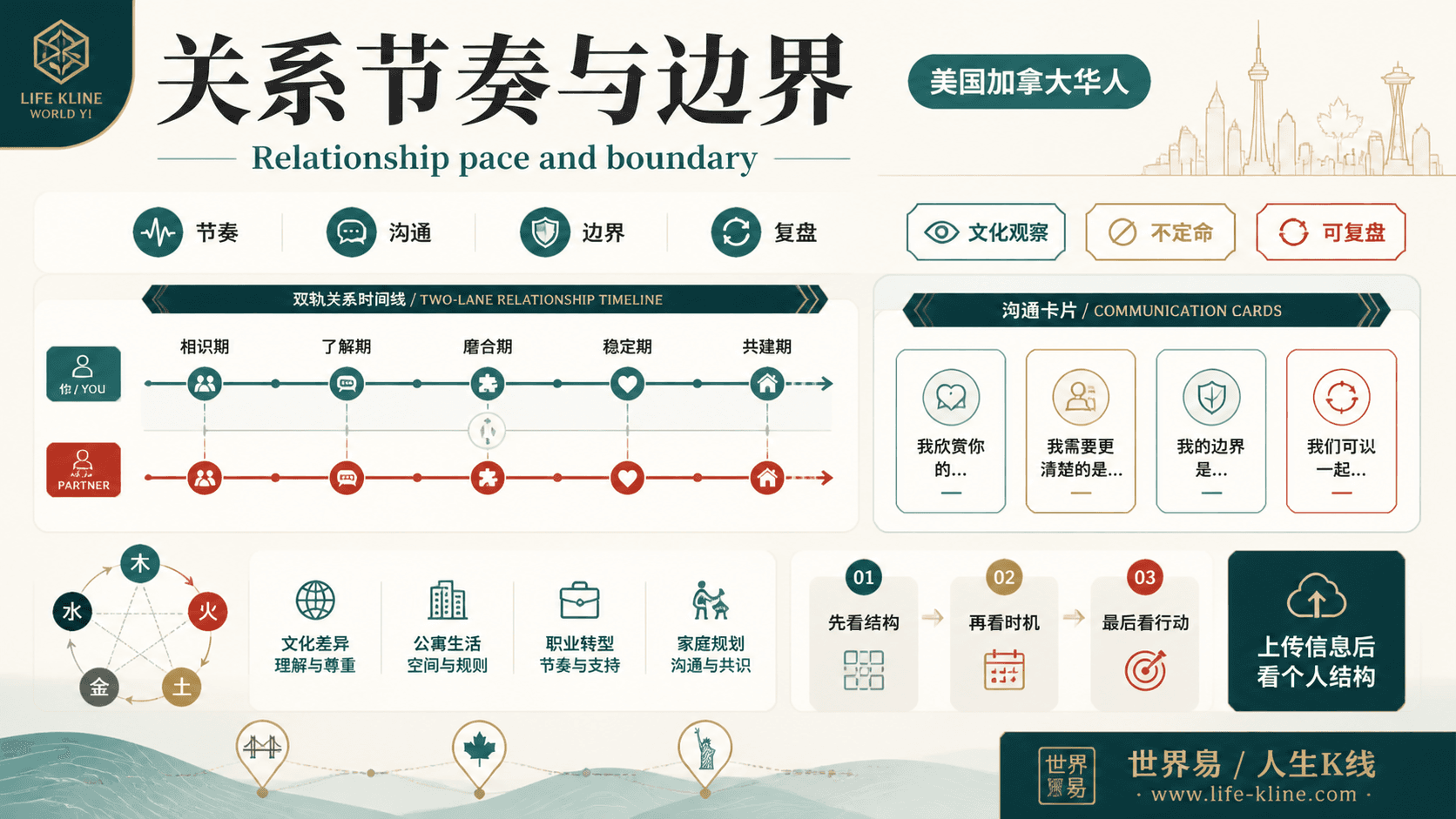
关系节奏与边界|美国加拿大华人
这张图把《Analysis of He-Chong (Combination-Clash) Relationships in Shareholder Conflicts and Exit Decision-Making》里的命理概念转成关系、边界和应用场景,适合先看图建立结构,再回到案例正文理解细节。
关系节奏与边界不应被写成固定结论。更适合美国加拿大华人的读法,是把传统术语翻译成结构、时机、环境、行动和复盘。
查看图片解读