Analysis of Cultural Integration and Timing for Divestment in a 55-Year-Old Female Entrepreneur’s Team Acquisition
先看完案例关键信息,再进入分析页验证自己的结构与阶段。
Client Background
The client is a 55-year-old female entrepreneur currently at a critical transformation stage in her career. She recently acquired a small team, aiming to promote sustainable development of her business through resource and team integration. However, post-acquisition, cultural differences and value conflicts within the team have led to a tense cooperative atmosphere, affecting overall operational efficiency. This situation has left her confused and worried about potential long-term development obstacles.
On the family front, the client bears significant responsibilities, needing to maintain the stability of the family business while also attending to her children’s growth. She hopes to find an appropriate timing for adjustments, unwilling to blindly abandon invested resources nor delay actions that might cause greater losses. She seeks to find a balance point for cultural integration and divestment through analysis from a BaZi perspective.
BaZi Chart Structure Interpretation
The client’s Day Master is Geng Metal (庚金, Geng Jin), but it is relatively weak overall, indicating certain limitations in her own resources and energy, requiring external environmental support for better growth. Her pattern is Pian Cai (偏财), meaning she excels in expanding her business through external investments and partnerships but must also be cautious in financial management and risk control.
Regarding the Five Elements Yong Shen and Ji Shen, Earth (土) is the Yong Shen, symbolizing stability and support, suitable for maintaining achievements and steady development; Water and Wood are Ji Shen, representing potential disturbances and obstacles. She is currently in the Ji Hai (己亥) Da Yun, which presents a relatively stable atmosphere, favoring preservation rather than aggressive advancement. The corresponding Liu Nian is Bing Wu (丙午), where strong Fire generates Earth, beneficial for actively responding to changes but also indicating the need for flexible strategy adjustments.
In summary, the client benefits from the Pian Cai pattern’s advantage of utilizing external resources to develop her business but must not neglect the importance of internal stability. The combination of the current Da Yun and Liu Nian suggests that balancing steadiness and flexibility is key at this stage.
Focused Problem Analysis
Regarding the client’s current challenge of cultural integration within the small team, the relatively weak Geng Metal Day Master requires nourishment from Earth to stabilize itself. However, the team’s cultural differences resemble the Wood and Water elements, which are Ji Shen, introducing disharmony within the enterprise’s internal environment. At this point, the client should focus on whether adjustments in team structure and management can introduce more Earth elements to strengthen stability.
The Ji Hai Da Yun is generally stable, favoring preservation over risk-taking. Combined with the Bing Wu Liu Nian’s strong Fire generating Earth characteristic, the current Liu Nian supports the client’s active efforts in cultural integration but also warns that under strong Fire, the Ji Shen Water and Wood may retaliate, intensifying conflicts and increasing cooperation risks.
The optimal timing for divestment should be when internal team conflicts escalate and the Yong Shen Earth cannot effectively harmonize the Ji Shen influences. Especially toward the end of the Bing Wu Liu Nian, when Fire and Earth energies weaken and Ji Shen Water and Wood may seize the opportunity to disrupt the situation, the client needs to proactively plan, conduct risk assessments, and decisively divest to preserve overall stability and avoid greater losses.
Recommended Actions and Timing
Firstly, the client should continue leveraging the stable advantage of the current Ji Hai Da Yun by reinforcing the Earth attribute within the team through institutional building, cultural training, and value unification to consolidate the team foundation. Patience is required to observe the progress of cultural integration and avoid hasty decisions during this phase.
Secondly, take advantage of the favorable characteristics of the Bing Wu Liu Nian to actively promote internal communication and problem-solving, flexibly responding to sudden conflicts. It is recommended to closely monitor team members’ attitudes and cooperation effectiveness from mid to late Liu Nian, evaluating whether irreconcilable differences exist.
Finally, if effective integration cannot be achieved by the end of the Bing Wu Liu Nian and the Ji Shen Water and Wood influences intensify, the client should decisively initiate the divestment plan to prevent further losses caused by delay. The suggested timing for divestment is before the end of the Bing Wu Liu Nian and the arrival of the next Liu Nian, to prevent unfavorable factors from spreading.
Review and Reminders
A common pitfall is divesting too early or blindly maintaining the status quo. The client should be wary of rushing to results and neglecting the essence of team integration, as well as over-tolerance leading to accumulation of internal problems. Although the Yong Shen Earth’s power can stabilize the situation, the impact of Ji Shen Water and Wood should not be underestimated, requiring flexible strategy adjustments.
Furthermore, BaZi provides only trend and directional references. Practical operations must also consider the enterprise’s specific circumstances and market environment. Divestment decisions should be based on comprehensive data and interpersonal communication, avoiding emotional decision-making.
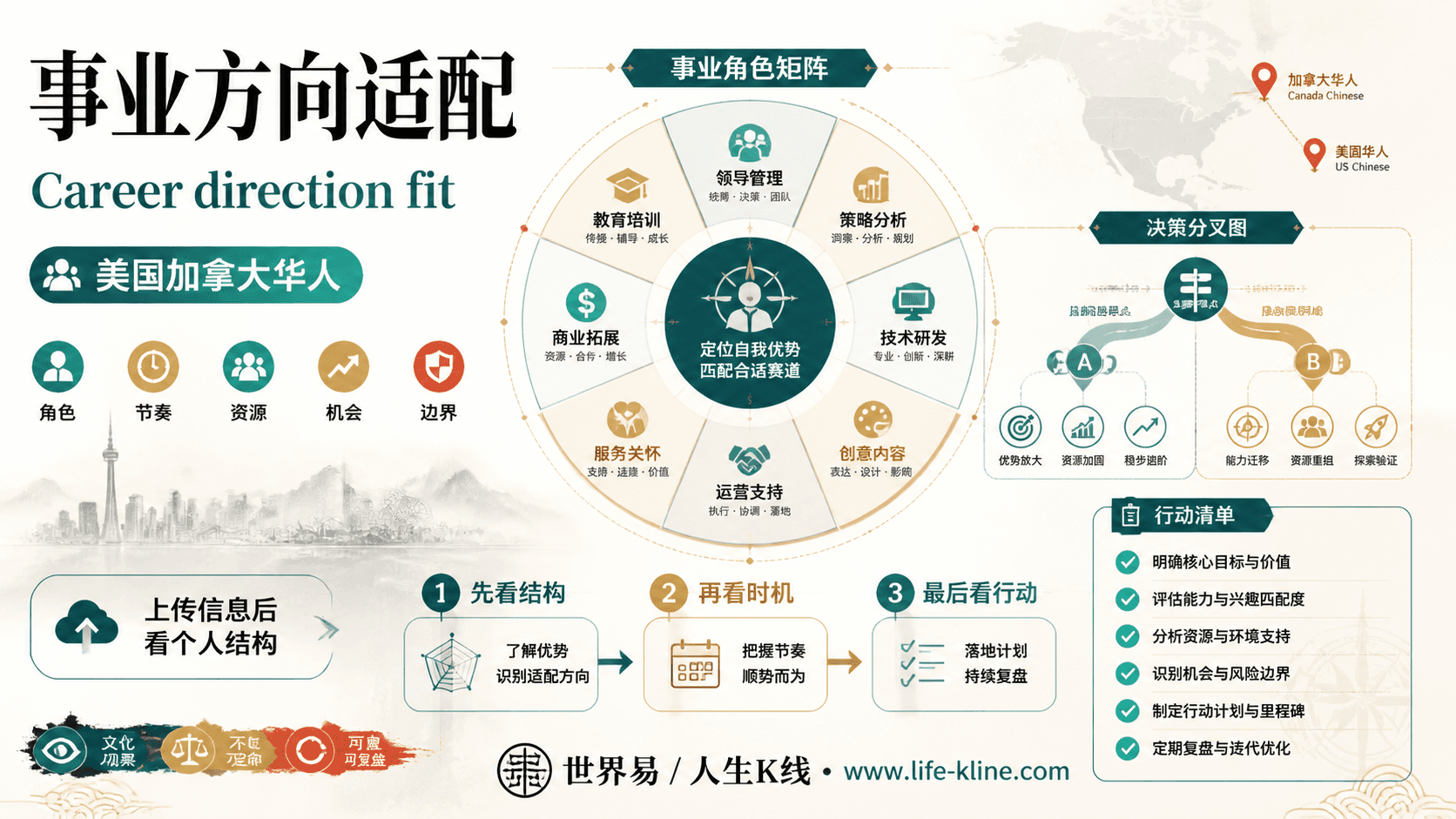
事业方向适配|美国加拿大华人
这张图把《Analysis of Cultural Integration and Timing for Divestment in a 55-Year-Old Female Entrepreneur’s Team Acquisition》里的命理概念转成关系、边界和应用场景,适合先看图建立结构,再回到案例正文理解细节。
事业方向适配不应被写成固定结论。更适合美国加拿大华人的读法,是把传统术语翻译成结构、时机、环境、行动和复盘。
查看图片解读