Analysis of the He-Chong Relationship Behind Shareholder Internal Conflicts and Exit Decisions
先看完案例关键信息,再进入分析页验证自己的结构与阶段。
Client Background
The client is a woman aged between 35 and 40, managing a partnership enterprise. Recently, intensified conflicts among partners have strained the cooperative relationship. She plays a core role in the business, bearing important decision-making responsibilities. As tensions escalate, the client has begun considering whether to exit the partnership to avoid greater losses.
Facing internal conflicts among partners, the client feels deeply conflicted. She wants to maintain the current cooperative achievements but also worries about future development obstacles. How to judge the He-Chong relationship between both parties and assess the sustainability of the cooperation has become an urgent issue for her.
Interpretation of the Natal Chart Structure
The client’s Day Pillar is Ji You (己酉), with Ji Earth (己土) as the Day Master (Ri Zhu) which is relatively strong, in a Yang Ren (羊刃) pattern. This indicates she has a resolute and decisive personality, possessing strong autonomous judgment when facing problems. The relatively strong Day Master means she has sufficient personal strength to manage situations well but also carries the risk of being overly rigid, potentially triggering conflicts.
The Yong Shen (favorable elements) are Wood and Water, indicating that in her career and interpersonal relationships, she needs to rely on the gentle and flowing qualities of Wood and Water to balance the rigidity of Earth. The Ji Shen (unfavorable element) is Fire, meaning the presence of Fire may exacerbate conflicts and bring adverse effects. Currently, she is in the Yi Wei (乙未) Da Yun, which is a favorable luck phase, showing improvements in career and financial fortune.
The Liu Nian (annual fortune) is Bing Wu (丙午), which aligns harmoniously with the Da Yun, suggesting that this year’s energy is relatively strong and suitable for proactive actions, though attention should be paid to potential conflicts brought by the Fire element. Overall, the natal chart shows the client possesses strong internal resources and should wisely utilize the Wood and Water energies of the Yong Shen to regulate tensions in cooperation.
Focused Problem Judgment
Based on the client’s Ji Earth Day Master and the Heavenly Stems and Earthly Branches of the partners, there is a clear He-Chong (combining and clashing) interaction between them. Ji Earth is relatively strong, and if the partners belong to Fire or have prominent Fire characteristics, it easily triggers the negative effects of the Ji Shen Fire, intensifying the tense atmosphere of internal conflict. The aggressive nature of Fire combined with the rigidity of Earth may escalate conflicts, making cooperation difficult to sustain.
However, the combination of the Yi Wei Da Yun and Bing Wu Liu Nian provides the client with good external support and energy flow, implying that during this period, adjusting the cooperative relationship through wisdom and strategy may still alleviate conflicts. The role of Wood and Water as Yong Shen is especially crucial, as they can help the client introduce softness and change, soothe the partners’ fiery temper, and promote communication and compromise.
If the partners’ elemental composition has weak Wood and Water and strong Fire, the He-Chong relationship will be difficult to harmonize, and the cooperation risk is high. In this case, exiting the cooperation or seeking restructuring would be a safer choice. Conversely, if the partners can accept the client’s Wood and Water harmonizing strategy and improve relations through communication, cooperation still has prospects.
Recommended Actions and Timing
First, the client should leverage her relatively strong Ji Earth stability and the decisiveness of the Yang Ren pattern to proactively engage in communication and coordination measures, using the Wood and Water energies of the Yong Shen to find balance within the cooperation. Specifically, this can be done by adjusting the team structure, introducing mediators, and reducing direct clashes caused by Fire conflicts.
Second, given the current auspicious Yi Wei Da Yun and the favorable Bing Wu Liu Nian, the client should seize this period to actively promote cooperative adjustments and avoid premature withdrawal that wastes resources. If conflicts cannot be effectively eased within the next 1 to 2 years, then the timing of exit should be assessed, prioritizing completion before the end of the Yi Wei Da Yun to avoid unfavorable influences from the next Da Yun.
Finally, the client should pay attention to the specific manifestations of the Yong Shen Wood and Water, such as introducing more flexible management and innovative strategies to reduce the aggressive manifestations of the Ji Shen Fire. It is recommended to participate in activities that enhance Water and Wood energy during the Da Yun, such as expanding networks and learning new knowledge, to strengthen adaptability to the cooperative environment.
Review and Reminders
In handling shareholder internal conflicts, the client must be cautious of becoming overly rigid and impatient due to the Yang Ren pattern, avoiding intensifying cooperative conflicts. Overlooking the harmonizing role of the Yong Shen easily leads to unnecessary disputes, which undermine the overall cooperative foundation.
Moreover, although exiting the cooperation is a feasible option, it should be based on a scientific judgment of the He-Chong relationship and the current Da Yun and Liu Nian trends, avoiding blind decisions. Reasonable timing assessments and proper transfer of resources and networks are essential to maximize the protection of the client’s long-term interests.
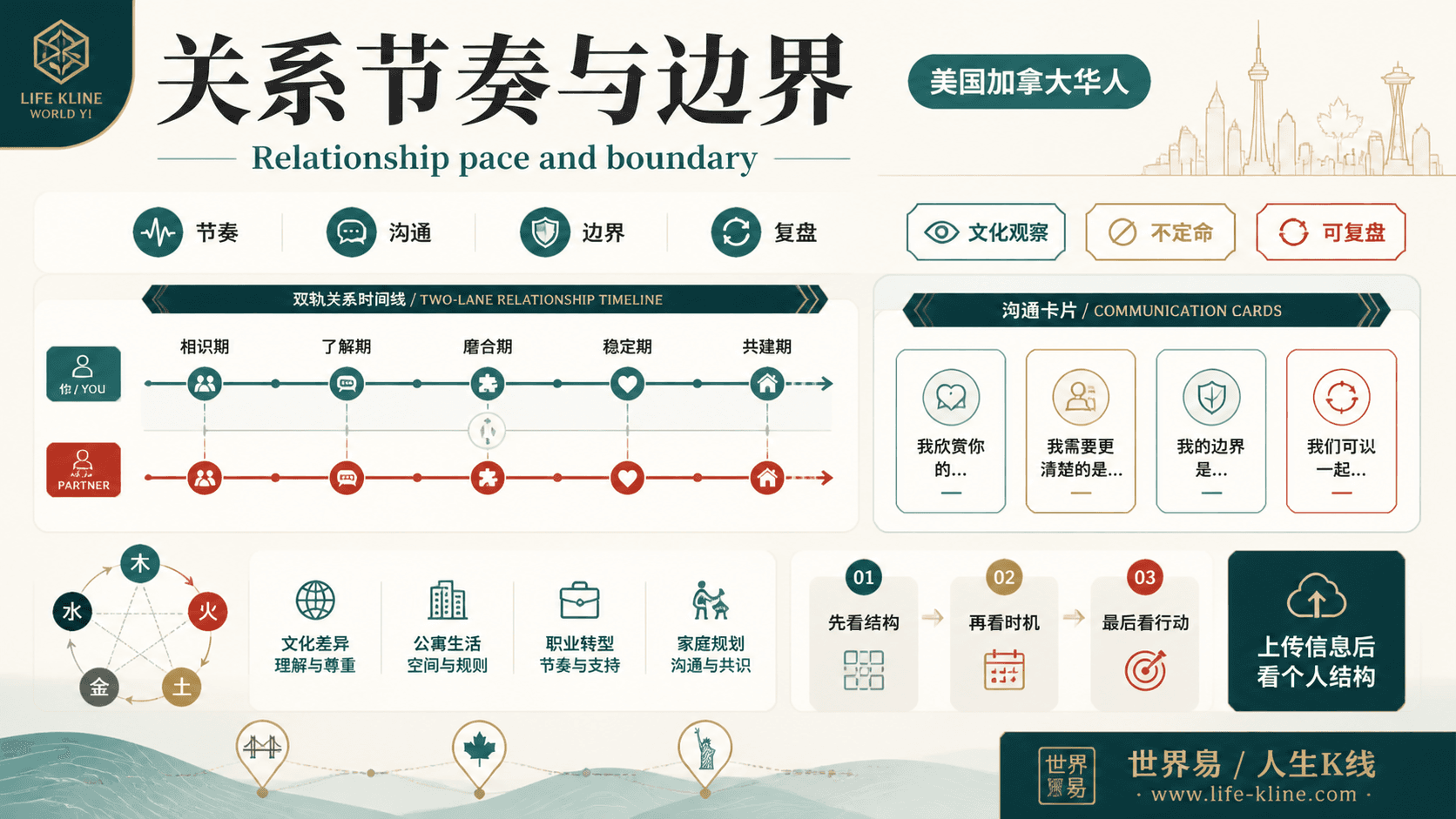
关系节奏与边界|美国加拿大华人
这张图把《Analysis of the He-Chong Relationship Behind Shareholder Internal Conflicts and Exit Decisions》里的命理概念转成关系、边界和应用场景,适合先看图建立结构,再回到案例正文理解细节。
关系节奏与边界不应被写成固定结论。更适合美国加拿大华人的读法,是把传统术语翻译成结构、时机、环境、行动和复盘。
查看图片解读