Analysis of He-Chong (Combination-Clash) Relationships in Partnerships — A Practical Case of a Former Colleague's Invitation to a New Company
先看完案例关键信息,再进入分析页验证自己的结构与阶段。
Client Background
The client is a woman nearing fifty-five years old, with extensive experience in corporate management and a rich network of industry contacts. Recently, she received an invitation from a former colleague to join a company as a business partner. Currently at a critical career transition stage, she looks forward to new breakthroughs but is also concerned about the stability of the partnership, particularly whether the He-Chong (combination-clash) relationship between her and the other party might affect future cooperation.
On the family front, the client enjoys a stable situation with a regular lifestyle and is especially cautious about her future career planning. She hopes to use precise BaZi analysis to clarify potential conflicts in the partnership and identify the best entry timing to ensure smooth career progress.
BaZi Chart Structure Interpretation
The client's BaZi chart has Ji Earth (己, Ji) as the Day Master, which is relatively strong, and features a Yang Ren (羊刃) pattern. This indicates a resilient and decisive personality with strong execution and leadership abilities. While this pattern gives her competitive advantages in her career, it may also cause internal friction due to rigidity, necessitating the use of appropriate Yong Shen (favorable elements) for balance.
Regarding Yong Shen, Wood and Water are key elements to regulate her chart. Wood can loosen Earth and promote growth, while Water moistens Earth, supporting steady career advancement. Fire is the Ji Shen (unfavorable element); excessive Fire consumes the Day Master Earth and can bring adverse effects. Currently, she is in the Ren Chen (壬辰) Da Yun, where Water and Earth interact beneficially, presenting a favorable luck phase with progress in career and wealth. The Liu Nian is Bing Wu (丙午), a Fire-strong year, reminding her to handle interpersonal conflicts cautiously during cooperation to avoid the negative impact of Fire.
Overall, the client has a solid career foundation and luck support, but must pay attention to the balance between Yong Shen and Ji Shen in partnership to ensure harmony and stability.
Focused Issue Judgment
To address the client's concern about the He-Chong relationship with the other party, the interaction of their Heavenly Stems and Earthly Branches is first examined from a BaZi perspective. The client’s Day Pillar is Ji (己) on Mao (卯), where Mao is Wood. Since her Ji Earth Day Master is relatively strong, Wood acts as Yong Shen, symbolizing growth and regulatory force. If the other party’s chart contains Wood or Water elements that can support or complement her, their relationship tends toward harmony, favoring cooperation.
Conversely, if the other party’s stems and branches contain a strong Fire element, especially with Bing (丙), Wu (午), or other Fire-strong branches, this will conflict with the client’s Ji Shen Fire, potentially causing friction and disputes in the partnership. Although Fire can warm Earth, excessive Fire consumes the Day Master, destabilizing the cooperation. Therefore, it is crucial to carefully examine the distribution and strength of Fire elements in the other party’s chart.
Additionally, the client’s chart includes Chen Earth (辰), which is wet Earth and easily depleted by Wood. If the other party’s chart carries Chen or Mao (卯) or other Wood-Earth conflicting combinations, it may pose hidden risks to the partnership. In summary, if both sides can use Wood and Water as bonding elements while avoiding intense Fire conflicts, their cooperation will be more stable.
Recommended Actions and Timing
Based on the above analysis, before joining the new company as a partner, the client should first request detailed BaZi information from the other party. Using BaZi tools, confirm the mutual generating and overcoming relationships between their stems and branches, focusing on the complementarity of Yong Shen Wood and Water and the control of Ji Shen Fire. If the other party’s Fire element is too strong, it is advisable to adjust the cooperation model or establish clear boundaries to prevent conflicts caused by excessive Fire.
Regarding timing, the client is currently in the fifth year of the Ren Chen (壬辰) Da Yun. Ren Water generates Ji Earth, and this Da Yun is auspicious, favorable for career development. Although the Bing Wu (丙午) Liu Nian is Fire-strong, by following the trend and avoiding exacerbating conflicts, breakthroughs in cooperation can be achieved. Therefore, the latter half of this year through early next year is an optimal period to join the partnership, leveraging the beneficial influence of the Da Yun and Liu Nian to facilitate smooth cooperation.
During cooperation, emphasis should be placed on communication and coordination, using the soft qualities of Wood and Water Yong Shen to regulate the relationship and reduce conflicts caused by Ji Shen Fire. If necessary, introducing a third-party mediator or employing Feng Shui arrangements can help harmonize the environment and foster a more amicable partnership.
Review and Reminders
This case reminds us that while BaZi He-Chong relationships are important references in partnerships, they are not absolute determinants. The client should combine actual interpersonal interactions and business realities to make rational judgments about cooperation opportunities. It is unwise to avoid opportunities solely due to BaZi conflicts, but potential risks should not be ignored either. Maintaining a balanced perspective is crucial.
Furthermore, although Yong Shen and Ji Shen guide overall trends, cooperation details require comprehensive consideration of both parties’ personalities, interest distribution, and team collaboration mechanisms. Avoid relying solely on BaZi analysis which might lead to biased decisions. It is recommended that the client engage in thorough communication before cooperation, clarify responsibilities and risks, and jointly build a win-win partnership.
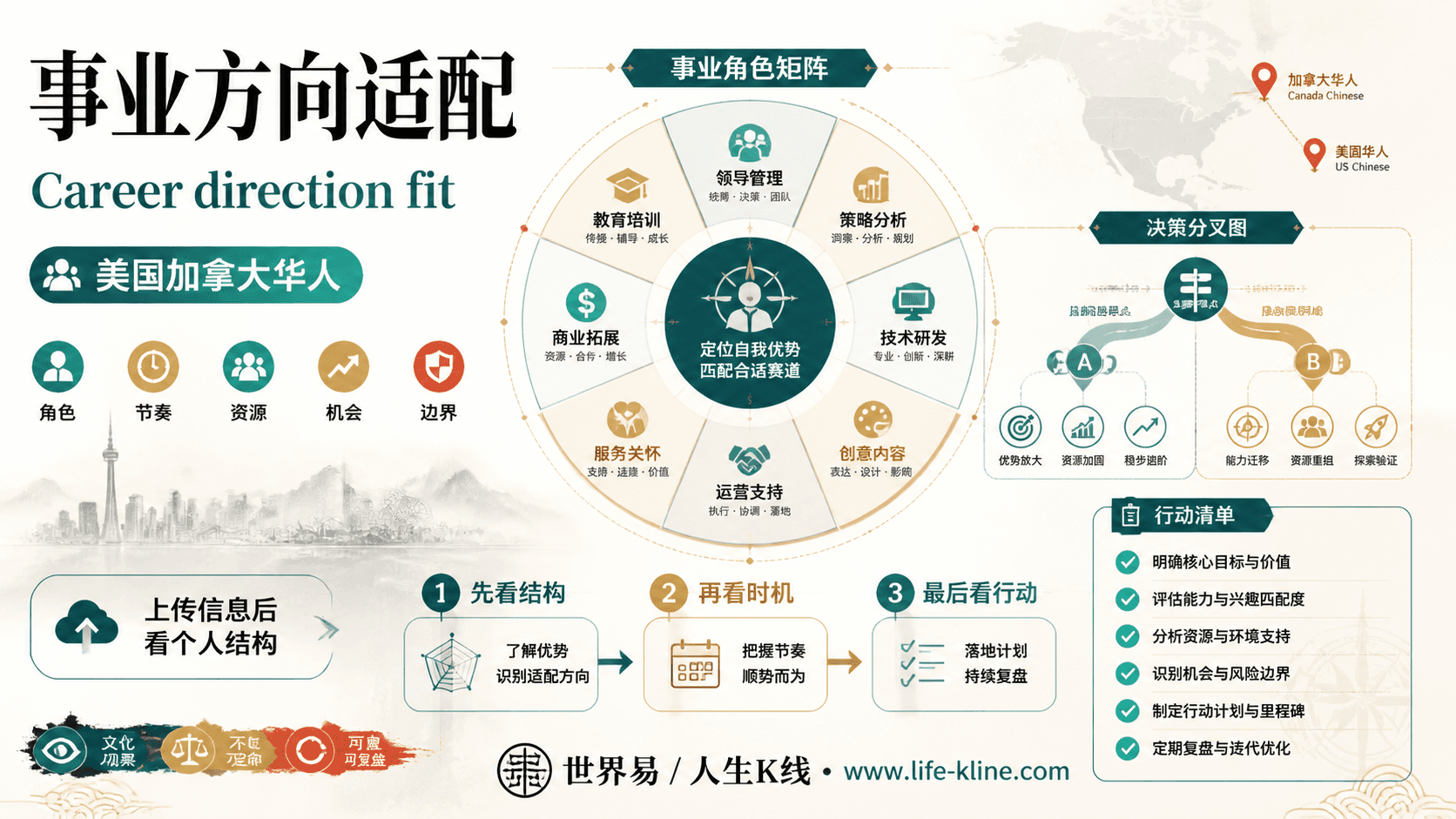
事业方向适配|美国加拿大华人
这张图把《Analysis of He-Chong (Combination-Clash) Relationships in Partnerships — A Practical Case of a Former Colleague's Invitation to a New Company》里的命理概念转成关系、边界和应用场景,适合先看图建立结构,再回到案例正文理解细节。
事业方向适配不应被写成固定结论。更适合美国加拿大华人的读法,是把传统术语翻译成结构、时机、环境、行动和复盘。
查看图片解读