Choices Amidst Shareholder Conflicts: Analysis of Cooperation and Exit under the Gui Wei Da Yun
先看完案例关键信息,再进入分析页验证自己的结构与阶段。
Client Background
The client is a man aged between 35 and 40, currently in the mid-stage of his career, serving as a shareholder in a partnership enterprise. In recent years, the business development has been stable, but internal conflicts among shareholders have gradually intensified, leading to a tense cooperative atmosphere. The client feels caught in a dilemma, worried that continuing cooperation might exacerbate conflicts and is considering whether to exit the partnership to avoid greater losses.
On the family front, the client carries significant responsibilities, needing to balance personal and family stability. The current partnership conflicts not only affect his work mood but also impact his quality of life. Facing these disturbances, the client hopes to use a BaZi perspective to clarify how current luck cycles influence the cooperative relationship, thereby making a rational decision.
BaZi Structure Interpretation
The client’s Day Master is Ji Earth (己土), which is slightly strong, indicating he possesses considerable internal energy and a steady character, suitable for taking responsibility and leadership. The four pillars include a Geng Wu (庚午) year pillar and a Xin Wei (辛未) hour pillar, representing Metal-Earth mutual generation, providing solid support to the Day Master. This shows he has certain external resources and backing.
The pattern belongs to the Bi Jian (比肩) structure, indicating the client has a strong self-awareness and independence, while also implying coexistence of competition and cooperation. The Yong Shen (favorable element) is Fire, representing vitality and motivation. However, the Ji Shen (unfavorable element) is also Fire, suggesting that emotions and conflicts may cause internal friction and need to be handled carefully. The current Da Yun is Gui Wei (癸未), where Water and Earth coexist harmoniously, creating an overall stable environment, favoring consolidation rather than aggressive moves.
The appearance of the Liu Nian Bing Wu (丙午) Fire introduces some volatility into the Da Yun. The active Fire element may intensify frictions within the cooperative relationship but also brings opportunities for transformation and change. Overall, the BaZi structure suggests the client is suited to maintain the existing cooperation during this stable Da Yun while flexibly responding to challenges brought by the Liu Nian.
Focused Issue Judgment
Regarding whether the client should exit amidst current shareholder conflicts, BaZi shows he is in the sixth year of the Gui Wei Da Yun, where Water and Earth mutually generate, creating a stable overall environment that favors maintaining the status quo rather than making sudden changes. The slightly strong Ji Earth Day Master has the capacity to harmonize and is beneficial for resolving conflicts through internal mediation.
Although the Liu Nian Bing Wu Fire is the Ji Shen (unfavorable element), it also brings certain momentum and changes, indicating that rigidly sticking to old patterns is unwise, but rashly exiting is also inadvisable. The active nature of Fire suggests the client needs to maintain communication and compromise, avoiding emotional escalation that could break the cooperation.
Considering the Bi Jian pattern and the relationship between Yong Shen and Ji Shen, the current Da Yun favors stability and consolidation within cooperation. The risk of going independent is relatively high, especially if exiting without adequate preparation, potentially causing greater uncertainty and losses. Therefore, it is recommended that the client first pursue internal reconciliation and adjustments, postponing any exit decisions.
Recommended Actions and Timing
First, during the stable period of the current Gui Wei Da Yun, the client should actively promote communication and coordination among shareholders. Leveraging the slightly strong Ji Earth Day Master’s harmonizing power, efforts should be made to resolve conflicts. Practical measures may include introducing third-party mediation mechanisms, clarifying each party’s interests, seeking consensus, and avoiding decisions driven by emotional impulses.
Second, given the pressures and changes brought by the Liu Nian Bing Wu Fire, the client needs to maintain a flexible approach and adjust cooperation strategies in a timely manner. It is advised to monitor the changes in Liu Nian over the next 1-2 years, assess the cooperative atmosphere and personal resource status, and prepare preliminary plans for exit, but avoid hasty actions.
Finally, upon entering the later stage of the Gui Wei Da Yun or the transition to the next Da Yun (around age 40 and beyond), the client should comprehensively evaluate whether it is suitable to develop independently or exit the cooperation based on actual circumstances and BaZi changes. By then, the client’s accumulated experience and external environment may have shifted, making the decision more secure.
Review and Reminders
A common pitfall is hastily exiting due to intense current conflicts, neglecting the stability of the Da Yun and the Day Master’s harmonizing ability, which may hinder future development. The client should avoid emotional decisions and fully utilize BaZi guidance to progress steadily.
Additionally, since both Yong Shen and Ji Shen are Fire, the client is reminded to maintain vitality in cooperation while guarding against emotional escalation and conflict intensification. Reasonable communication and choosing appropriate timing are key; the client should not be swayed by short-term fluctuations but focus on long-term planning.
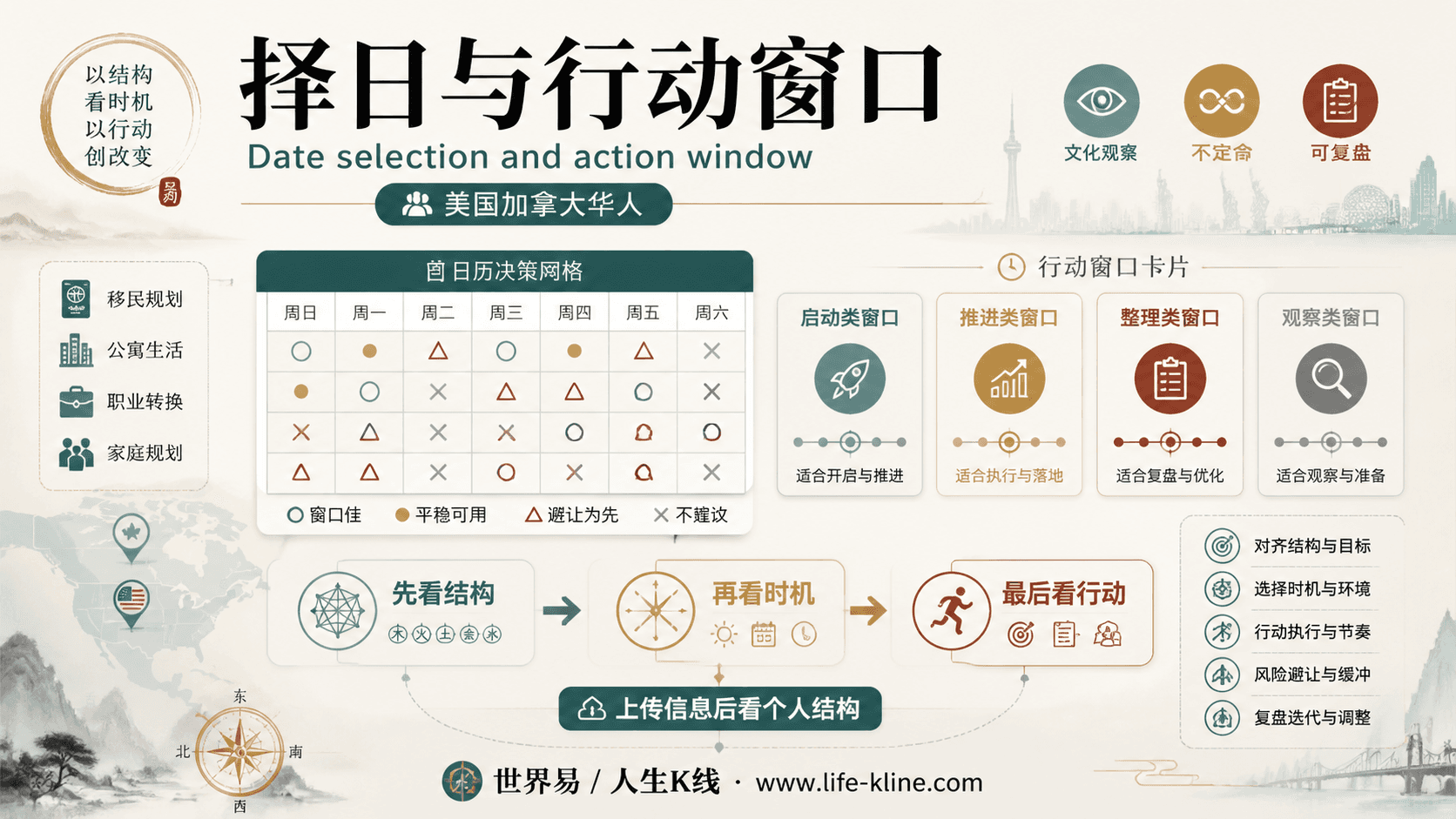
择日与行动窗口|美国加拿大华人
这张图把《Choices Amidst Shareholder Conflicts: Analysis of Cooperation and Exit under the Gui Wei Da Yun》里的命理概念转成关系、边界和应用场景,适合先看图建立结构,再回到案例正文理解细节。
择日与行动窗口不应被写成固定结论。更适合美国加拿大华人的读法,是把传统术语翻译成结构、时机、环境、行动和复盘。
查看图片解读