Practical Control of He-Chong Relationships and Boundaries in Relative Shareholding Partnerships
先看完案例关键信息,再进入分析页验证自己的结构与阶段。
Client Background
The client is a male between 35 and 40 years old, currently at a critical stage in his career, serving as a partner in a medium-sized enterprise. Recently, a relative proposed to join as a shareholder to participate in business operations and profit distribution, which has caused the client to struggle with managing the boundaries between family relationships and business interests. The involvement of family members increases the complexity of the partnership, intertwining emotional bonds with potential conflicts of interest.
During the current Yi Wei (乙未, Yi Wei) Da Yun, the client's career is relatively stable, suitable for maintaining and steady development. However, facing the relative's request to invest, the client worries that unclear boundaries might affect the company's operational efficiency and family harmony. Therefore, he hopes to use metaphysics to assess the He-Chong (combination-conflict) relationships between both parties to make a rational decision.
Natal Chart Structure Interpretation
The client’s Four Pillars (BaZi) show a Day Master (Ri Zhu) of Ren Water (壬水, Ren Shui) that is relatively strong, with a robust self-element and a Zheng Guan (正官, Proper Authority) pattern, indicating a personality that is rigorous with a strong sense of responsibility and management capability. Individuals with a Zheng Guan pattern usually emphasize rules and order, making them suitable for managing standardized cooperative relationships. Thus, the client places great importance on clear systems and boundaries in partnerships.
Both the Yong Shen (用神, favorable element) and Ji Shen (忌神, unfavorable element) are Metal, which means Metal’s influence on the client is complex and requires balance. Metal represents rules and authority; it is both key to regulating the client’s own strength and a sensitive factor in cooperation. Currently in the Yi Wei Da Yun, overall fortune is stable and suitable for maintenance, suggesting the client should handle the partnership cautiously to avoid conflicts that could disrupt existing stability.
Additionally, the interaction between this year’s Bing Wu Liu Nian and the Yi Wei Da Yun shows the client possesses a certain adaptability to external changes this year, which is especially important for managing the complex interpersonal dynamics of a relative joining as a shareholder.
Focused Issue Assessment
A relative joining as a shareholder means the two parties will form certain He-Chong (combination-conflict) relationships within the enterprise. Metaphysically, attention must be paid to the mutual interaction of their Five Elements. The client’s Day Master is Ren Water (壬水, Ren Shui) and relatively strong; if the other party’s Five Elements contain Metal, it may activate the client’s Yong Shen Metal energy, presenting both support and challenge. A detailed analysis of the Heavenly Stems (Tian Gan) and Earthly Branches (Di Zhi) combinations of both parties is necessary.
He-Chong relationships in cooperation manifest as mutual complementarity or conflict in interests and personalities. The Zheng Guan pattern in the client’s chart indicates a strong desire to uphold rules and authority. When the partner’s behavior deviates from established rules, it easily triggers friction. If the relative’s Five Elements contain elements that clash with the client’s, blurred boundaries will exacerbate conflicts.
The stability of the Yi Wei Da Yun combined with the dynamism of the Bing Wu Liu Nian forms a dynamic balance. At this stage, the client is better suited to establish a clear cooperation framework, including defined responsibilities and transparent profit-sharing mechanisms. By judging the He-Chong relationships through metaphysics, it is recommended that the client further understand the relative’s specific Five Elements traits to avoid cooperation breakdown caused by elemental clashes.
Simultaneously, the client should maintain the flexibility and adaptability of his Ren Water Day Master, leveraging this year’s Liu Nian advantage to adjust cooperation strategies flexibly. It is important to uphold principles while allowing moderate compromise to prevent the partnership from falling into opposition.
Recommended Actions and Timing
First, it is recommended that the client explicitly define the rights, responsibilities, and interest boundaries of both parties in the cooperation agreement to prevent future disputes caused by ambiguity. Specifically, the agreement should detail the use of invested funds, decision-making processes, and exit mechanisms, ensuring the relative’s rights and obligations as a partner are clear and transparent.
Second, during the early stage of cooperation, utilize the strong adaptability of the Bing Wu Liu Nian to arrange multiple communication and coordination meetings to promptly identify and resolve potential He-Chong conflicts. This phase should maintain an open attitude, listen to reasonable demands from the relative, while insisting on bottom-line principles to avoid sacrificing business norms due to emotional factors.
Finally, it is advisable to conduct a partnership review in the later stage of the Yi Wei Da Yun (around age 42), combining the company’s development status and changes in the relationship between both parties to evaluate whether to adjust the cooperation model or redefine boundaries. This timing aligns with the rhythm of the Da Yun, facilitating actions that follow the trend and ensuring long-term stability of the partnership.
Review and Reminders
When managing partnerships involving relatives as shareholders, common pitfalls include emotional entanglement and unclear boundaries, which can lead to decreased decision-making efficiency and intensified family conflicts. The He-Chong relationships in metaphysics remind the client to insist on standardized and institutional management to avoid letting personal feelings interfere with business judgment.
Moreover, the chart shows both Yong Shen and Ji Shen are Metal, indicating the client must be cautious of rigidity caused by overemphasizing rules, while also avoiding losing control due to excessive compromise. Maintaining flexibility and firmness is key to overcoming challenges brought by He-Chong relationships.
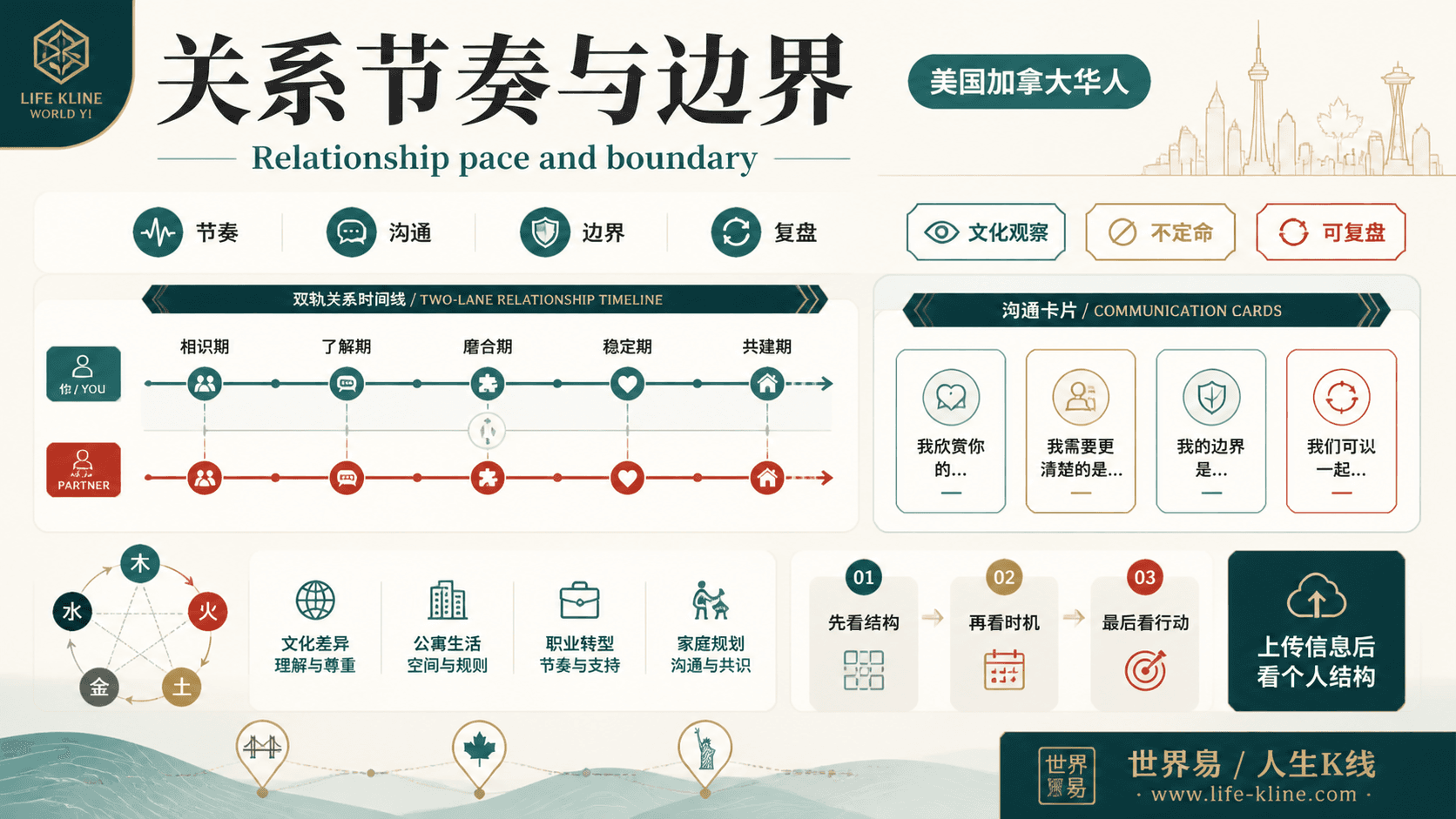
关系节奏与边界|美国加拿大华人
这张图把《Practical Control of He-Chong Relationships and Boundaries in Relative Shareholding Partnerships》里的命理概念转成关系、边界和应用场景,适合先看图建立结构,再回到案例正文理解细节。
关系节奏与边界不应被写成固定结论。更适合美国加拿大华人的读法,是把传统术语翻译成结构、时机、环境、行动和复盘。
查看图片解读