Partnership Decisions Amid Shareholder Conflicts: The Conservative Wisdom of the Xin Hai Da Yun
先看完案例关键信息,再进入分析页验证自己的结构与阶段。
Client Background
The client is a young woman between 25 and 30 years old, currently a shareholder in a startup company. Her business skills and professional competence are recognized, but recently internal disagreements and conflicts of interest among shareholders have created a tense cooperative atmosphere. As disputes escalate, she hesitates over whether to exit the partnership, worried that staying might affect her personal development and future benefits.
She hopes to maintain steady business growth while avoiding unnecessary psychological stress and resource waste caused by internal strife. However, the complex market environment and partner conflicts make her decision-making difficult, especially at critical junctures. She seeks BaZi analysis to find the best path under the current Da Yun and Liu Nian conditions—whether to persist in partnership or pursue independent development.
BaZi Structure Interpretation
From the BaZi structure perspective, the client’s Day Master is Yi Wood (乙, Yi), which is relatively weak, with a clear Zheng Cai (Direct Wealth) pattern. This indicates she has sensitivity and responsibility regarding wealth and cooperative relationships. A weak Wood Day Master means her actions and decisions need external support, specifically Yong Shen (favorable element) Water to nourish and assist her, while Ji Shen (unfavorable elements) Fire and Earth suggest that impulsiveness and excessive pressure would adversely affect her.
She is currently in the Xin (辛, Xin) Hai (亥, Hai) Da Yun phase. Xin Metal is her Zheng Cai (Direct Wealth), and Hai Water supports her Yong Shen. Overall, this Da Yun shows a steady and preservation-oriented trend. The Xin Hai Da Yun favors maintaining existing partnerships and stable operations rather than aggressive expansion or impulsive withdrawal. Although the Bing (丙, Bing) Wu (午, Wu) Liu Nian brings a certain degree of strong Fire energy, it creates a dynamic requiring flexible adjustments rather than outright rejection of cooperation.
In summary, the BaZi indicates that at this stage, the client is better suited to steady progress, leveraging the Zheng Cai and Water nourishment advantages of the Xin Hai Da Yun to streamline cooperative relationships and avoid impulsive actions that could lead to greater upheaval.
Focused Issue Judgment
Regarding the client’s question of whether the current Da Yun favors cooperation or independence, the BaZi structure and the interaction between Da Yun and Liu Nian provide important clues. The Xin Hai Da Yun primarily emphasizes preservation, with Hai Water as the Yong Shen helping to ease partnership conflicts, enhance communication and compromise abilities, and support the maintenance of cooperative relationships. Rashly exiting now might lose stable Zheng Cai support, causing a break in career and wealth.
Furthermore, although the Bing Wu Liu Nian’s strong Fire energy could potentially intensify conflicts, it also forces the client to adapt flexibly, seeking new balances within the partnership—such as adjusting equity structures, clarifying responsibilities, or introducing third-party mediation—instead of simply choosing independence.
Overall, the current Da Yun and Liu Nian suggest that the client should prioritize cooperation as the main strategy, resolving internal conflicts through rational communication and strategic optimization to build trust and consensus among partners. Exiting carries significant risks and may hinder financial and career development.
Recommended Actions and Timing
Based on BaZi analysis, the client should adopt a conservative and steady approach, actively engaging in internal partnership communication and coordination. It is recommended that over the next one to two years, she carefully review partnership agreements, clarify rights and responsibilities, resolve potential conflicts, and strengthen the cooperative foundation. Taking advantage of the Hai Water Yong Shen period, she might appropriately involve a rational third party to assist mediation, avoiding emotional decisions that could break the partnership.
At the same time, she should be cautious of the Ji Shen Fire and Earth influences, avoiding emotionally charged or overly aggressive actions during the Bing Wu Liu Nian. Important decisions can be scheduled for the later part of the Liu Nian or subsequent phases of the Xin Hai Da Yun, when the overall luck environment is more stable, before considering any partnership adjustments.
If the partnership atmosphere continues to deteriorate and communication fails, the client can begin preparing an exit plan in the later stage of the Da Yun, selecting a more favorable timing to ensure a smooth transition of resources and career after withdrawal, avoiding difficulties caused by premature independence.
Review and Reminders
This case serves as a reminder that when facing partnership conflicts and decisions about exiting, one must avoid impulsiveness. The balance between Yong Shen and Ji Shen in BaZi emphasizes the importance of rationality and preservation. Impulsive withdrawal may not only break the current Zheng Cai pattern but also bring greater uncertainty and risks.
Moreover, while BaZi analysis can provide trend and timing guidance, practical actions must also consider the real environment and interpersonal dynamics, adjusting strategies flexibly. Preservation does not mean passivity; active communication and timely adjustments are key to resolving conflicts and overcoming difficulties.
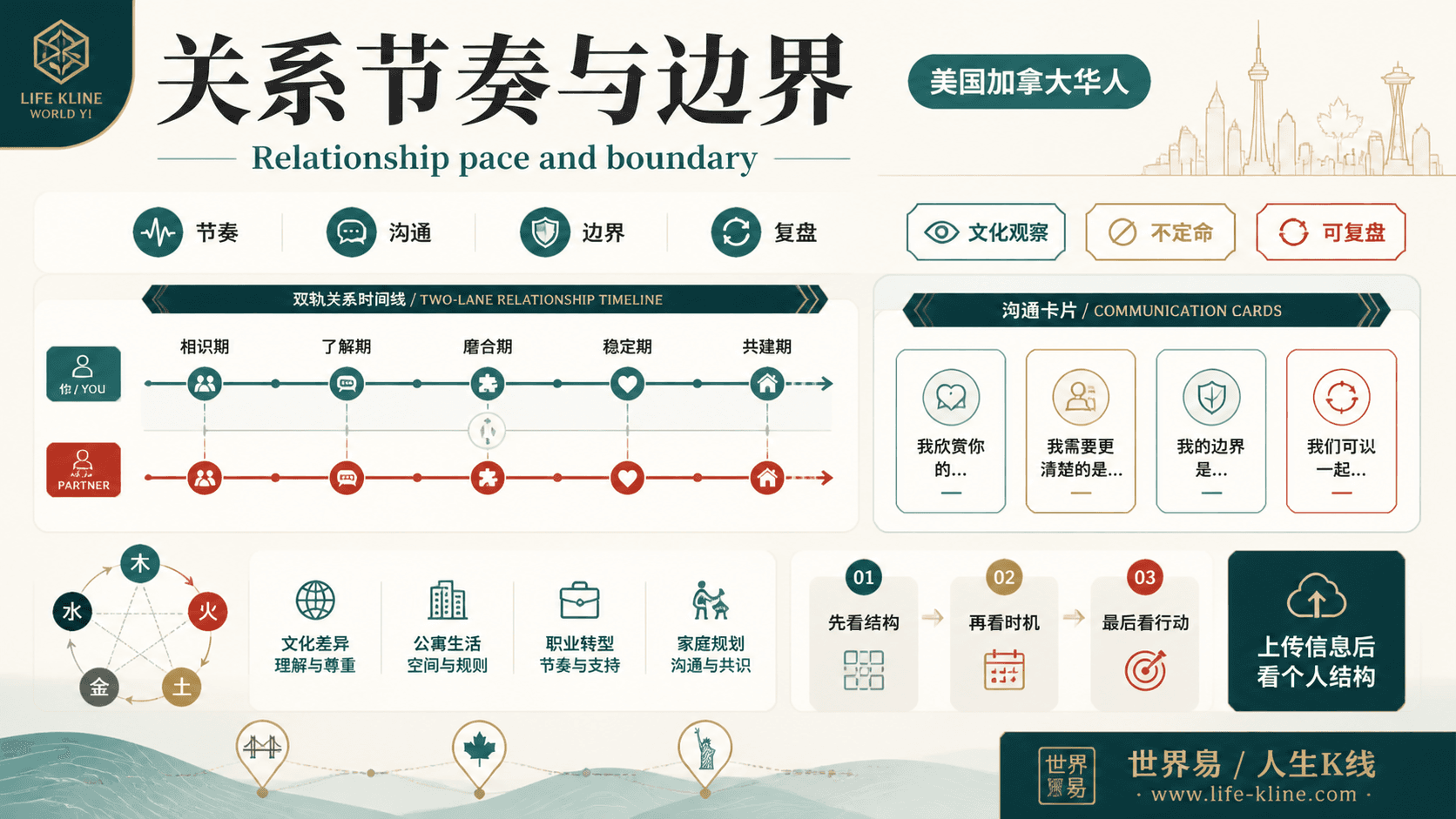
关系节奏与边界|美国加拿大华人
这张图把《Partnership Decisions Amid Shareholder Conflicts: The Conservative Wisdom of the Xin Hai Da Yun》里的命理概念转成关系、边界和应用场景,适合先看图建立结构,再回到案例正文理解细节。
关系节奏与边界不应被写成固定结论。更适合美国加拿大华人的读法,是把传统术语翻译成结构、时机、环境、行动和复盘。
查看图片解读