Analysis of Boundaries and He-Chong Relationships in Partnerships Involving Relatives' Equity Participation
先看完案例关键信息,再进入分析页验证自己的结构与阶段。
Client Background
The client is a male aged between 30 and 35, currently at a critical stage in career development, facing a request from relatives for equity participation in a partnership. As family members, this cooperation carries emotional undertones but also presents challenges in the distribution of interests and responsibilities. The client values career stability and is presently in a phase requiring preservation of achievements, thus being particularly sensitive to cooperation boundaries and risks.
The client's career involves a field that requires flexible responses to market changes, where team collaboration and resource allocation are key. He is concerned about potential management conflicts and interest disputes arising from relatives' equity participation, while hoping to enhance resource integration through cooperation. In this context, clarifying the rights and responsibilities of both parties and defining the scope of cooperation to prevent conflicts arising from He-Chong relationships is an urgent issue to resolve.
BaZi Chart Structure Interpretation
The client's Day Master is Yi Wood (乙木), which is relatively weak. The overall structure corresponds to the Shi Shen (食神) pattern. The weak Yi Wood Day Master indicates that the client needs to rely on the nurturing effect of Water to strengthen personal energy. Water is the Yong Shen (favorable element), signifying the importance of wisdom and resource management. Fire and Earth are Ji Shen (unfavorable elements); excessive Fire and Earth will consume the Day Master's strength, leading to obstruction of personal will.
Currently, the client is in the Geng Xu (庚戌) Da Yun. This period is suitable for preservation and steady development, not for aggressive advancement. Although Geng Metal (庚金) tends to restrain Wood, the overall Da Yun is stable and helps consolidate existing foundations. The Liu Nian is Bing Wu (丙午); the presence of Bing Fire (丙火) brings external challenges and changes. Although Fire is a Ji Shen, its influence this year requires the client to adapt flexibly.
From a metaphysical perspective, with a weak Yi Wood Day Master, if the cooperating party brings an excess of Fire and Earth elements, it may form He-Chong (combination and clash) relationships that deplete the client's energy. Therefore, identifying the relative's BaZi attributes and their He-Chong relationship with the client is a crucial basis for preventing cooperation risks.
Focused Issue Assessment
Regarding the He-Chong relationship in relatives' equity participation, the first step is to clarify whether the relative's Heavenly Stems and Earthly Branches (Gan Zhi) attributes clash with the client's BaZi chart. The client’s Yi Wood Day Master is weak and avoids Fire and Earth; if the relative's BaZi contains excessive Fire and Earth, energy conflicts are inevitable during cooperation, causing tension and difficulty in aligning interests.
Secondly, the setting of cooperation boundaries should refer to the direction of the Yong Shen Water element. Water symbolizes flow and resource allocation; if the relative can bring Water support or other beneficial elements, the cooperation is more favorable. Conversely, if Fire and Earth are dominant, caution is necessary. By comparing both parties' BaZi charts, one can assess whether there is mutual generation or restriction, thereby designing reasonable cooperation terms.
Combined with the macro environment of the current Geng Xu Da Yun, the client should focus on preservation and avoid introducing too many variables. The interference from Bing Fire in this Liu Nian is strong; cooperation may face sudden conflicts or disputes. Therefore, negotiation during this Liu Nian should allow flexibility and avoid full-scale investment at once.
Recommended Actions and Timing
First, the client should clearly define cooperation boundaries with the relative, emphasizing avoidance of areas heavily influenced by Fire and Earth. Cooperation should focus on business domains where Water and Wood elements mutually generate, ensuring complementary energies and minimizing conflicts. Contracts should establish clear rights and responsibilities and include breach mechanisms to prevent escalation of conflicts caused by He-Chong relationships.
Second, conduct a detailed BaZi comparison between both parties before cooperation to confirm whether significant He-Chong relationships exist. If the relative’s chart shows strong Fire and Earth, it is advisable to postpone cooperation and advance only when future luck cycles are more favorable. Conversely, during the stable Geng Xu Da Yun period, business can proceed gradually to ensure cooperation stability.
Regarding timing, given the current Liu Nian is Bing Wu, a period of strong Fire, it is best to avoid initiating major cooperation projects during this peak Fire phase. Choosing seasons when Fire influence diminishes or waiting for upcoming Da Yun or Liu Nian with Metal-Water mutual generation will allow more harmonious energy and lower risks.
Review and Reminders
A common pitfall in cooperation is the confusion of emotions and interests, especially involving relatives, which can easily overlook potential risks from BaZi He-Chong relationships. The client should remain rational, fully utilizing BaZi analysis as an auxiliary tool to reasonably delineate cooperation boundaries and avoid emotional interference leading to poor decisions.
Moreover, while BaZi analysis provides directional guidance, the key to successful cooperation lies in communication and consensus between parties. It is recommended that the client maintain flexibility during cooperation, adjust strategies timely, and avoid rigid thinking that could miss valuable opportunities.
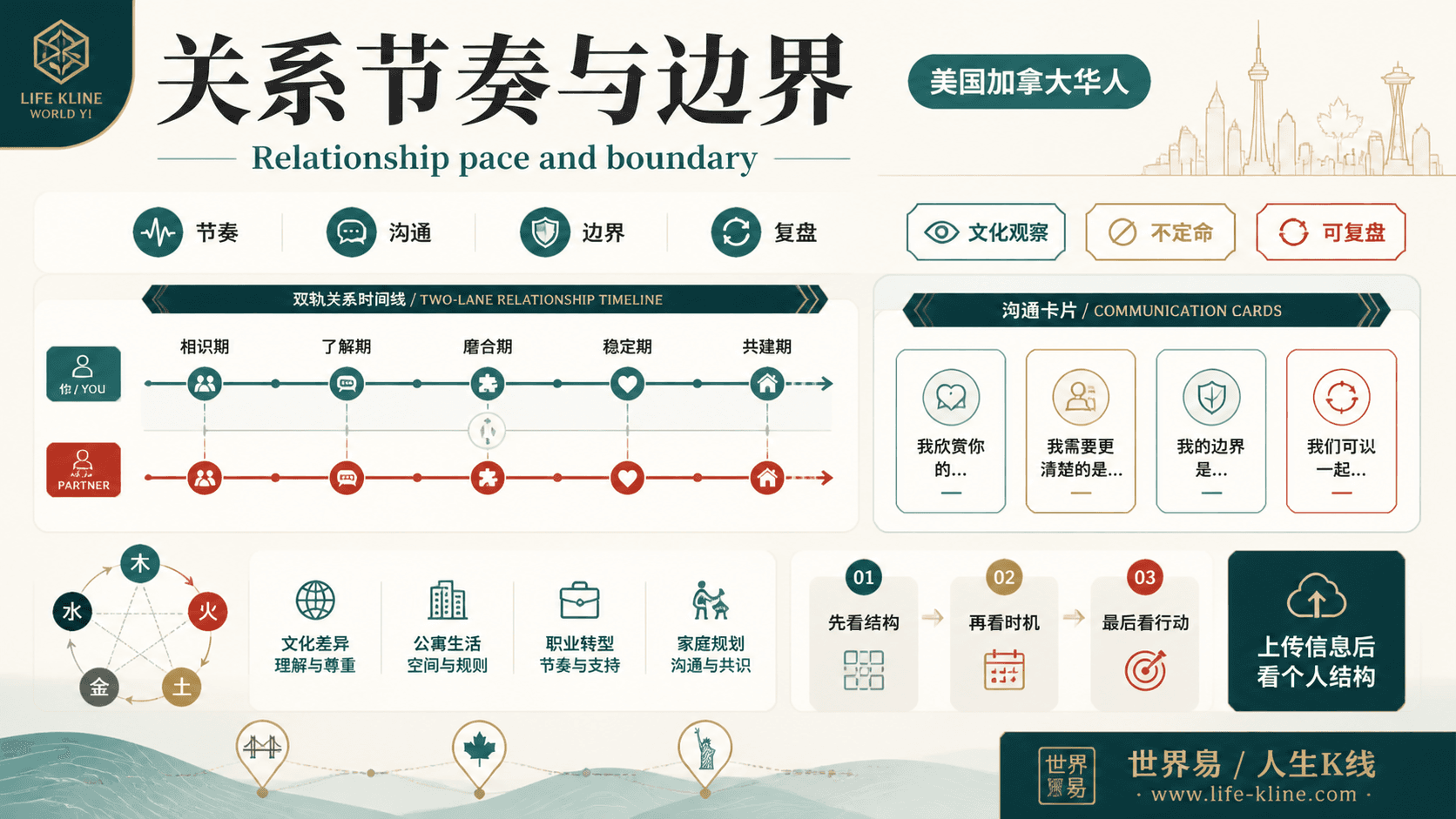
关系节奏与边界|美国加拿大华人
这张图把《Analysis of Boundaries and He-Chong Relationships in Partnerships Involving Relatives' Equity Participation》里的命理概念转成关系、边界和应用场景,适合先看图建立结构,再回到案例正文理解细节。
关系节奏与边界不应被写成固定结论。更适合美国加拿大华人的读法,是把传统术语翻译成结构、时机、环境、行动和复盘。
查看图片解读