Risk Analysis of He-Chong Conflicts in Exclusive Upstream-Downstream Partnership Agreements
先看完案例关键信息,再进入分析页验证自己的结构与阶段。
Client Background
The client is a female entrepreneur aged between 25 and 30, currently at a critical stage of career development. Her business involves connecting upstream and downstream supply chains, and she is recently considering signing an exclusive agreement with a partner to ensure supply stability. Her family background supports her entrepreneurial decisions, but she remains cautious about potential conflicts of interest and risks in the partnership.
The client is presently in the Da Yun (decade luck cycle) of Ren Xu (壬戌), a phase characterized by overall stable fortune, suitable for consolidating and maintaining existing achievements. Meanwhile, the Liu Nian (annual fortune) has entered Bing Wu (丙午), prompting her to adapt flexibly and adjust strategies to fit changing external conditions. Facing possible He-Chong (combination and clash) relationships in cooperation, she hopes to find reasonable coping methods from a BaZi perspective.
BaZi Chart Structure Interpretation
The client’s Day Master is Bing Fire (丙火), in a neutral state, exhibiting a Cong Er (从儿) pattern, which means Earth is the Yong Shen (favorable element). Earth can restrain Wood and strengthen her own energy. Her primary favorable elements are Earth and Metal, while Wood is the Ji Shen (unfavorable element). This indicates that in cooperation, factors represented by Wood should be avoided to maintain the stability of Earth and Metal.
The Year Pillar Wu Yin (戊寅) and Hour Pillar Wu Xu (戊戌) both belong to Earth, reinforcing the support for the Yong Shen and enabling the client to maintain resilience against external challenges. The Month Pillar Jia Zi (甲子) contains Jia Wood (甲木), which is the Ji Shen, symbolizing potential Wood element shocks in cooperation—namely, instability or conflict possibly brought by the partner.
The current Da Yun of Ren Xu (壬戌) includes Ren Water (壬水), which provides some moistening effect, promoting environmental fluidity, while Xu Earth (戌土) stabilizes Earth’s strength, supporting the client in maintaining achievements. In the Bing Wu (丙午) Liu Nian, Bing Fire (丙火) aligns with the Day Master, enhancing her initiative and adaptability. Overall, the chart suggests the client is suited for steady cooperation and should avoid rashly signing restrictive agreements.
Focused Issue Assessment
The He-Chong relationship between the client and the partner is especially critical in cooperation. The client’s Ji Shen is Wood, and if the partner represents Wood attributes, elemental conflicts will arise, causing tension in the partnership. The Yin Wood (寅) in the Year Pillar Wu Yin (戊寅) clashes with the Xu Earth (戌土) in the Hour Pillar Wu Xu (戊戌), indicating the partner may weaken the client’s Yong Shen Earth.
From a BaZi perspective, exclusive agreements symbolize restriction and limitation. If the partner’s Wood element is excessive, it will activate the Ji Shen, increasing cooperation risks. During the current Bing Wu (丙午) Liu Nian, the strong Fire benefits the client by boosting her energy, but her ability to suppress Wood is limited, so careful handling of the partnership is necessary to avoid trust crises or interest conflicts caused by He-Chong.
Additionally, although the Ren Xu (壬戌) Da Yun is stable, the flowing nature of Ren Water (壬水) advises the client to remain vigilant and avoid being influenced by the partner’s changes. Both parties should clarify cooperation boundaries to prevent deepening conflicts caused by the exclusive agreement. The BaZi chart indicates potential He-Chong conflicts between partners; the key lies in adjusting cooperation methods to strengthen Earth and Metal elements while weakening Wood’s influence.
Recommended Actions and Timing
Based on BaZi analysis, the client should enhance the use of Earth and Metal elements in cooperation, for example by clearly defining contract terms to protect her rights, establishing reasonable risk mitigation mechanisms, and preventing excessive interference from the partner’s Wood attributes. Maintaining open communication channels is also essential to promptly identify and resolve potential conflicts of interest.
It is recommended that the client leverage the strong Fire energy of the current Bing Wu (丙午) Liu Nian to proactively adjust cooperation strategies, increase her initiative, and timely propose modifications or optimizations to the agreement to enhance its flexibility and adaptability. Signing important agreements during months or periods dominated by Wood should be avoided to reduce Ji Shen influence.
Approaching the transition of the next Da Yun, especially near age 30, the client should carefully evaluate cooperation outcomes and relationship changes. Introducing Metal element resources, such as third-party guarantees or legal support, can strengthen the cooperation’s stability. Negotiations and agreement signings should be scheduled to avoid Wood-dominant periods, ensuring a harmonious overall cooperative environment.
Review and Reminders
While BaZi analysis provides directional insights into cooperation risks, practical decisions must integrate market conditions and legal terms for comprehensive judgment. A common pitfall is neglecting the partner’s interests, which can intensify conflicts triggered by the Wood Ji Shen, ultimately damaging the relationship.
The client is advised to continuously safeguard her Yong Shen and avoid letting external Wood energy disturb her mindset and judgment, maintaining steadiness and rationality. Although exclusive agreements offer protection, they may limit flexibility; careful weighing of pros and cons is necessary to prevent deadlock caused by He-Chong conflicts.
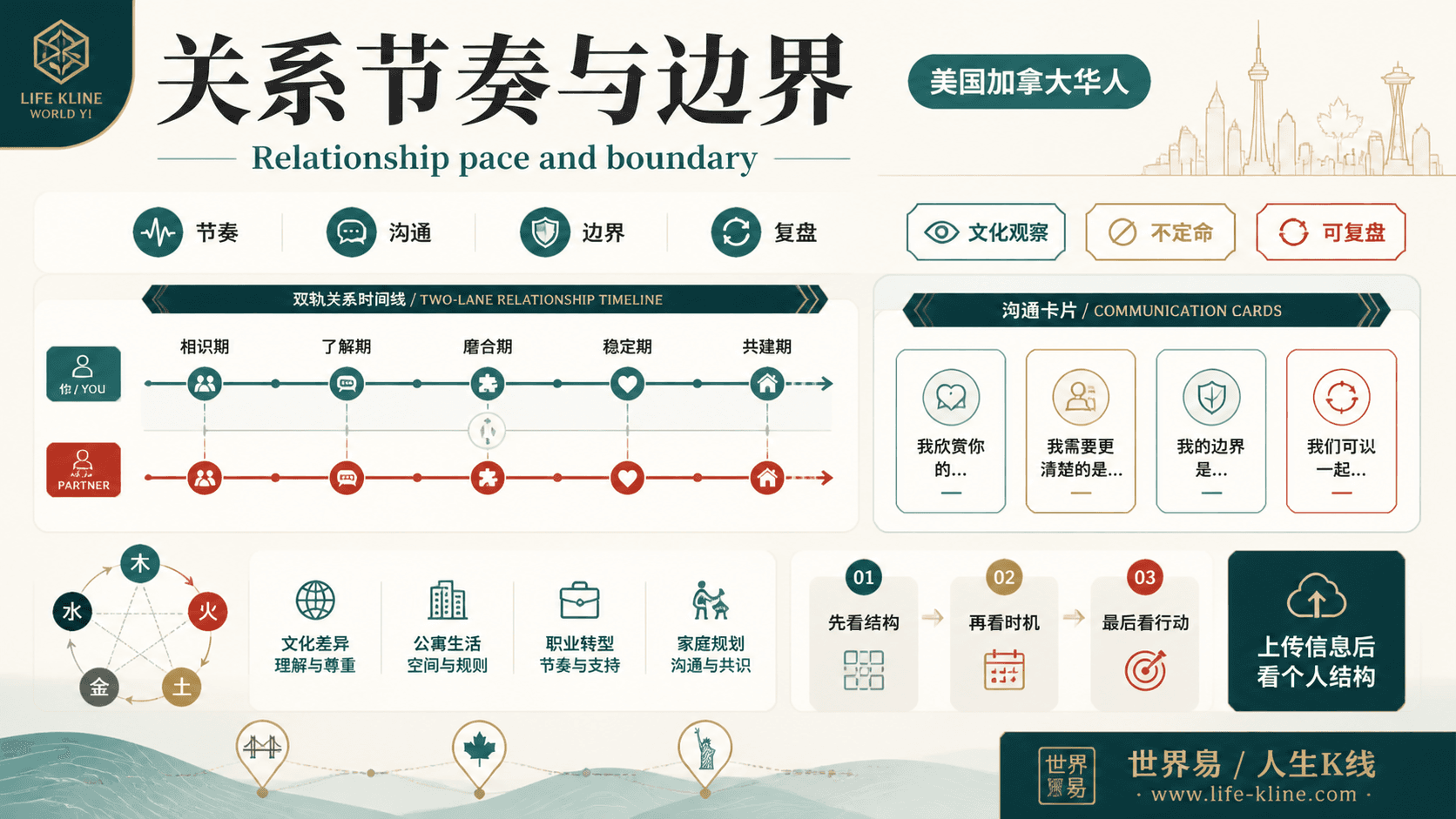
关系节奏与边界|美国加拿大华人
这张图把《Risk Analysis of He-Chong Conflicts in Exclusive Upstream-Downstream Partnership Agreements》里的命理概念转成关系、边界和应用场景,适合先看图建立结构,再回到案例正文理解细节。
关系节奏与边界不应被写成固定结论。更适合美国加拿大华人的读法,是把传统术语翻译成结构、时机、环境、行动和复盘。
查看图片解读