Analysis and Resolution Strategies of He-Chong Relationships in Mentor-Mentee Cooperation Breakdown
先看完案例关键信息,再进入分析页验证自己的结构与阶段。
Client Background
The client is a woman in her twenties, currently at the early stage of her career development, serving as a mentee responsible for assisting her mentor in project research and management. Being young and relatively inexperienced, she faces certain confusion and pressure in maintaining and coordinating the cooperative relationship. Recently, a clear breakdown occurred between her and the mentor, resulting in trust and communication barriers, which not only affected the project progress but also caused her anxiety and bewilderment.
The client hopes to understand the relational conflicts between both parties from a metaphysical perspective, especially wanting to know whether the He-Chong relationship with the mentor is a key factor leading to the cooperation breakdown. She also seeks specific adjustment suggestions and timing to properly handle the current cooperation crisis and avoid further deterioration.
BaZi Chart Structure Interpretation
The client's BaZi chart has a Bing (丙, Fire) Day Master, which is relatively weak, indicating her own energy and stress resistance are limited and require external support to enhance her stability and influence. Her pattern is Zheng Cai (正财, Proper Wealth), showing she is suited to gain resources and support through legitimate channels and steady cooperation. Under this pattern, the Yong Shen (favorable element) is Wood, as Wood generates Fire and strengthens the Day Master; the Ji Shen (unfavorable elements) are Earth and Metal, which suppress her Day Master, causing energy depletion and emotional fluctuations.
Currently, she is in the Jia-Chen (甲辰) Da Yun (decade luck cycle), which is a stable period, suggesting she should maintain and consolidate rather than take risks. This advises her to be steady and patient in handling the cooperation relationship, avoiding impulsiveness that could worsen conflicts. The Liu Nian (annual fortune) is Bing-Wu (丙午), where Fire energy is strong, implying she needs to utilize flexibility and adaptability to adjust strategies and resolve the crisis. Overall, the chart indicates she is easily affected by Earth and Metal elements in cooperation, which may correspond to the mentor’s personality or working style, resulting in He-Chong conflicts and friction.
Focused Problem Judgment
Regarding the client’s concern about the 'He-Chong relationship with the other party,' the metaphysical analysis shows that the mentor likely represents Earth or Metal attributes in their interaction, which are the client’s Ji Shen (unfavorable elements). Since Earth and Metal restrain Wood and Fire, the client’s energy is restricted, creating a tense He-Chong state that leads to communication and collaboration obstacles.
In BaZi, He-Chong relationships often manifest as conflicts in personality and needs. The client’s relatively weak Day Master requires nourishment from Wood, but the mentor’s Earth and Metal characteristics invisibly suppress her growth space, causing the cooperation relationship to easily become unbalanced. Understanding this, the client should realize that the current conflict is not purely personal opposition but a reflection of the BaZi mutual generation and restriction dynamics, requiring a breakthrough by harmonizing the Yong Shen.
Moreover, the interaction between Da Yun and Liu Nian offers the client timing opportunities for adjustment. The stable atmosphere of the Jia-Chen Da Yun suits maintaining the current situation without rash actions, while the Bing-Wu Liu Nian emphasizes flexible response and timely strategy adjustment. This means the client needs to adopt a gentle and flexible communication approach, reducing head-on conflicts.
In summary, the client should focus on strengthening Wood energy, minimizing the negative influence of Earth and Metal, and leverage the favorable timing of the current Da Yun and Liu Nian to gradually repair the cooperation relationship with the mentor.
Recommended Actions and Timing
First, the client should focus on enhancing her Yong Shen — Wood energy, which can be achieved by improving her learning ability and communication skills. Specifically, she can proactively study the art of communicating with the mentor, adjusting her expression to 'soft overcome hard,' avoiding direct confrontation with the mentor’s Earth and Metal attributes. Meanwhile, actively seeking third-party coordination or referrals can inject new vitality into the cooperation through external resources.
Second, during the first half of the Jia-Chen Da Yun, the client should maintain the stability of the cooperation relationship, emphasizing consolidation and accumulation without rushing forward. During this period, it is advised to maintain the status quo, avoid intensifying conflicts, and allow both sides some buffer and adjustment space. She can gradually rebuild trust through written communication or regular feedback.
Entering the Bing-Wu Liu Nian, the client should utilize the active Fire characteristic of the year to flexibly adjust cooperation strategies, appropriately showing initiative and innovative thinking, and seek new entry points for cooperation. At this time, she can attempt to propose new cooperation plans or shared goals to shift the focus and reduce the tension caused by He-Chong. Simultaneously, she should closely observe the mentor’s feedback, seize the window when the mentor’s attitude softens, and actively promote the reconstruction of the cooperation relationship.
Review and Reminders
When dealing with He-Chong relationships, the client needs to be cautious of emotional fluctuations and impulsive actions caused by the Ji Shen Earth and Metal elements, and must not escalate conflicts due to momentary displeasure. In BaZi, He-Chong often reflects conflicts in personality and needs; understanding this makes adjusting mindset and strategy crucial.
Additionally, the chart indicates that the current Da Yun and Liu Nian favor consolidation and adaptability, meaning it is unwise to seek quick success. The client should allow time and space for repairing the cooperation relationship, avoiding blind actions that cause greater losses. Maintaining patience, adjusting communication methods, and timely leveraging auxiliary forces will effectively help her overcome the cooperation breakdown.
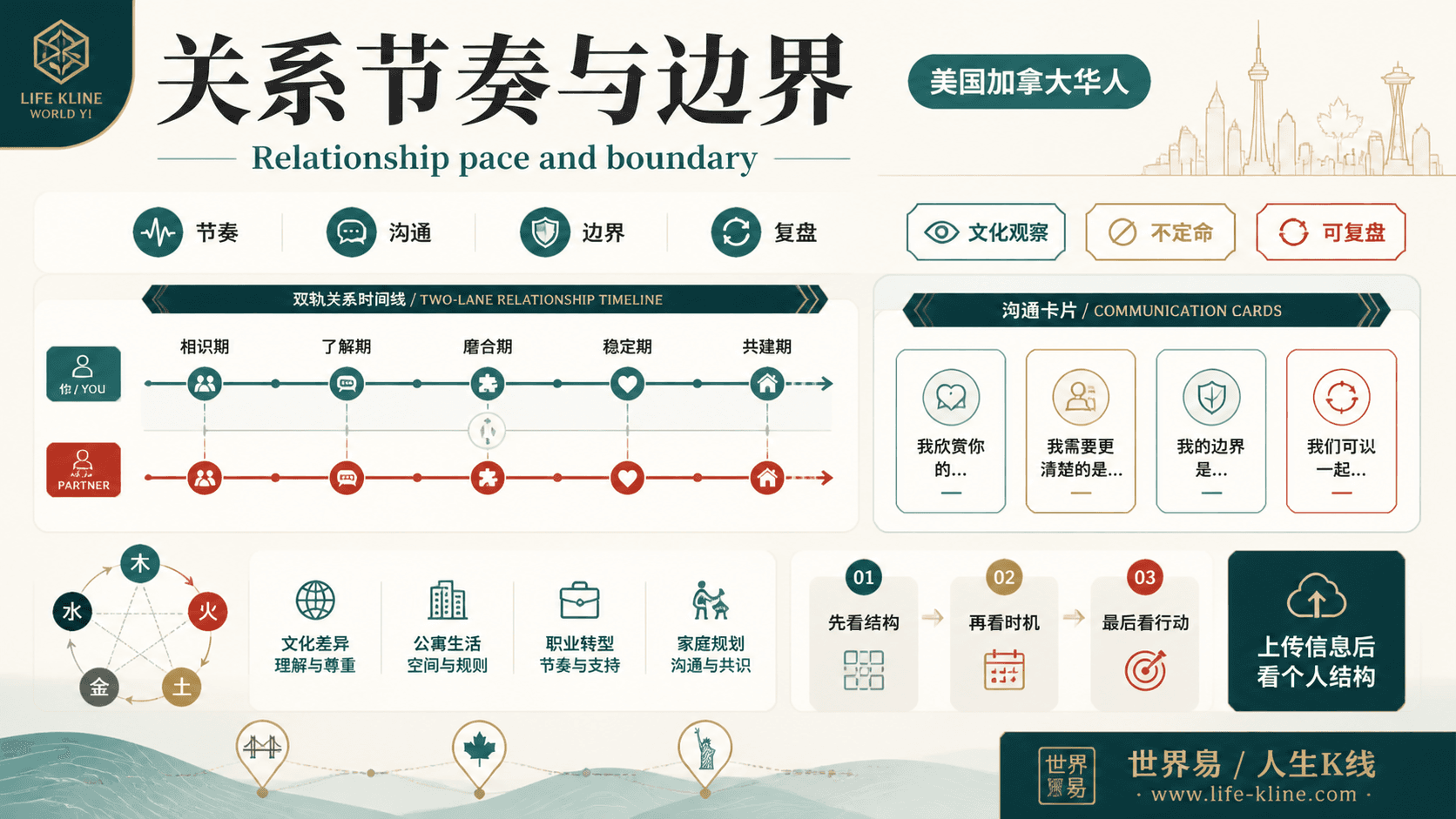
关系节奏与边界|美国加拿大华人
这张图把《Analysis and Resolution Strategies of He-Chong Relationships in Mentor-Mentee Cooperation Breakdown》里的命理概念转成关系、边界和应用场景,适合先看图建立结构,再回到案例正文理解细节。
关系节奏与边界不应被写成固定结论。更适合美国加拿大华人的读法,是把传统术语翻译成结构、时机、环境、行动和复盘。
查看图片解读