Analysis and Decision Guidance on He-Chong (Combination-Clash) Relationships in Contract Cooperation
先看完案例关键信息,再进入分析页验证自己的结构与阶段。
Client Background
The client is a woman in her fifties, at a relatively mature stage in her career, currently undergoing a critical contract negotiation. She works in a highly competitive industry where cooperative relationships are crucial for future development. Recently, the counterpart proposed significant concessions, causing the client to hesitate about signing the contract, concerned that this might affect the stability of long-term cooperation.
On the family front, the client bears considerable responsibilities and must balance the dual pressures of career and family. She hopes to find the optimal balance in cooperation through scientific analysis, avoiding unnecessary risks caused by blind signing.
BaZi Chart Structure Interpretation
The client’s BaZi chart shows the Day Master as 丙火 (Bing Fire), which is relatively weak, indicating insufficient inner energy and a need to rely on external resources to strengthen herself. Her pattern is a Bi Jian (比肩) structure, suggesting that in her career she values cooperation and competition among peers, often needing collaboration with similar forces to advance.
The Yong Shen (favorable element) is fire, emphasizing the importance of maintaining internal and external enthusiasm and motivation; earth and metal are the Ji Shen (unfavorable elements), meaning these elements may bring obstacles and depletion, requiring cautious handling. Currently, she is in the 辛卯 (Xin Mao) Da Yun (decade luck cycle), with overall stable fortune, suitable for consolidation rather than aggressive moves. The Liu Nian (annual fortune) is 丙午 (Bing Wu), where fire is strong, providing energy support for adaptability.
Focused Issue Assessment
Regarding the He-Chong (combination and clash) relationship between the counterpart and the client, in BaZi, “He” (combination) means both parties can complement each other’s resources and strengths, while “Chong” (clash) may manifest as conflicts of interest or value collisions. The client’s weak Day Master means she needs support from the partner, but if the counterpart’s Five Elements include earth or metal, it may exert pressure on the client, causing clashes.
The current Liu Nian’s strong fire can partially neutralize potential harm from the counterpart’s earth and metal elements. However, due to the stable nature of the 辛卯 (Xin Mao) Da Yun, the client should remain cautious to avoid losing core interests through excessive concessions. If the counterpart’s Five Elements contain earth or metal that counter fire, the client should be alert to hidden conditions and potential risks during negotiations.
On the combination side, if the counterpart’s main element is wood, since wood generates fire, it can assist the client’s Yong Shen fire, promoting smooth and mutually beneficial cooperation. Such a combination is worth positive consideration. Conversely, if the counterpart is heavy in metal and earth, it may form a He-Chong, leading to conflicts and disputes in cooperation.
Additionally, the client’s Bi Jian pattern emphasizes support from similar energies. If the counterpart reflects similar energy and philosophy, the cooperation foundation will be more solid. Considering the actual concessions in the contract, excessive concessions may suppress the client’s Yong Shen fire, weakening overall motivation and cooperative vitality.
Recommended Actions and Timing
Based on the BaZi analysis, it is recommended that before signing, the client thoroughly evaluate the counterpart’s background and resource composition, paying special attention to whether the counterpart supports the client’s Yong Shen fire, such as with wood elements, and avoid excessive compromise with earth- and metal-heavy opponents. Meanwhile, the client should maintain core interests and principles, not sacrificing long-term development for short-term gains.
In the fifth year of the current 辛卯 (Xin Mao) Da Yun, the overall fortune tends to be stable, favoring consolidation rather than aggressive expansion. Therefore, the client should use this period to strengthen resource integration and risk control, avoiding rash expansion. The fire-strong Liu Nian 丙午 (Bing Wu) enhances adaptability, suitable for flexible negotiation strategies but not for making major concessions lightly.
Specific timing recommendations focus on fire-strong periods within the Liu Nian, such as the Wu month or Bing day, leveraging the power of fire to advance cooperation details. At the same time, avoid signing key agreements during earth- and metal-strong periods to prevent rigid clashes that could cause obstacles in subsequent cooperation.
Review and Reminders
A common pitfall in cooperative relationships is over-reliance on the counterpart’s conditions while neglecting the maintenance of one’s own Yong Shen, especially under the influence of Ji Shen earth and metal. Excessive concessions can lead to weakened strength and affect future development. The client should always pay attention to her own BaZi Yong Shen to ensure energy balance in cooperation.
At the same time, BaZi analysis is only an auxiliary decision-making tool; actual cooperation must also consider market environment, legal clauses, interpersonal communication, and other factors. Avoid making extreme judgments based solely on BaZi. A comprehensive and flexible approach is necessary to achieve stable and mutually beneficial cooperation.
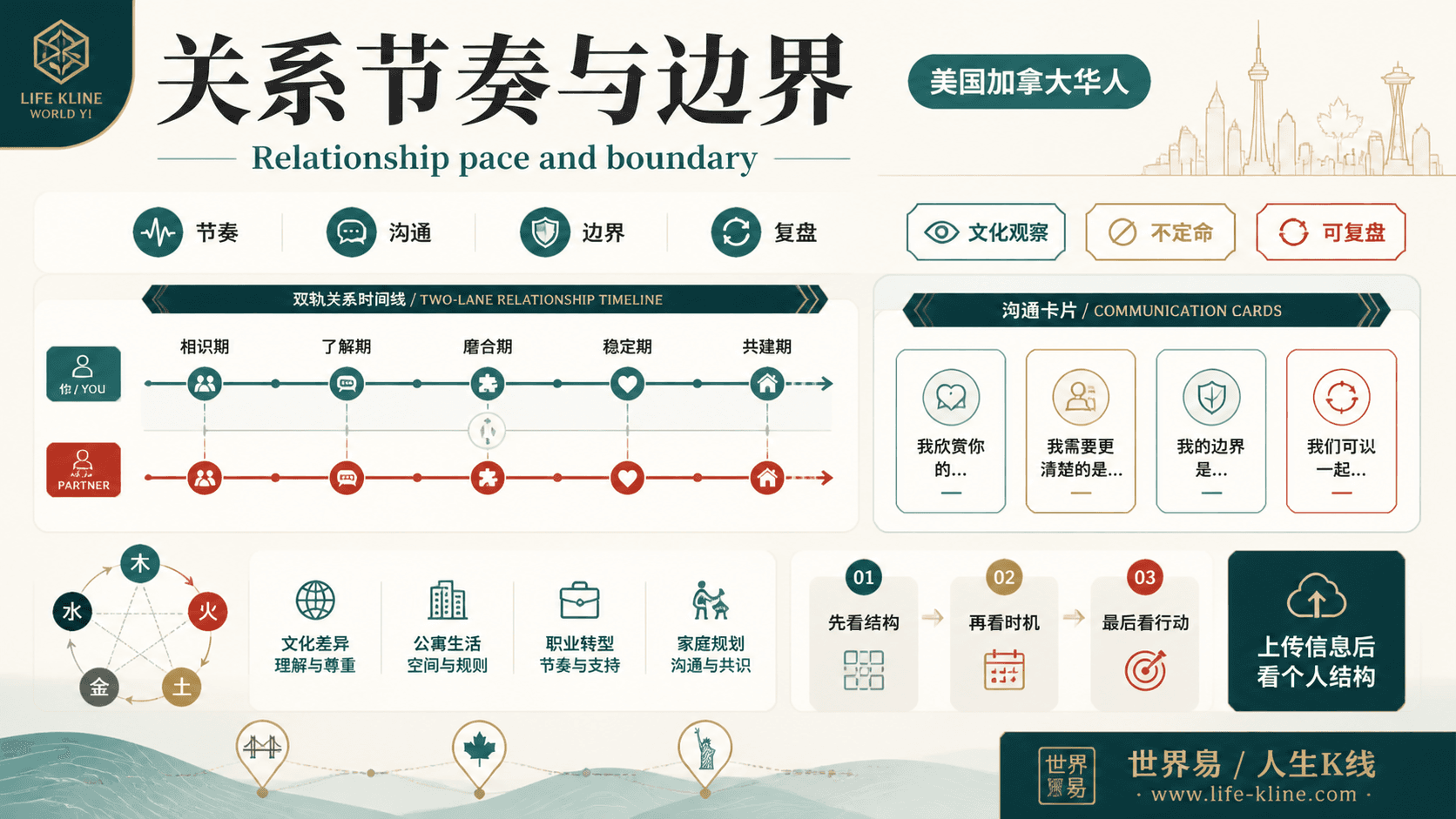
关系节奏与边界|美国加拿大华人
这张图把《Analysis and Decision Guidance on He-Chong (Combination-Clash) Relationships in Contract Cooperation》里的命理概念转成关系、边界和应用场景,适合先看图建立结构,再回到案例正文理解细节。
关系节奏与边界不应被写成固定结论。更适合美国加拿大华人的读法,是把传统术语翻译成结构、时机、环境、行动和复盘。
查看图片解读