Strategies to Resolve Clashes and Conflicts in Mentor-Mentee Relationships
先看完案例关键信息,再进入分析页验证自己的结构与阶段。
Client Background
The client is a male mentor aged approximately fifty to fifty-five, who has long been engaged in professional teaching and guidance. In recent years, a significant rift has developed in his cooperative relationship with a mentee, resulting in communication difficulties and stalled project progress. As a key part of the partnership cooperation model, the mentor hopes to clarify the fundamental reasons behind the relationship breakdown and seek effective paths for repair.
The mentor's career has been generally stable, but with increasing age and accumulated experience, he is more focused on maintaining team harmony through reasonable relationship adjustments. The current cooperation crisis not only affects project execution but also threatens future collaboration opportunities and personal reputation. He hopes to leverage the BaZi perspective to analyze the relationship between the two charts and find practical solutions to resolve the clashes.
Analysis of the BaZi Structure
The mentor's Four Pillars (Si Zhu) chart shows the Day Master as 丁火 (Ding Fire), which is relatively weak, placing him in a Bi Jian (Peer) pattern. The Fire element dominates his personal traits, but due to its weakness, he relies on the Wood element as the Yong Shen (favorable element) to nourish and strengthen his own energy. Wood represents the driving force of positivity and innovation in his career and interpersonal relationships. Conversely, Earth and Metal are Ji Shen (unfavorable elements), symbolizing environmental factors that may cause obstruction and depletion.
Currently, the mentor is in the mid-to-late stage of the 壬午 (Ren Wu) Da Yun (decade luck cycle). This phase is generally stable, suitable for consolidating existing achievements rather than taking risks. The Liu Nian (annual fortune) is 丙午 (Bing Wu), with strong Fire energy, which adds vibrancy to the external environment but may also amplify inner emotional fluctuations. This combination indicates that when facing cooperative conflicts, the mentor should rely more on flexibility and internal energy harmonization, avoiding suppression and clashes caused by Earth and Metal.
Combining the BaZi structure, the mentor’s weak Ding Fire Day Master needs nourishment from Wood to neutralize the negative effects of Earth and Metal. In the cooperative relationship, the clash (He Chong) manifests as emotional and ideological collisions that can easily escalate conflicts. The mentor needs to identify the conflict points in the mentee’s chart, especially those involving Earth and Metal stems and branches, to prevent both parties from falling into deadlocks in decision-making and communication.
Focusing on the Core Issues
Regarding the clash relationship between the mentor and mentee, the BaZi analysis shows that they may have fundamental differences in core values and problem-solving approaches. Clashes often bring friction but also contain the potential for transformation. The mentor’s weak Ding Fire Day Master requires support from Wood, while if the mentee’s chart lacks Wood or has excessive Earth and Metal, opposing emotions and misunderstandings are likely to arise.
Under a clash relationship, mistrust may develop due to differences in interests, responsibilities, or communication styles. The mentor, currently in the 壬午 (Ren Wu) Da Yun, should adopt a conservative strategy and avoid aggressive actions. The Liu Nian 丙午 (Bing Wu) with strong Fire energy can stimulate initiative but may also intensify emotional tensions and conflicts. Therefore, when handling clashes, the mentor should avoid confrontational stances and instead seek a balance between emotion and reason.
From a BaZi perspective, the key to resolving clashes lies in introducing the Yong Shen Wood element to increase growth and understanding in cooperation, while reducing the suppressive effects of Earth and Metal. Both parties should attempt to establish consensus and emotional guidance to avoid impulsive behaviors caused by the clash, gradually softening the cooperative relationship.
At the same time, the mentor should pay attention to nurturing his own energy to prevent further weakening of the Fire Day Master due to overexertion, which would affect judgment and leadership. By adjusting the cooperation model and communication mechanisms, the negative impacts of the clash can be effectively reduced and transformed into motivation for cooperative growth.
Recommended Actions and Timing
Based on the stable characteristics of the current 壬午 (Ren Wu) Da Yun, the mentor should prioritize a steady and conservative approach within the next two to three years, avoiding major changes in the cooperative relationship. This phase is suitable for focusing on communication and emotional management, gradually resolving the conflicts brought by the clash and promoting deeper understanding and trust between both parties.
Specifically, the mentor should proactively invite the mentee to participate in informal exchanges to ease tensions, leveraging the Wood element’s growth energy to facilitate relationship repair. Meanwhile, adjusting work pace and task allocation to reduce confrontational topics can create a win-win environment. Utilizing the strong Fire energy of the Liu Nian, the mentor can appropriately express sincerity and leadership but should avoid being overly forceful to prevent exacerbating the clash.
Before the end of the current Da Yun and the transition into a new cycle, the mentor can gradually introduce new cooperation frameworks, taking advantage of Wood-related timing nodes in BaZi to strengthen the foundation of cooperation. It is recommended to focus on suitable Wood-strong periods within the next two years, such as spring or months with abundant Wood Qi, to carry out key communications and project advancement.
Review and Reminders
When addressing clash issues, the mentor needs to guard against emotional decision-making and excessive self-protection tendencies, avoiding passive withdrawal caused by the weak Ding Fire Day Master being suppressed by Earth and Metal. BaZi indicates that although the cooperative relationship faces challenges, through reasonable adjustment of the Yong Shen direction and communication methods, dangers can be transformed into opportunities.
It is also important to note that BaZi provides trends and energy references; practical actions must integrate specific human nature and environmental factors. One should avoid relying solely on BaZi while neglecting real-world communication skills. Although clashes bring conflicts, they also nurture opportunities for transformation. Proper guidance can convert them into growth momentum. Continuously monitoring changes in Da Yun and Liu Nian and flexibly adjusting strategies is essential to ensure the long-term stability of the cooperative relationship.
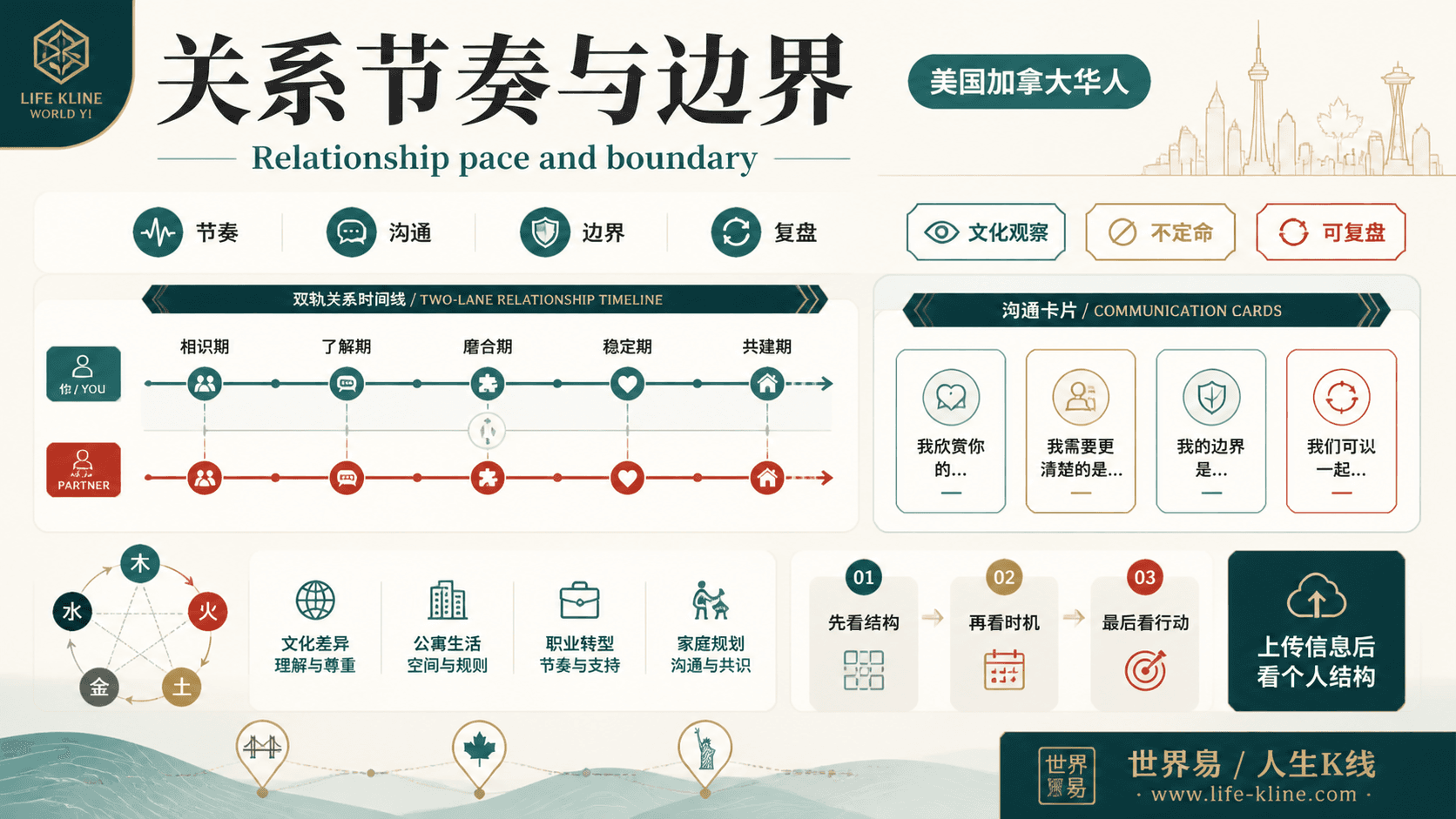
关系节奏与边界|美国加拿大华人
这张图把《Strategies to Resolve Clashes and Conflicts in Mentor-Mentee Relationships》里的命理概念转成关系、边界和应用场景,适合先看图建立结构,再回到案例正文理解细节。
关系节奏与边界不应被写成固定结论。更适合美国加拿大华人的读法,是把传统术语翻译成结构、时机、环境、行动和复盘。
查看图片解读